
 darkknight:
An isosceles triangle has sides of length x,x and y. In addition, assume the triangle has perimeter 12. a) Find the rule for a function that computes the area of the triangle as a function of x. Describe the largest possible domain of this function.
 justjm:
The first thing to do is to draw a diagram |dw:1581720298261:dw| Perimeter is 12, so you can say that 2x+y=12 Now, let's move to the area. Area of a triangle is 1/2 bh Let b=y from the diagram. Now, we must find h. |dw:1581720391914:dw| If you draw an imaginary line for h that acts like a perpendicular bisector for base y, you can relate the base, y, and x using the Pythagorean thm. You can conclude that \(h=\sqrt{x^2 - (\frac{y}{2})^2}\) |dw:1581720443820:dw| Hence, Area of the full isosceles triangle is \(A=(\frac{1}{2})(y)(\sqrt{x^2 - (\frac{y}{2})^2})\) The issue we have is that there are 3 variables which is unfavorable for the Cartesian plane. Hence, manipulation is required. Recall the equation for perimeter 2x+y=12 You can say that y=12-2x Substitute the expression for y into the area. \(A=(\frac{1}{2})(y)(\sqrt{x^2 - (\frac{y}{2})^2}\) \(y=12-2x\) Hence, \(A=(\frac{1}{2})(12-2x)(\sqrt{x^2 - (\frac{12-2x}{2})^2}\) That was fun Now for the maximum, you can either use a graphing calculator or take the derivative \(\frac{dA}{dx}\) and find critical points. Then evaluate if they are a maximum by using the first or second derivative test.
justjm:
Oh wait it said domain. The only limiting thing here is the square root. Set the inside to 0 and solve for x. That is the lowest x value possible.
darkknight:
whats a derivative
darkknight:
we are not allowed to use graphing calculators either
justjm:
Derivative is a way to measure the instantaneous rate of change of a function, where the point of interest is continuous along f(x) and that \(\lim_{h\rightarrow{0}}\frac{f(h+a)-f(a)}{h}=f'(x)\) this might explain better:https://www.youtube.com/watch?v=lowavG2SXsQ But it's not required for this question, I misunderstood.
justjm:
Wait, so by 'largest possible domain' of this function is it asking for the domain interval or...?
darkknight:
brb in a min
darkknight:
the answer is domain 3 ≤ x ≤ 6
darkknight:
so domain interval ithink
justjm:
Yes that is correct. Sorry, so since this is a triangle, negative areas or not possible. Hence the function we found for A(x) is only bounded by where A(x) is above the x axis. You can solve for the zeroes of the function and determine by plugging in if the intervals between the zeroes are positive or negative.
darkknight:
thx
darkknight:
I got the domain to be from -9 to 6 where it is non-zero. But the answer is 3 to 6. What did I do wrong?
darkknight:
I set -2x+12=0 and x+9 = 0
 Shadow:
Where did you get x+9 = 0?
darkknight:
so I have (1/2)(y)(sqrt(x^2-(y/2)^2) right? I plugged -2x+12 for y. so Now I have (-x+6)(sqrt(12x+36)) sqrt(12x+36) is the same as sqrt((4)(x+9)) so I have (-x+6) times 2 times sqrt(x+9)
darkknight:
wait, I think I did math wrong
darkknight:
so I got sqrt(12x-36)
darkknight:
nvm I got it, thanks
Shadow:
Ah okay, glad you got it (:
darkknight:
I'm a little confused on the second part: Assume that the maximum value of the function a(x) in (a) occurs when x=4.Find the maximum value of z=a(x) and z=2a(3x+3) +1.
darkknight:
I got the first part
darkknight:
I don't get the second part though
 Collin:
my brain hurts
justjm:
lmao I did all that work for nothing my dude.... Basically you need to take the maximum you got for \(z=a(x)\) and plug that into \(2(n)+1\) Here's why. Let's say you have a function \(f(x)\) which has an extremum at \(x=n\). If you now have \(f(g(x))\) the extremum will still be at \(x=n\). By this, the maximum you got for \(a(x)\) at \(x=n\) will just need to be plugged in to \(2n+1\).
darkknight:
my brain also hurts
darkknight:
this shouldn't be a calculus problem
justjm:
So the maximum for \(a(x)\) is y=\(4\sqrt{3}\) Just find \(2(4\sqrt{3})+1\)
darkknight:
yes
justjm:
No it isn't, it just happens when your common sense goes to sleep :/
darkknight:
so the answer for finding the max value for z=2a(3x+3) +1. is just 2(max for a(x)) +1?
darkknight:
wow!
justjm:
Yes. The maximum for \(f(g(x))\) is the same as the maximum for \(f(x)\) because putting a composite function inside doesn't move the function up or down.
darkknight:
thanks
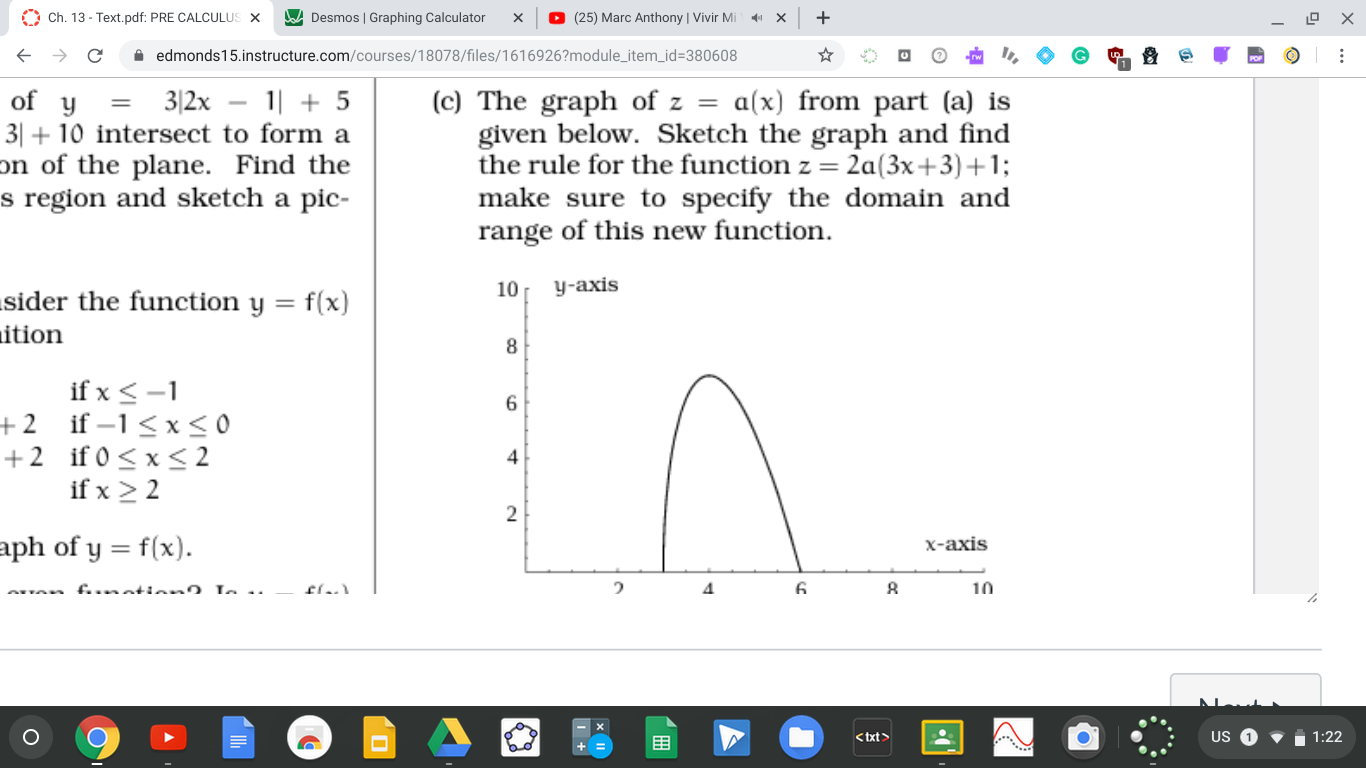 darkknight:
I drew the original graph and applied the transformations. But how does the rule of the function transform in 2a(3x+3)+1?
darkknight:
nvm, I think I got it
darkknight:
nope, I don't got it
darkknight:
I did this.. so I have (-2x+12)(sqrt(3x+3)) right? then I got 2((-2(3x+3)+12)(sqrt(3(3x+3)+1)))+1
darkknight:
I got it, I just did math wrong
Join our real-time social learning platform and learn together with your friends!
 KBaby:
Verse 1 We left our names in the dust of the driveway Watched the old town shrink
KBaby:
Lyrics Generator Use AI to write the lyrics for a song. Suggested Genres: Pop Hip
KBaby:
Verse 1 We left our names in the dust of the driveway Watched the old town shrink
KBaby:
Lyrics Generator Use AI to write the lyrics for a song. Suggested Genres: Pop Hip

 aitexturegenerator:
How are you all handling AI-generated textures for 3D models and game assets without losing the hand-made feel? I've been doing a small stylized environment
aitexturegenerator:
How are you all handling AI-generated textures for 3D models and game assets without losing the hand-made feel? I've been doing a small stylized environment

 Demon25:
Woke up feeling like that girl and that dude well he still aint crap pluse the du
Demon25:
Woke up feeling like that girl and that dude well he still aint crap pluse the du
 playtsec:
how do I get rid of stress from teachers... I just feel like running out the classroom and leaving on my own.
playtsec:
how do I get rid of stress from teachers... I just feel like running out the classroom and leaving on my own.
 JohnnyLFowler0812:
What type of gamer would play something and then get off for a while. Why not sta
JohnnyLFowler0812:
Which is better? Metallica Rap Country R&B hiphop Medal Gospel Chill Which 3 opti
JohnnyLFowler0812:
What type of gamer would play something and then get off for a while. Why not sta
JohnnyLFowler0812:
Which is better? Metallica Rap Country R&B hiphop Medal Gospel Chill Which 3 opti