
 InsatiableSuffering:
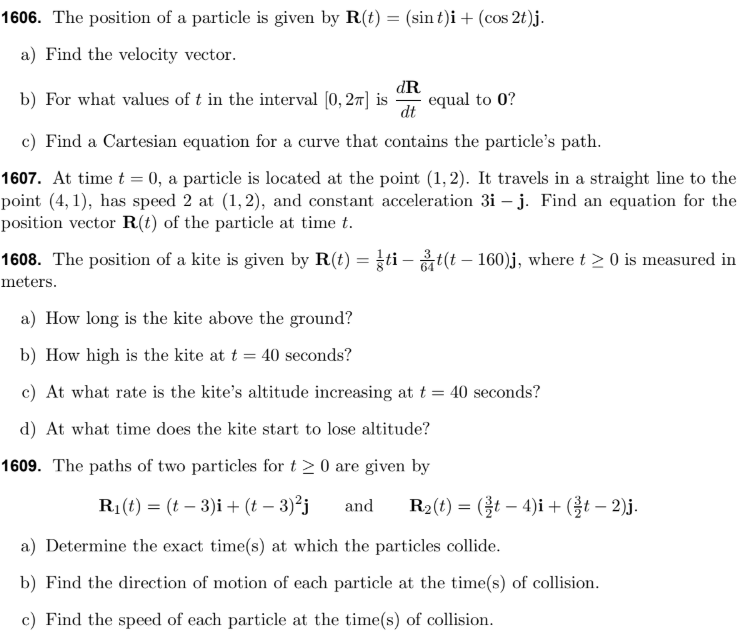
Some more calc questions. How do I do 1606c, 1607, and 1609bc?
 justjm:
yeah I'm in that unit too, let me take a look
justjm:
For 1606c you have to convert the vector to cartesian (scalar) if you remember from precalc from R(t)=(sin t)i + (cos 2t)j x= sin t and y = cos 2t So you have to eliminate the parameter t by solving for t in one of them, I'll do sin t because that's a bit easier x = sin t arcsin(x)=t then substitute t into y=cos 2t y= cos(2arcsin(x))
InsatiableSuffering:
I did that for 1606c, but that wasn't the answer at all
InsatiableSuffering:
Oh wait nvm I looked at the answer key wrong oof
justjm:
oof lol it happens
justjm:
For 1607 you would need to first integrate the a=3i-j to get the velocity, and for (c1, c2), you would need to find the unit vector from the finding the direction of the particle using the two points. Those are c1 and c2, and you would put them within the base vectors. Then you would integrate again and use the initial point (1,2). @imqwerty
 imqwerty:
That's right. You can integrate the acceleration over time to get velocity, and the velocity vector will include the constants of integration, integrate the velocity again to find the displacement, which will also contain some constants of integration. To find the constants of integration use the given conditions of position and velocity
imqwerty:
1609 The R(t) vector at any time t is essentially the direction in which the particle is headed. Find the time of collision of the particles by equating their i and j coordinates and then plug this time in their respective R(t) to get their direction of motion at collision To find the speed at collision just differentiate R(t) wrt t and get their velocity vectors, plug in the t which you calculated above. Don't forget to take the mod tho bcz speed is always positive
InsatiableSuffering:
Thank you both so much! That really helped clear my confusion.
Join our real-time social learning platform and learn together with your friends!
 KBaby:
Verse 1 We left our names in the dust of the driveway Watched the old town shrink
KBaby:
Lyrics Generator Use AI to write the lyrics for a song. Suggested Genres: Pop Hip
KBaby:
Verse 1 We left our names in the dust of the driveway Watched the old town shrink
KBaby:
Lyrics Generator Use AI to write the lyrics for a song. Suggested Genres: Pop Hip

 aitexturegenerator:
How are you all handling AI-generated textures for 3D models and game assets without losing the hand-made feel? I've been doing a small stylized environment
aitexturegenerator:
How are you all handling AI-generated textures for 3D models and game assets without losing the hand-made feel? I've been doing a small stylized environment

 Demon25:
Woke up feeling like that girl and that dude well he still aint crap pluse the du
Demon25:
Woke up feeling like that girl and that dude well he still aint crap pluse the du
 playtsec:
how do I get rid of stress from teachers... I just feel like running out the classroom and leaving on my own.
playtsec:
how do I get rid of stress from teachers... I just feel like running out the classroom and leaving on my own.
 JohnnyLFowler0812:
What type of gamer would play something and then get off for a while. Why not sta
JohnnyLFowler0812:
Which is better? Metallica Rap Country R&B hiphop Medal Gospel Chill Which 3 opti
JohnnyLFowler0812:
What type of gamer would play something and then get off for a while. Why not sta
JohnnyLFowler0812:
Which is better? Metallica Rap Country R&B hiphop Medal Gospel Chill Which 3 opti