
 justjm:
Power series

 justjm:
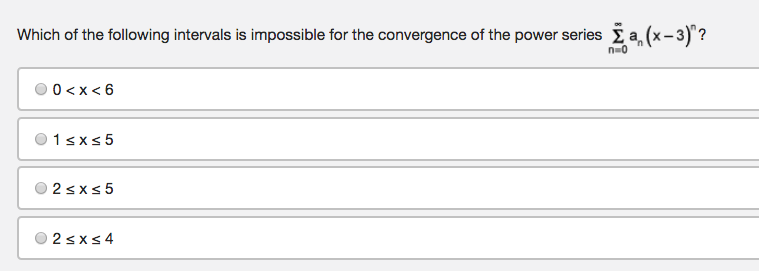
Just need help on both questions. The options for the first picture are I only II only I and III II and III
justjm:
For the first one, I think it's I and III (option C)
justjm:
@InsatiableSuffering
justjm:
First one was C I just thought of an example, which was infinite series of ln(x), and differentiating it leading to the infinite series of 1/x. They do not converge at the same points Second one is C because since it's x-3, it's centered at x=3. So you'll check where the center of the interval of convergence is, and wherever it isn't 3, that's the 'impossible' interval of convergence
 InsatiableSuffering:
Ooooh that's neat. I get the second one, but not so much the first question. Can you elaborate on what the statements actually mean? Does this relate to power series by any chance?
justjm:
Sometimes to find the power series of other functions, you can differentiate the power series of one function. A good example could be using the power series of \(\frac{1}{1-x}\) to find the power series of \(\frac{1}{(1-x)^2}\). The power series of \(\frac{1}{1-x}=\sum_{n=1}^{\infty} x^n\) If you note the derivative of \(\frac{1}{1-x}\) is \(\frac{1}{(1-x)^2}\), so you can differentiate the power series of \(\frac{1}{1-x}\) to find the power series of\(\frac{1}{(1-x)^2}\) \(\frac{1}{(1-x)^2}=\frac{d}{dx}\sum_{n=1}^{\infty} x^n=\sum_{n=1}^{\infty} nx^{n-1}\) So that's the power series for \(\frac{1}{(1-x)^2}\) Sometimes the IOC for the differentiated series is different, and typically differentiating a series will lead to new endpoints. I couldn't think of an example yet, but @DuarteME might explain better
 DuarteME:
@justjm gave good examples above. The power series for \(\frac{1}{1-x}\) shows how differentiating a series term by term leads to a new series with the same radius of convergence and the same interval of convergence. Please note that this series should start at \(n = 0\), rather than \(n = 1\): \(\displaystyle\dfrac{1}{1-x} = \sum_{n=0}^\infty x^n \quad \ddot{\smile}.\) I'll now expand on the logarithm example above, which clearly shows how the interval of convergence can change under differentiation. Take the series: \(\displaystyle \ln(1+x) = \sum_{n=1}^\infty \dfrac{(-1)^{n+1}}{n}x^n.\) This series has a radius of convergence \(R = 1\), due to the ratio test, and converges for \(-1<x\leq 1\). For the endpoints, in particular, notice that substituting \(x=1\) above gives the alternating harmonic series, which converges due to the alternating series test., while \(x=-1\) gives the harmonic series, which diverges. If you differentiate this term by term, you get: \(\displaystyle \dfrac{\textrm{d}}{\textrm{d}x}\sum_{n=1}^\infty \dfrac{(-1)^{n+1}}{n}x^n = \sum_{n=1}^\infty \dfrac{(-1)^{n+1}}{n}nx^{n-1} = \sum_{n=1}^\infty (-1)^{n+1} x^{n-1}.\) By letting \(k = n-1\), we get: \(\displaystyle \sum_{k=0}^\infty (-1)^{k+2} x^k = \sum_{k=0}^\infty (-1)^k x^k = \sum_{k=0}^\infty (-x)^k = \dfrac{1}{1-(-x)} = \dfrac{1}{1+x} .\) This series also has a radius of convergence \(R=1\) and converges for \(-1<x<1\) since it is a geometric series. For the endpoints, in particular, notice that both \(x=\pm 1\) give divergent series, so we "lost" the endpoint at \(x=1\). Therefore, we can see an example where differentiating a series term by term leads to a series with the same radius of convergence, but different intervals of convergence, due to different behaviours at the endpoints. The upshot is that, in general, differentiating a series leads to a new series with the same radius of convergence, but with potentially different intervals of convergence, due to different behaviours at the endpoints: the differentiated series may "lose" endpoints. Moreover, you can also invert this to see that integrating a series term by term leads to a new series with the same radius of convergence, but with potentially different intervals of convergence, due to different behaviours at the endpoints, but this time it is because the integrated series may "gain" endpoints. Hope I was clear enough \(\ddot{\smile}\).
justjm:
This is extremely helpful @DuarteME, thank you for the thorough explanation!
DuarteME:
No problem (:
Join our real-time social learning platform and learn together with your friends!
 KBaby:
Verse 1 We left our names in the dust of the driveway Watched the old town shrink
KBaby:
Lyrics Generator Use AI to write the lyrics for a song. Suggested Genres: Pop Hip
KBaby:
Verse 1 We left our names in the dust of the driveway Watched the old town shrink
KBaby:
Lyrics Generator Use AI to write the lyrics for a song. Suggested Genres: Pop Hip
 aitexturegenerator:
How are you all handling AI-generated textures for 3D models and game assets without losing the hand-made feel? I've been doing a small stylized environment
aitexturegenerator:
How are you all handling AI-generated textures for 3D models and game assets without losing the hand-made feel? I've been doing a small stylized environment

 Demon25:
Woke up feeling like that girl and that dude well he still aint crap pluse the du
Demon25:
Woke up feeling like that girl and that dude well he still aint crap pluse the du
 playtsec:
how do I get rid of stress from teachers... I just feel like running out the classroom and leaving on my own.
playtsec:
how do I get rid of stress from teachers... I just feel like running out the classroom and leaving on my own.
 JohnnyLFowler0812:
What type of gamer would play something and then get off for a while. Why not sta
JohnnyLFowler0812:
Which is better? Metallica Rap Country R&B hiphop Medal Gospel Chill Which 3 opti
JohnnyLFowler0812:
What type of gamer would play something and then get off for a while. Why not sta
JohnnyLFowler0812:
Which is better? Metallica Rap Country R&B hiphop Medal Gospel Chill Which 3 opti