
 eviant:
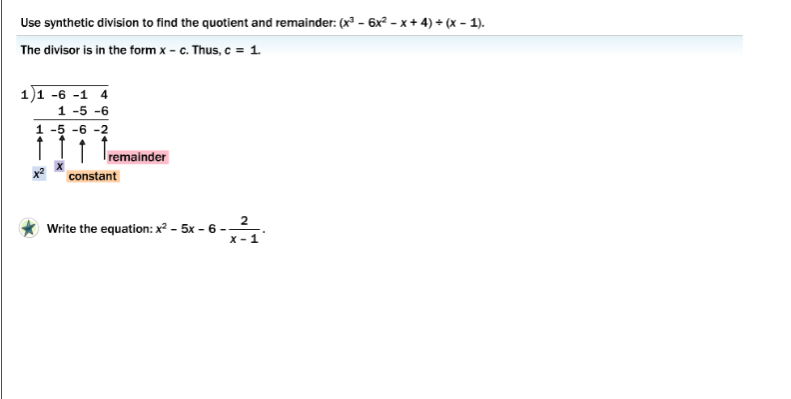
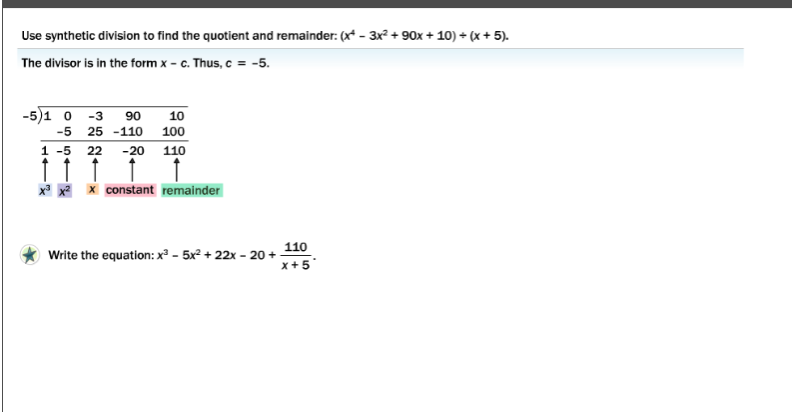
Math question I am learning synthetic division, and I'm having trouble figuring out when to add a zero, please explain this to me
 eviant:
@dude @Hero @Shadow
eviant:
so, in the first problem, there is no need to add a zero, but in the second problem we have to add a zero, why is this?
 Hero:
Hero:
The zero represents the x-cubed term that is zero. If you have a nth degree polynomial, then it has n + 1 terms. In this case, you have a fourth degree polynomial so it will have five terms. The x-cubed term is the fifth term but since it is zero, they don't usually include it in the original expression.
 AyellowBlanket:
In order to do synthetic equations, you have to have all the different terms. So in the first one you are not skipping a term, what I mean is the x^3 and the -6x^2 terms. In the second equation there is a zero because there is no x^3 term. You can't skip a term
eviant:
@AyellowBlanket so every equation has to have a x^3 term?
AyellowBlanket:
No, it goes down in order. So if your highest term is x^2, then you need to have an x term and so on
AyellowBlanket:
If you have something like this: x^5+3x^3+x^2+17x+99, then you have to have 0 for the x^4
eviant:
so if there was an x^4 there needs to be an x^3, x^2, and x term?
AyellowBlanket:
yes, it is progressive
eviant:
thanks for explaining!
AyellowBlanket:
uw
Join our real-time social learning platform and learn together with your friends!
 KBaby:
Verse 1 We left our names in the dust of the driveway Watched the old town shrink
KBaby:
Lyrics Generator Use AI to write the lyrics for a song. Suggested Genres: Pop Hip
KBaby:
Verse 1 We left our names in the dust of the driveway Watched the old town shrink
KBaby:
Lyrics Generator Use AI to write the lyrics for a song. Suggested Genres: Pop Hip
 aitexturegenerator:
How are you all handling AI-generated textures for 3D models and game assets without losing the hand-made feel? I've been doing a small stylized environment
aitexturegenerator:
How are you all handling AI-generated textures for 3D models and game assets without losing the hand-made feel? I've been doing a small stylized environment

 Demon25:
Woke up feeling like that girl and that dude well he still aint crap pluse the du
Demon25:
Woke up feeling like that girl and that dude well he still aint crap pluse the du
 playtsec:
how do I get rid of stress from teachers... I just feel like running out the classroom and leaving on my own.
playtsec:
how do I get rid of stress from teachers... I just feel like running out the classroom and leaving on my own.
 JohnnyLFowler0812:
What type of gamer would play something and then get off for a while. Why not sta
JohnnyLFowler0812:
Which is better? Metallica Rap Country R&B hiphop Medal Gospel Chill Which 3 opti
JohnnyLFowler0812:
What type of gamer would play something and then get off for a while. Why not sta
JohnnyLFowler0812:
Which is better? Metallica Rap Country R&B hiphop Medal Gospel Chill Which 3 opti