
 justjm:
More Power Series 3 questions below
 justjm:
I answered 2 of them but I'm not sure, and I didn't get the 2nd one @DuarteME thank you very much for taking the time (:
justjm:
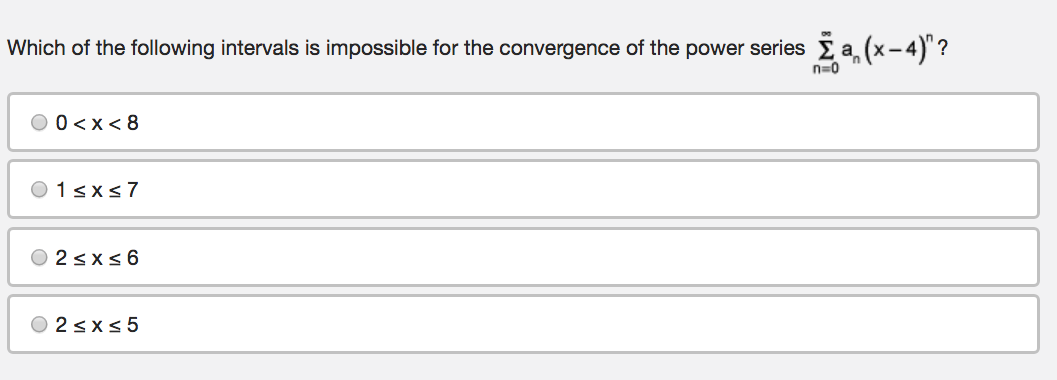
^ Regarding the 2nd one I was confused on the \(a_n\) bit, I thought of using the root test and getting rid of \(a_n\) but got the interval of convergence to be 3≤x≤5. So I believe I'm doing something wrong there.
 DuarteME:
Okay, so, let me start by saying a few general things about the interval of convergence of a series. Whenever we have a series like \(\sum_{k=0}^\infty c_k (x-a)^k\), then this series converges at least on the open interval \((a-R, a+R)\), where \(R\) is the radius of convergence. The endpoints must always be checked independently. We can compute this from \(R = \lim\limits_{k \to \infty}\left|\dfrac{c_k}{c_{k+1}}\right|\), whenever the limit exists. The reasoning for this comes from the ratio test. We can also use a more general (and also more complicated) definition that comes from the root test. The upshot here is that the convergence interval is always centred on \(x=a\). Using the information above on the 2nd question, we start by noticing that the series is written in powers of \(x-4\). Therefore, the interval of convergence must be centred on \(x=4\). Can you see which of the intervals is NOT centred on \(x = 4\)?
DuarteME:
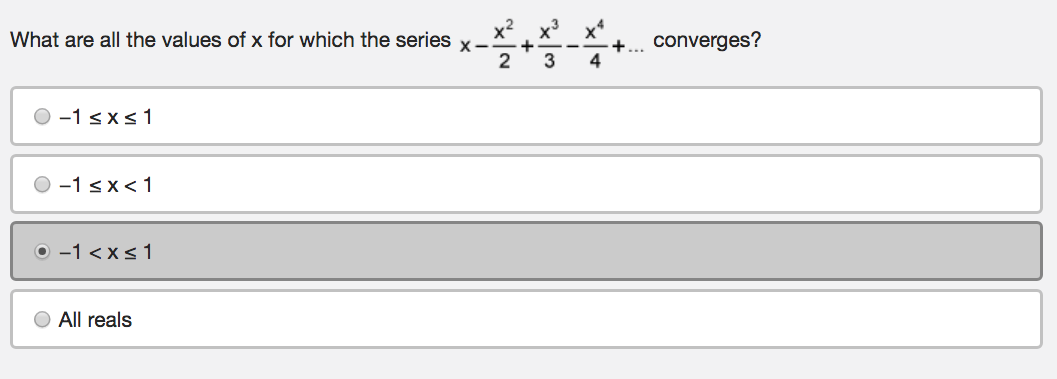
The problem I mentioned with the endpoints is actually highlighted on the 3rd question. The series is: \(\displaystyle \sum_{k=1}^\infty (-1)^{k+1}\dfrac{x^k}{k}.\) Now we plug in the endpoints: • For \(x=1\), we get: \(\displaystyle \sum_{k=1}^\infty (-1)^{k+1}\dfrac{1^k}{k} = \sum_{k=1}^\infty \dfrac{(-1)^{k+1}}{k}.\) This corresponds to the alternating harmonic series, which is known to converge due to the alternating series test. • For \(x=-1\), we get: \(\displaystyle \sum_{k=1}^\infty (-1)^{k+1}\dfrac{(-1)^k}{k} = \sum_{k=1}^\infty \dfrac{(-1)^{2k+1}}{k} = - \sum_{k=1}^\infty \dfrac{1}{k}.\) This corresponds to the harmonic series, which is known to diverge due to the integral test. Therefore, it converges for \(-1 < x \leq 1\), just like you selected. (: In fact, this is the series of \(\ln(1+x)\) about \(a = 0\), so it's clearer why \(x = -1\) leads to trouble whereas \(x=1\) simply gives \(\ln 2\).
justjm:
Oh wow, I didn't realize that the power series was centered at 4! That is quite helpful actually, let me take a look
justjm:
That would then be 2≤x≤5 for q2
DuarteME:
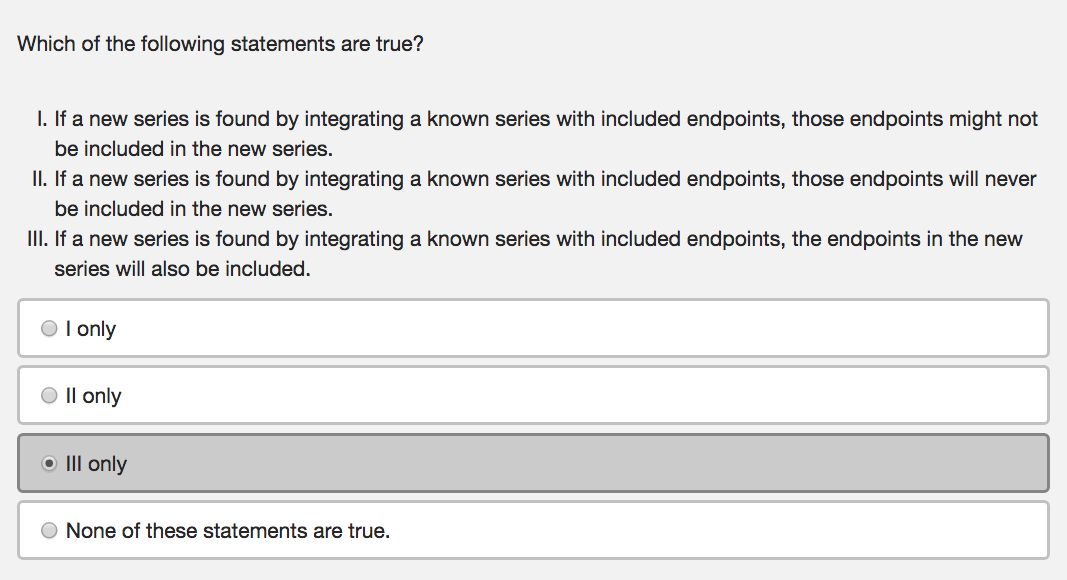
For the 1st one, you simply need to recall that an integrated series always converges wherever the original series converges. This includes the endpoints, so if the original series includes them, then the new series will also include them. The reasoning for this comes from the fact that integration increases the powers by one, so the Dirichlet \(p\)-series test always ensures that the endpoints are also included. So the selected answer is the correct one. Please notice that this does not mean that the interval of convergence is always necessarily the same. Notice that for instance, if the original series does not converge at some endpoint, the integrated series might converge at that point. This does not contradict what I said above, since the implication is: \(\textrm{the original series converges at } x \implies \textrm{the integrated series converges at } x.\) Hope this helps! (:
justjm:
Thank you for the clarification! So the converse is not necessarily true that means?
justjm:
I got it now! Thank you very much once again! I'll let you know if I have another query! (:
DuarteME:
\(\color{#0cbb34}{\text{Originally Posted by}}\) @justjm Thank you for the clarification! So the converse is not necessarily true that means? \(\color{#0cbb34}{\text{End of Quote}}\) Yes, the converse is not necessarily true. For instance, just take the series we discussed above: \(\displaystyle \sum_ {k=1}^\infty (-1)^{k+1}\dfrac{x^k}{k},\) which converges for \(-1<x\leq 1\). If we integrate it, we get: \(\displaystyle \sum_ {k=1}^\infty (-1)^{k+1}\dfrac{x^{k+1}}{k(k+1)}.\) The implication above means that this series must converge at least for \(-1<x\leq 1\), but it actually converges for \(-1\leq x\leq 1\). In fact, we have: \(\dfrac{c_{k+1}}{c_k} = \dfrac{k(k+1)}{(-1)^{k+1} x^{k+1}} \times \dfrac{(-1)^{k+2} x^{k+2}}{(k+1)(k+2)} = -\dfrac{k+1}{k+2}x,\) So the ratio tests lets us conclude that: \(\lim\limits_{k\to\infty}\left|\dfrac{c_{k+1}}{c_k}\right| < 1 \iff |x| < 1.\) We must now check the endpoints explicitly: • For \(x=1\): \(\displaystyle \sum_ {k=1}^\infty (-1)^{k+1}\dfrac{1^{k+1}}{k(k+1)} = \sum_ {k=1}^\infty \dfrac{(-1)^{k+1}}{k(k+1)}.\) The alternating series test lets us conclude that this converges, since \(\dfrac{1}{k(k+1)}\) is decreasing and \(\dfrac{1}{k(k+1)} \to 0\) as \(k \to \infty\). • For \(x=-1\): \(\displaystyle \sum_ {k=1}^\infty (-1)^{k+1}\dfrac{(-1)^{k+1}}{k(k+1)} = \sum_ {k=1}^\infty \dfrac{1}{k(k+1)} = \sum_ {k=1}^\infty \left(\dfrac{1}{k} -\dfrac{1}{k+1}\right) = 1,\) since it is a telescoping serires. Therefore, it is also convergent. We can now see that the integrated series converges for \(-1 \leq x \leq 1\). It converges for all points in which the original series already converged, but it additionally converges also for \(x=-1\).
justjm:
You are very knowledgeable about this, and I really appreciate you helping me! Thank you once again! :) :)
justjm:
Sorry to bother you over and over, but here is the question: I had just missed this question and was wondering how to solve it. I knew I had to substitute the value and further solve for the new radius but I went wrong somewhere.
 DuarteME:
Since the radius of convergence of the original series is \(R = 25\), then the ratio test lets us conclude that: \(\lim\limits_{k\to \infty} \left|\dfrac{a_{k+1} x^{k+1}}{a_k x^k}\right| = \lim\limits_{k\to \infty} \left|\dfrac{a_{k+1}}{a_k}\right||x| < 1 \iff |x| < \lim\limits_{k\to \infty} \left|\dfrac{a_k}{a_{k+1}}\right| = 25.\) We now apply the same reasoning to the to the new series by letting \(x \to x^2\): \(\lim\limits_{k\to \infty} \left|\dfrac{a_{k+1} x^{2k+2}}{a_k x^{2k}}\right| = \lim\limits_{k\to \infty} \left|\dfrac{a_{k+1}}{a_k}\right||x|^2 < 1 \iff |x|^2 < \lim\limits_{k\to \infty} \left|\dfrac{a_k}{a_{k+1}}\right| = 25.\) Therefore, the last equality gives: \(|x|^2 < 25 \iff |x| < 5.\) So the radius of convergence of this series is \(R' = 5\). In fact, we can look at the original series as a function \(f: D \to \mathbb{R}\) with domain \(D = (-25,25)\), with: \(f(x) = \displaystyle\sum_{k=0}^\infty a_k x^k.\) We now compose \(f\) with \(g:\mathbb{R}\to\mathbb{R}\) given by \(g(x)=x^2\), i.e., we define \(h = f \circ g\), so that: \(h(x) = f[g(x)] = f(x^2) = \displaystyle\sum_{k=0}^\infty a_k (x^2)^k = \sum_{k=0}^\infty a_k x^{2k}.\) Since the argument of \(f\) must be in \(D\), we conclude that \(-25 < g(x) < 25\ \iff |g(x)| < 25 \iff |x|^2 < 25 \iff |x| < 5,\) so just like before, we get that.
justjm:
This is extremely helpful stuff @DuarteME, I really do appreciate that you're taking the time to explain it!
DuarteME:
No problem (:
justjm:
@InsatiableSuffering
Join our real-time social learning platform and learn together with your friends!
 KBaby:
Verse 1 We left our names in the dust of the driveway Watched the old town shrink
KBaby:
Lyrics Generator Use AI to write the lyrics for a song. Suggested Genres: Pop Hip
KBaby:
Verse 1 We left our names in the dust of the driveway Watched the old town shrink
KBaby:
Lyrics Generator Use AI to write the lyrics for a song. Suggested Genres: Pop Hip
 aitexturegenerator:
How are you all handling AI-generated textures for 3D models and game assets without losing the hand-made feel? I've been doing a small stylized environment
aitexturegenerator:
How are you all handling AI-generated textures for 3D models and game assets without losing the hand-made feel? I've been doing a small stylized environment

 Demon25:
Woke up feeling like that girl and that dude well he still aint crap pluse the du
Demon25:
Woke up feeling like that girl and that dude well he still aint crap pluse the du
 playtsec:
how do I get rid of stress from teachers... I just feel like running out the classroom and leaving on my own.
playtsec:
how do I get rid of stress from teachers... I just feel like running out the classroom and leaving on my own.
 JohnnyLFowler0812:
What type of gamer would play something and then get off for a while. Why not sta
JohnnyLFowler0812:
Which is better? Metallica Rap Country R&B hiphop Medal Gospel Chill Which 3 opti
JohnnyLFowler0812:
What type of gamer would play something and then get off for a while. Why not sta
JohnnyLFowler0812:
Which is better? Metallica Rap Country R&B hiphop Medal Gospel Chill Which 3 opti