
 jennylove:
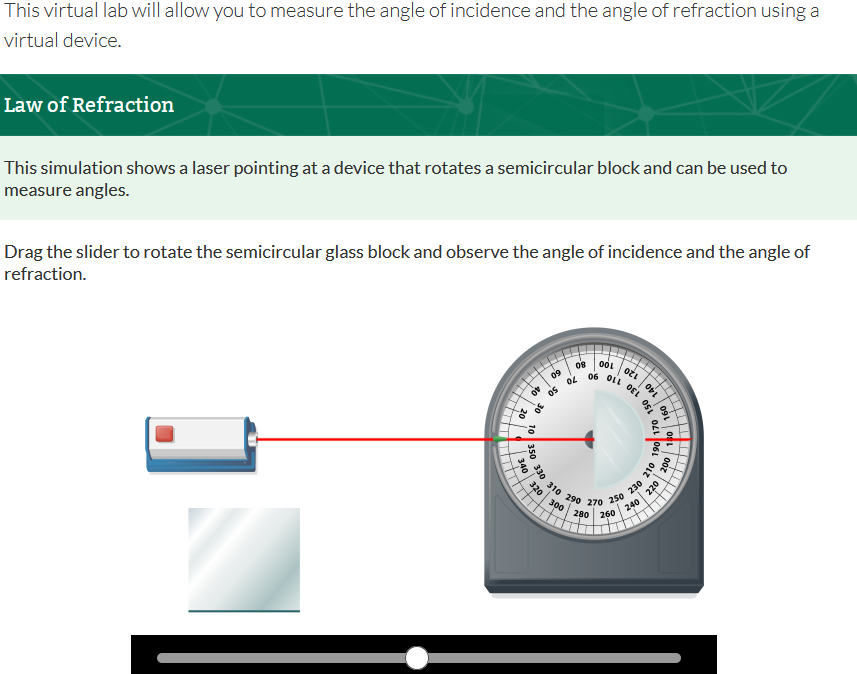
Different materials have distinct indexes of refraction. Explain how you might identify a material based on experiments like this one? by the way , the experiment was ( exploring how light is refracted when it passes through a semicircular lens. and studying the angle of incidence and the resulting angle of reflection) Mention at least one of the difficulties in identifying materials based on their indexes of refraction.
jennylove:
i think i understand the last question, could one by like depending on the size and shape ?
jennylove:
of the material
 justjm:
Yes that and also not all materials are homogenous by composition. That is, many are amorphous mixtures and could have varied properties all over the object.
jennylove:
vared properties? whats that
jennylove:
varied*
jennylove:
also how would we be able to determine the material through the index of refraction? im kind of confused on that too
justjm:
You would just need a really pure object, there can't be impurities that change the index @DuarteME might be more helpful
 DuarteME:
Under the same conditions (e.g., temperature and pressure), a pure, homogeneous piece of material should always have the same refractive index, regardless of size and shape. Therefore, under the same conditions, if you have 2 blocks with different refractive indices, then they are not made of the same material. Therefore, this might be used to identify a material. The same conditions portion is really important! For instance, water at 20 °C has a refractive index of about 1.333, but at 25 °C it is 1.3325, according to some websites online. On the other hand, there are some issues with this. First, you have some experimental problems, since it might not be easy to keep every condition fixed. You might also find it hard to have a pure homogeneous material, like @justjm mentioned, since that means that the refractive index is not unique, but varies across the material. Moreover, it is also possible to have 2 different materials with similar refractive indices. For instance, it is quite common for plastics to have refractive indices close to 1.33, like water, so this might make it harder to identify a material based solely on its refractive index.
jennylove:
Thank you for giving me multiple options of the difficulties! This is very great info. I do have a question regrading the first part of your response, your experiment seems to be different then the one I have attached using the laser to determine the path of the light into the material. but how would you be able to inentify a material by doing that ?
jennylove:
or maybe I got it wrong, what is a block? is that what is being used?
jennylove:
im sorry im a bit confused
DuarteME:
When I said "block" I meant a piece or portion of a material, so it would be your "sample". In the context of your exercise, they refer to the "semicircular glass block", for instance. The experiment is exactly the same as you have, since measuring both the angle of incidence and the angle of refraction lets you compute the refractive index using Snell's law: \(n_1\sin\theta_1 = n_2\sin\theta_2.\) In this case, we have: \(n_1 =1\) (since the light comes from the air); \(\theta_1 = \theta_\textrm{incidence}\); \(n_2 = n_\textrm{glass}\); \(\theta_2 = \theta_\textrm{refraction}\). Therefore: \(1 \times \sin\theta_\textrm{incidence} = n_\textrm{glass} \times\sin\theta_\textrm{refraction}.\) So we can solve for \(n_\textrm{glass}\): \(n_\textrm{glass} = \dfrac{\sin\theta_\textrm{incidence}}{\sin\theta_\textrm{refraction}}.\) So, if you measure both angles on the right hand side, you can compute the refractive index on the left hand side and get the conclusions I mentioned above.
jennylove:
ohhh okay, yes this makes sense now. thank you so much for the specific explanation, you have helped a lot!
DuarteME:
No problem (:
Join our real-time social learning platform and learn together with your friends!
 Demon25:
For a hoco proposal with a cheerleader and football player, what else should be a
Demon25:
For a hoco proposal with a cheerleader and football player, what else should be a

 Breathless:
TOC: "MGF any confirmation on the commander? we require confirmation as soon as[radio static].
Breathless:
TOC: "MGF any confirmation on the commander? we require confirmation as soon as[radio static].
 EdwinJsHispanic:
I wrote something that I don't know if I want it as a poem or song, Please let me know on yours thoughts about it, I'm still doing this! "Broken promises an
EdwinJsHispanic:
I wrote something that I don't know if I want it as a poem or song, Please let me know on yours thoughts about it, I'm still doing this! "Broken promises an
 thehearken:
hi um I don't know if this is the right section for this, but can someone go over my poem and tell me if its good enough to give my English professor for a
thehearken:
hi um I don't know if this is the right section for this, but can someone go over my poem and tell me if its good enough to give my English professor for a
 heartlessprophet:
Aye what's 19z%u00f74p=9u03c0 my teacher thinking of impossible questions for us
heartlessprophet:
Aye what's 19z%u00f74p=9u03c0 my teacher thinking of impossible questions for us
 kippppp:
does anyone have any good tips for writing stories? i'm trying to write a dnd campaign but i'm not that great of a writer yet.
kippppp:
does anyone have any good tips for writing stories? i'm trying to write a dnd campaign but i'm not that great of a writer yet.
 GRIZZLEY19:
Y'all let me know what y'all think about this beat I made I took me like a hour maybe rate it 0/10 https://drive.
GRIZZLEY19:
Y'all let me know what y'all think about this beat I made I took me like a hour maybe rate it 0/10 https://drive.
 Ultrilliam:
Welcome to the 10th Anniversary Update! (Part 2) Sorry this one passed the date a
Ultrilliam:
Welcome to the 10th Anniversary Update! (Part 2) Sorry this one passed the date a
 Twaylor:
was walking downtown and my adhd brain wanted to make some (rock?) lyrics: There'
Twaylor:
was walking downtown and my adhd brain wanted to make some (rock?) lyrics: There'