
 jennylove:
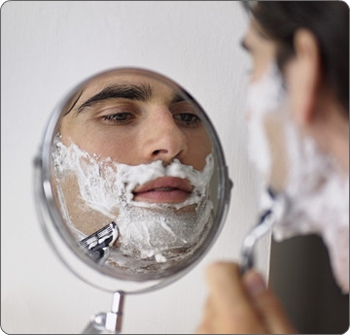
What kind of mirror is being used in this photo? a convex mirror at a distance greater than a focal length a concave mirror at a distance greater than a focal length a convex mirror at a distance less than a focal length a concave mirror at a distance less than a focal length
 jennylove:
okay, so based on the last question i think it would then be a convex, since it does the opposite of a concave which makes things smaller
jennylove:
wait a minute...
 justjm:
\(\color{#0cbb34}{\text{Originally Posted by}}\) @jennylove okay, so based on the last question i think it would then be a convex, since it does the opposite of a concave which makes things smaller \(\color{#0cbb34}{\text{End of Quote}}\) Keep in mind that those were lens and these are mirrors; properties differ. e.g. in a concave mirror, images converge. Yet in a concave lens, rays diverge.
jennylove:
ohhh okay, i didnt know there was a differece
justjm:
Typically vanity mirrors are concave mirrors so I'm not too optimistic about choosing an answer that involves convex mirrors.
jennylove:
so then it would have to be , a concave mirror at a distance less than a focal length , because we want to produce a real image correct?
jennylove:
i mean greater than a focal length*
jennylove:
wait i think i got it all confused, im sorry im not really great with this. it would be a concave mirror at a distance greater than a focal length , because we would produce a virtual image ?
justjm:
I might need to get back to you on this one. I'm leaning much towards D however, because the image seems to be upright, virtual, and enlarged. But I'm not fully sure. @DuarteME
jennylove:
Okay, thats fine , i can see what @DuarteME says . Thank you for your help.
DuarteME:
\(\color{#0cbb34}{\text{Originally Posted by}}\) @justjm I might need to get back to you on this one. I'm leaning much towards D however, because the image seems to be upright, virtual, and enlarged. But I'm not fully sure. @DuarteME \(\color{#0cbb34}{\text{End of Quote}}\) This is just it! Vanity mirrors do use concave mirrors in order to enlarge the images. Moreover, we know that the image is virtual (i.e., it is "beyond" the mirror), so the distance must be smaller than the focal length. It's not really that easy to explain these in words. It's much better to use ray tracing. I recommend that you check this website and try to understand the images there: http://www.leydenscience.org/physics/electmag/raymir.html
Join our real-time social learning platform and learn together with your friends!
 KBaby:
Verse 1 We left our names in the dust of the driveway Watched the old town shrink
KBaby:
Lyrics Generator Use AI to write the lyrics for a song. Suggested Genres: Pop Hip
KBaby:
Verse 1 We left our names in the dust of the driveway Watched the old town shrink
KBaby:
Lyrics Generator Use AI to write the lyrics for a song. Suggested Genres: Pop Hip
 aitexturegenerator:
How are you all handling AI-generated textures for 3D models and game assets without losing the hand-made feel? I've been doing a small stylized environment
aitexturegenerator:
How are you all handling AI-generated textures for 3D models and game assets without losing the hand-made feel? I've been doing a small stylized environment

 Demon25:
Woke up feeling like that girl and that dude well he still aint crap pluse the du
Demon25:
Woke up feeling like that girl and that dude well he still aint crap pluse the du
 playtsec:
how do I get rid of stress from teachers... I just feel like running out the classroom and leaving on my own.
playtsec:
how do I get rid of stress from teachers... I just feel like running out the classroom and leaving on my own.
 JohnnyLFowler0812:
What type of gamer would play something and then get off for a while. Why not sta
JohnnyLFowler0812:
Which is better? Metallica Rap Country R&B hiphop Medal Gospel Chill Which 3 opti
JohnnyLFowler0812:
What type of gamer would play something and then get off for a while. Why not sta
JohnnyLFowler0812:
Which is better? Metallica Rap Country R&B hiphop Medal Gospel Chill Which 3 opti