
 jennylove:
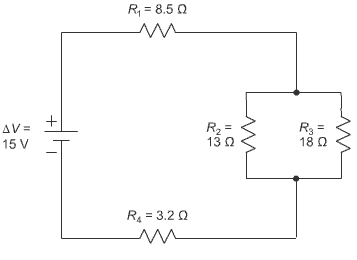
In the circuit shown, a current of 0.33 A will pass through which of the following resistors? R3 R1 R2 R4
 jennylove:
R1?
jennylove:
@justjm if you could help as well?
 TheSmartOne:
I've been looking at this far too long and I'm stumped Are you sure that the question/image are correct? I'm not able to get 0.33 at all mhmm
TheSmartOne:
Or if you could show how you got to that and I'm just completely overthinking it
jennylove:
actually nvm that r1 would be for 6.6 V because (0.78)(8.6) = 6.6
jennylove:
im not sure 0.33 :/
TheSmartOne:
Are you sure you're not misreading it and we're supposed to find 0.83 and not 0.33
jennylove:
R1 and R4 and the parallel combo R2 R3 all have the same current through them (I did not calculate it......it will likely be r2 or r3 since you cannot choose multiple )
jennylove:
right?
jennylove:
idk
jennylove:
and no it is 0.33, its not an error :/
TheSmartOne:
Yes you're right So for parallel, the voltage is the same and the resistance would be 1/(1/13 + 1/18) = 7.55 ohms And voltage is 15 V (stays same in parallel, changes in series) So 7.55 + 8.5 + 3.2 = 19.25 ohms V = IR So current for the resistors in series will all be the same which would be 15/19.25 = 0.779 A So it can't be resistor 1 or 4
TheSmartOne:
I think we're not considering the voltage drop after resistor 1
jennylove:
hmm , okay yes that does make some more sense.. im honestly not sure
TheSmartOne:
@imqwerty whenever you get a chance and you're free, if you could take a look at this. We could use your intelligence:))
jennylove:
would it be okay if i closed this question, just so i can upload more? until @imqwerty esponds
jennylove:
responds
TheSmartOne:
Yea, for sure
TheSmartOne:
Circuits and all are always a little tricky >,<
jennylove:
very true! ive been having a lot of difficulty
 imqwerty:
\(\color{#0cbb34}{\text{Originally Posted by}}\) @TheSmartOne Yes you're right So for parallel, the voltage is the same and the resistance would be 1/(1/13 + 1/18) = 7.55 ohms And voltage is 15 V (stays same in parallel, changes in series) So 7.55 + 8.5 + 3.2 = 19.25 ohms V = IR So current for the resistors in series will all be the same which would be 15/19.25 = 0.779 A So it can't be resistor 1 or 4 \(\color{#0cbb34}{\text{End of Quote}}\) this is correct, it can't the resistor 1 or 4, so we need to check the current in resistors 3 and 2
imqwerty:
a total current of 0.779Amps flows in the circuit
imqwerty:
When the current arrives at the junction connecting wire of resistors 3 and 2, it splits up. So a part of the 0.779 A goes into resistor 2 and the remaining goes into resistor 3
imqwerty:
how to calculate the amount of current that goes into each resistor? ez- the more the resistance the lesser the current. current in r2 = \(\large {I \times \frac{r_2}{r_2+r_3}}\) current in r3 = \(\large {I \times \frac{r_3}{r_2+r_3}}\) where I is the total current arriving at the junction = 0.799 A
imqwerty:
how did I get that formula to find the currents in each branch? - the potential drop across r2 and r3 will be the same because they have the same endpoints assume that the potential drop is \(V\) so \(V = r_2 \times i_2\) and \(V = r_3 \times i_3\) also \(i_2 + i_3 = I \) where \(i_2\) = current in resistor r2 and \(i_3 \) = current in resistor r3 solving the above equations you can get the expression for \(i_2 \) and \(i_3\) that i wrote in my previous message
TheSmartOne:
you're a genius qwerts <3
imqwerty:
master <3
Join our real-time social learning platform and learn together with your friends!
 KBaby:
Verse 1 We left our names in the dust of the driveway Watched the old town shrink
KBaby:
Lyrics Generator Use AI to write the lyrics for a song. Suggested Genres: Pop Hip
KBaby:
Verse 1 We left our names in the dust of the driveway Watched the old town shrink
KBaby:
Lyrics Generator Use AI to write the lyrics for a song. Suggested Genres: Pop Hip
 aitexturegenerator:
How are you all handling AI-generated textures for 3D models and game assets without losing the hand-made feel? I've been doing a small stylized environment
aitexturegenerator:
How are you all handling AI-generated textures for 3D models and game assets without losing the hand-made feel? I've been doing a small stylized environment

 Demon25:
Woke up feeling like that girl and that dude well he still aint crap pluse the du
Demon25:
Woke up feeling like that girl and that dude well he still aint crap pluse the du
 playtsec:
how do I get rid of stress from teachers... I just feel like running out the classroom and leaving on my own.
playtsec:
how do I get rid of stress from teachers... I just feel like running out the classroom and leaving on my own.
 JohnnyLFowler0812:
What type of gamer would play something and then get off for a while. Why not sta
JohnnyLFowler0812:
Which is better? Metallica Rap Country R&B hiphop Medal Gospel Chill Which 3 opti
JohnnyLFowler0812:
What type of gamer would play something and then get off for a while. Why not sta
JohnnyLFowler0812:
Which is better? Metallica Rap Country R&B hiphop Medal Gospel Chill Which 3 opti