
 Katy:
Katy:
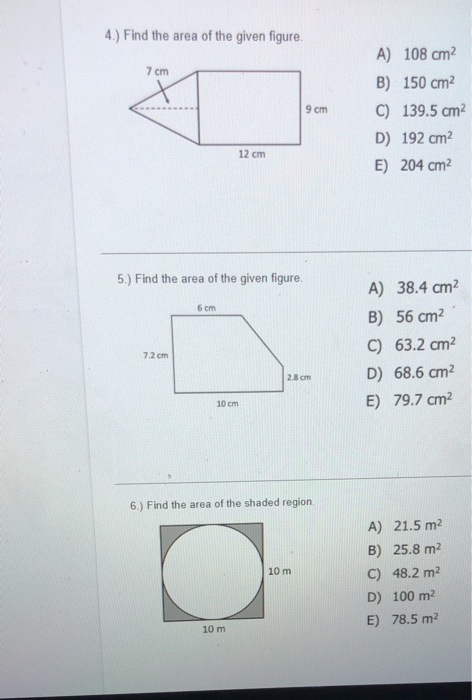
Find the area of the given figure.
 29shelbydtimms:
a
Katy:
what about 5 and 6?
 MrMudd183:
first off, do you know the formula for area and perimiter?
MrMudd183:
ok. so the formula for area is A=L*W Area = Length * Width
Katy:
4 is 108 cm^2 correct?
MrMudd183:
let me see. i will work it out in my head
MrMudd183:
i got C for it. because i did the area of the retangle. then i did the area of the triangle and added those two together and got 139.5
MrMudd183:
i can't figure out the other two. i'm sorry
MrMudd183:
i don't remember that much. and also I got C for the 1st problem because it said to find the area, so that makes me thing the area of the whole shape
 InsatiableSuffering:
So if you know your area formulas, this would be a cinch. Let's do a bit of review. The area of squares and rectangles is as follows \[A = bh\] where A is area, b is the length of the base, and h is the height. It doesn't matter which is which in a rectangle or square, as they will both yield the same product. The area of a circle is as follows \[A = πr ^{2}\] where A is area and r is the radius squared. Finally, the area of a trapezoid is as follows \[A = h(\frac{ b1+b2 }{ 2})\] where b1 is the length of one base, b2 is the length of the other parallel base, and h is the height of a trapezoid. Now we have all the tools that are necessary to finish this problem,
InsatiableSuffering:
So let's start with the second problem. For this one, you're given a 5 sided figure. However, because we don't currently know the area formula for this shape, we can simply divide it into TWO different shapes. So you can divide that figure into a rectangle and a trapezoid. |dw:1587652950602:dw| Sorry for the bad drawing, but this is the sketch of what I am talking about. Just use those area formulas to figure out the area of both of these shapes, and simply combine the areas of both together. Now for the third problem, we have a circle inscribed inside of a square, and I'm assuming you are looking for the area inside the square, but outside of the circle. Well, we know what the area of the square is. Now to find the area of the circle. You just simply find the radius, which is half the diameter of the circle. This is also known to be half of the length of the square. This is what the operation would look like. \[(10/2)^{2}\] Now just plug that into the area formula. Now, the trick to finding the area outside of the circle, but inside of the square is subtracting the area of the circle from the square, as the square has more area than the circle and the circle is also inscribed in the square. So it would essentially be \[A = bh - πr ^{2}\] I hope this helps.
InsatiableSuffering:
For 4, you have to add the areas of both the rectangle and the triangle. For the area of the triangle, the formula is as follows\[A = \frac{ bh }{ 2 }\] where b is the base of the triangle and h is the height of the triangle. As I have stated before, you must use the area formula for the rectangle/square to find that area. Then just find the area of the triangle with the formula given above. Add those two values and you'll find the area of the pentagon.
InsatiableSuffering:
I am not allowed to give an actual answer, but I am allowed to guide you. Remember, the area you are looking for is a PENTAGON. NOT JUST a rectangle. Remember, the pentagon is composed of a rectangle and a triangle. So how do you find the area of the pentagon, while taking into account both the areas of the rectangle and the triangle?
InsatiableSuffering:
The formula for a rectangle is simply A = bh. As long as you plug in the right side lengths and multiply them together, then you will find the area. If you have completed that process, then there is nothing to worry about regarding the area of the rectangle.
InsatiableSuffering:
Please reread the messages I sent above.
InsatiableSuffering:
\(\color{#0cbb34}{\text{Originally Posted by}}\) @InsatiableSuffering For 4, you have to add the areas of both the rectangle and the triangle. For the area of the triangle, the formula is as follows\[A = \frac{ bh }{ 2 }\] where b is the base of the triangle and h is the height of the triangle. As I have stated before, you must use the area formula for the rectangle/square to find that area. Then just find the area of the triangle with the formula given above. Add those two values and you'll find the area of the pentagon. \(\color{#0cbb34}{\text{End of Quote}}\) Reread this in particular.
InsatiableSuffering:
\(\color{#0cbb34}{\text{Originally Posted by}}\) @InsatiableSuffering So if you know your area formulas, this would be a cinch. Let's do a bit of review. The area of squares and rectangles is as follows \[A = bh\] where A is area, b is the length of the base, and h is the height. It doesn't matter which is which in a rectangle or square, as they will both yield the same product. \(\color{#0cbb34}{\text{End of Quote}}\) Hopefully, this part answers your latest question
Join our real-time social learning platform and learn together with your friends!
 KBaby:
Verse 1 We left our names in the dust of the driveway Watched the old town shrink
KBaby:
Lyrics Generator Use AI to write the lyrics for a song. Suggested Genres: Pop Hip
KBaby:
Verse 1 We left our names in the dust of the driveway Watched the old town shrink
KBaby:
Lyrics Generator Use AI to write the lyrics for a song. Suggested Genres: Pop Hip
 aitexturegenerator:
How are you all handling AI-generated textures for 3D models and game assets without losing the hand-made feel? I've been doing a small stylized environment
aitexturegenerator:
How are you all handling AI-generated textures for 3D models and game assets without losing the hand-made feel? I've been doing a small stylized environment

 Demon25:
Woke up feeling like that girl and that dude well he still aint crap pluse the du
Demon25:
Woke up feeling like that girl and that dude well he still aint crap pluse the du
 playtsec:
how do I get rid of stress from teachers... I just feel like running out the classroom and leaving on my own.
playtsec:
how do I get rid of stress from teachers... I just feel like running out the classroom and leaving on my own.
 JohnnyLFowler0812:
What type of gamer would play something and then get off for a while. Why not sta
JohnnyLFowler0812:
Which is better? Metallica Rap Country R&B hiphop Medal Gospel Chill Which 3 opti
JohnnyLFowler0812:
What type of gamer would play something and then get off for a while. Why not sta
JohnnyLFowler0812:
Which is better? Metallica Rap Country R&B hiphop Medal Gospel Chill Which 3 opti