
 darkknight:
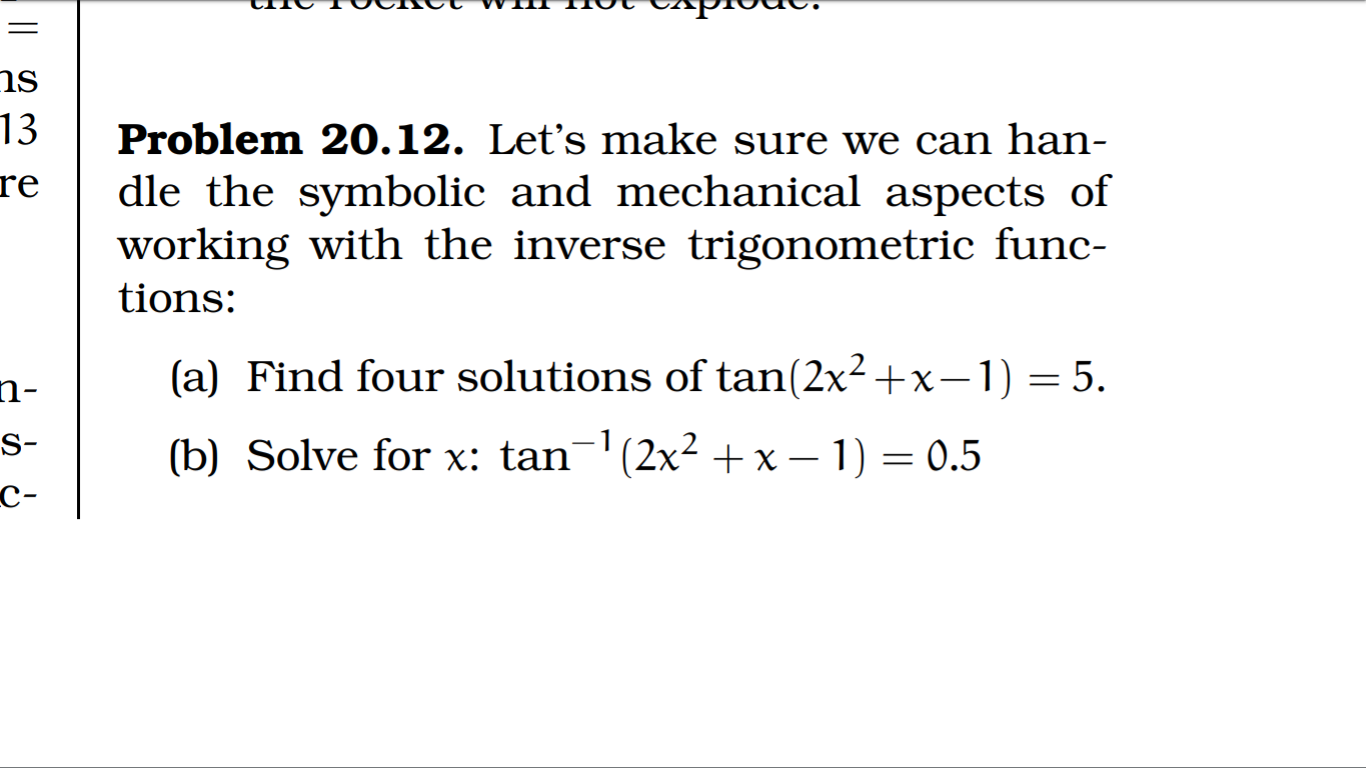
Let’s make sure we can handle the symbolic and mechanical aspects of working with the inverse trigonometric functions: (a) Find four solutions of tan(2x2 +x−1) = 5. (b) Solve for x: tan−1 (2x2 + x − 1) = 0.5
 darkknight:
@imqwerty, @isry @justjm I am a bit confused on how to do part A. (this is precalc btw) For B, is it just \[\tan^{-1} (2x^2+x-1) = .5\] \[\tan (\tan^{-1} (2x^2+x-1)=\tan (.5)\] So \[2x^2+x-1=\tan (.5)\] And then \[(2x-1)(x+1)=\tan(.5)\] And then individually solve for both equations? \[(\tan(.5) +1)/2\] and \[\tan(.5) -1\]
darkknight:
@Vocaloid
darkknight:
@jhonyy9
darkknight:
@TheSmartOne
 ramen:
@dude
 dude:
dude:
Rip my work went away But B is right, solve for each For A you can try doing the same process but add \(+\pi n\) to the \(tan^{-1}(5)\) because tangent returns to its value every pi units [It's period]
dude:
n can be substituted for any value +/- n value
ramen:
was it my fault? sorry
ramen:
try using the quadratic formula.
darkknight:
So how I got (tan(.5)+1)/2 and tan(.5)−1, I just add integer of pi to it? Like (pi+(tan(.5))+1)/2 and pi+tan(.5)−1 And multiply pi by any integer. But for some reason, none of the answer choices are working, the answer key said that sample answers for part a are −1.9293, −1.3677, 0.8677, 1.4293 and I don't know how it is getting those values.
dude:
So you want to have \((2x^{2}+x-1)=tan^{-1}(5)+0\pi\) => \(\color{green}{(2x^{2}+x-1)=tan^{-1}(5)}\) This will give you 2 solutions \((2x^{2}+x-1)=tan^{-1}(5)+1\pi\) => \(\color{green}{(2x^{2}+x-1)=tan^{-1}(5)+\pi}\) You can't really solve this by factoring so you could either complete the square or use the quadratic formula
dude:
The second will give you the other two
darkknight:
Wait. We can't factor (2x^2+x−1)? Doesn't it factor into 2x-1 and x+1?
darkknight:
And we want this in radian mode Correct?
dude:
Yes but the issue is that if you factor it you'll get two totally different answers You'll get two lines rather than a parabola And yes radians
dude:
It would be easier though quadratic eq
darkknight:
hold on, lemme do that real quick
dude:
You'll need a calculator for the decimal
darkknight:
(2x^2+x−1) for this? doesn't it just factor out to 0 and 1/2?
dude:
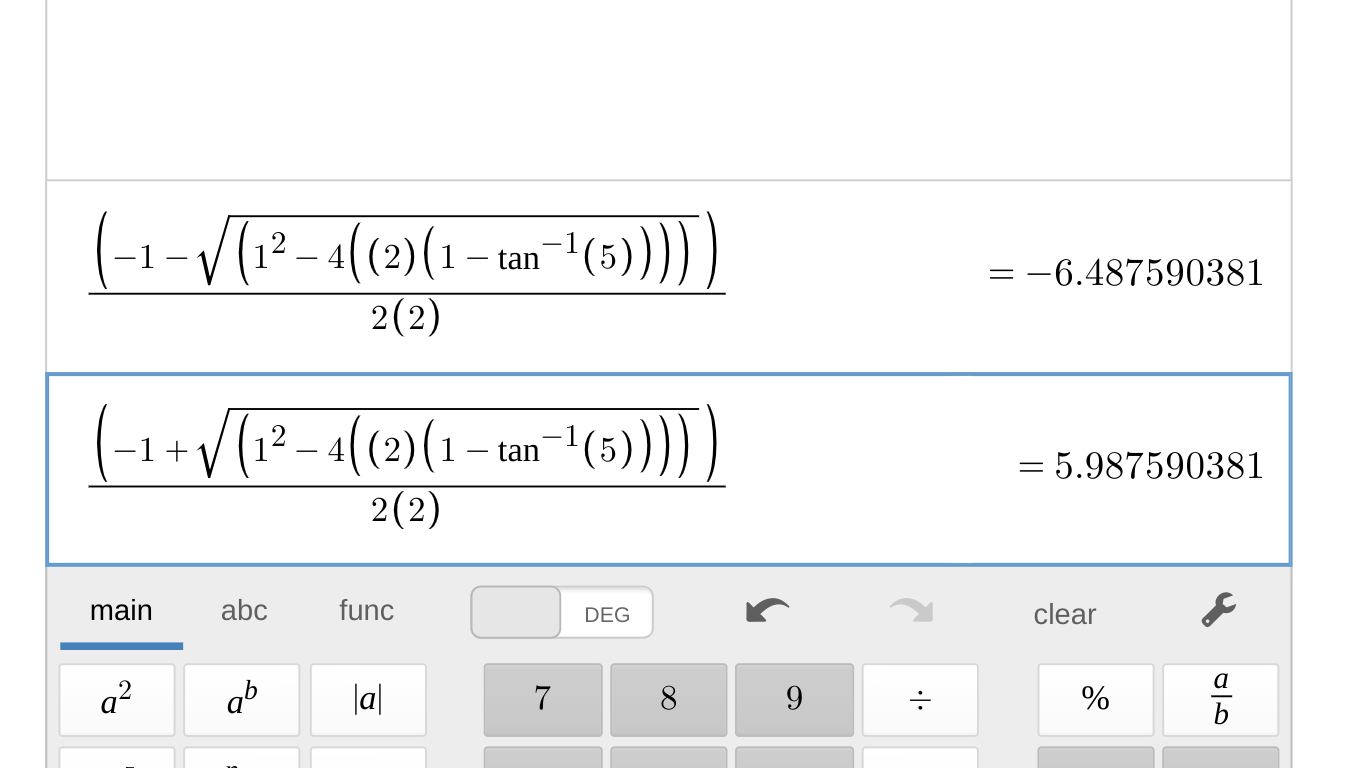
Don't factor By factoring you alter the equation \( (2x^2+x−1)=tan^{-1}(5)\) Set equal to zero \( 2x^2+x−1-tan^{-1}(5)=0\) Take the values \((1-tan^{-1}(5))\) as the c value (constant) You'll end up with something like this \(\dfrac{-1\pm\sqrt{(1^2-4((2)(1-tan^{-1}(5))))}}{2(2)}\) Spliting to + and -: \(\dfrac{-1+\sqrt{(1^2-4((2)(1-tan^{-1}(5))))}}{2(2)}\) and \(\dfrac{-1-\sqrt{(1^2-4((2)(1-tan^{-1}(5))))}}{2(2)}\) This is so long thats why it would be better to solve with calc ====================================== For the other equation: \( (2x^2+x−1)=tan^{-1}(5)+\pi\) Set equal to zero \( 2x^2+x−1-tan^{-1}(5)+\pi=0\) Take the values \(1-tan^{-1}(5)+\pi\) as the constant Now for this one you would do a similar one as previous only adding pi to it \(\dfrac{-1+\sqrt{(1^2-4((2)(1-tan^{-1}(5)+\pi)))}}{2(2)}\) and \(\dfrac{-1-\sqrt{(1^2-4((2)(1-tan^{-1}(5)+\pi )))}}{2(2)}\)
dude:
Quadratic eq is easier to use if they give you quadratic equations Treat the trig function as a constant if they do not have x
darkknight:
Thanks @dude, that explanation really helped. You are Great!!!
darkknight:
But dude, The equations where you added pi to it, are undefined. What does that mean?
dude:
Hmm What calculator are you using? I think some manual ones use arctan instead of tan^-1
dude:
Or the equation might be too long
ramen:
works for me... im using ti 84 plus
ramen:
try redoing the negatives... maybe you did a negative instead of a minus symbol.
ramen:
anyway quadratic formula did work though...
ramen:
I used degrees but radians still should work... it does for me
 dude:
dude:
Use radians D:
darkknight:
Still doesn't work. Could you screenshot what you did?
dude:
Oh I goofed I missed the negative sign in front of the 1 and pi First two set should be: \(\dfrac{-1+\sqrt{1^2-4(2)(\color{red}{-}1-tan^{-1}(5))}}{2(2)}\) and \(\dfrac{-1+\sqrt{1^2-4(2)(\color{red}{-}1-tan^{-1}(5))}}{2(2)}\) Second set should be: \(\dfrac{-1+\sqrt{1^2-4(2)(\color{red}{-}1-tan^{-1}(5)\color{red}{-}\pi)}}{2(2)}\) and \(\dfrac{-1+\sqrt{1^2-4(2)(\color{red}{-}1-tan^{-1}(5)\color{red}{-}\pi)}}{2(2)}\)
darkknight:
Oh lol, its okay. thanks dude.
Join our real-time social learning platform and learn together with your friends!
 KBaby:
Verse 1 We left our names in the dust of the driveway Watched the old town shrink
KBaby:
Lyrics Generator Use AI to write the lyrics for a song. Suggested Genres: Pop Hip
KBaby:
Verse 1 We left our names in the dust of the driveway Watched the old town shrink
KBaby:
Lyrics Generator Use AI to write the lyrics for a song. Suggested Genres: Pop Hip

 aitexturegenerator:
How are you all handling AI-generated textures for 3D models and game assets without losing the hand-made feel? I've been doing a small stylized environment
aitexturegenerator:
How are you all handling AI-generated textures for 3D models and game assets without losing the hand-made feel? I've been doing a small stylized environment

 Demon25:
Woke up feeling like that girl and that dude well he still aint crap pluse the du
Demon25:
Woke up feeling like that girl and that dude well he still aint crap pluse the du
 playtsec:
how do I get rid of stress from teachers... I just feel like running out the classroom and leaving on my own.
playtsec:
how do I get rid of stress from teachers... I just feel like running out the classroom and leaving on my own.
 JohnnyLFowler0812:
What type of gamer would play something and then get off for a while. Why not sta
JohnnyLFowler0812:
Which is better? Metallica Rap Country R&B hiphop Medal Gospel Chill Which 3 opti
JohnnyLFowler0812:
What type of gamer would play something and then get off for a while. Why not sta
JohnnyLFowler0812:
Which is better? Metallica Rap Country R&B hiphop Medal Gospel Chill Which 3 opti