
 Momajdy:
d2iL(t)dt2+1LCiL(t)=ALCδ(t−9.0) a-What is the natural frequency, in Hertz, of this circuit? 0.249 b-For the remaining parts of the question, you should round the above value off to two decimal places to make calculations easier. c-At the initial time what is the total energy, in Joules, stored in the circuit? d-At the time just before the impulse happens t=9.0s− what is the total energy, in Joules, stored in the circuit? e-At the time just before the impulse happens what is the current iL(9.0s−) , in Amperes, through the inductor? f-At the time just before the impulse happens what is the voltage vC(9.0s−) , in Volts, across the capacitor? g-At the time just after the impulse happens what is the current iL(9.0s+) , in Amperes, through the inductor? h-At the time just after the impulse happens what is the voltage vC(9.0s+) , in Volts, across the capacitor? i-At the time just after the impulse happens what is the total energy, in Joules, stored in the circuit?
SemiDefinite:
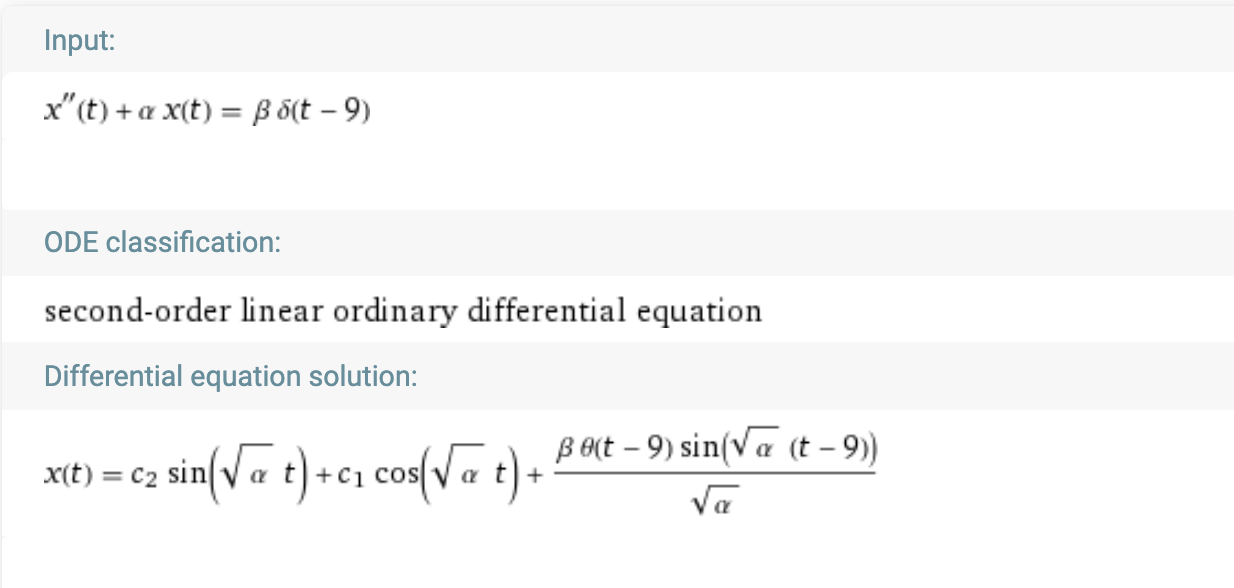
There is something not right about what you have posted, maybe screen grab the actual text? The underlying type of DE, here a non-hom DE for an L-C circuit, is: - \(\qquad x'' + \omega^2 x = \gamma ~ \delta (t - 9)\) The solution is: - \(\qquad x = c_1 \sin(\omega t) + c_2 \cos( \omega t) + \dfrac{\gamma \mathcal{H}(t - 9) sin(\omega (t - 9))}{\omega}\) ...with \(\mathcal{H}\) being the Heaviside/ unit step function Solution uses a Laplace T/f. So you still have that \(\dfrac{1}{\sqrt{ L C }}\) resonance thing going on
Join our real-time social learning platform and learn together with your friends!
 KBaby:
Verse 1 We left our names in the dust of the driveway Watched the old town shrink
KBaby:
Lyrics Generator Use AI to write the lyrics for a song. Suggested Genres: Pop Hip
KBaby:
Verse 1 We left our names in the dust of the driveway Watched the old town shrink
KBaby:
Lyrics Generator Use AI to write the lyrics for a song. Suggested Genres: Pop Hip
 aitexturegenerator:
How are you all handling AI-generated textures for 3D models and game assets without losing the hand-made feel? I've been doing a small stylized environment
aitexturegenerator:
How are you all handling AI-generated textures for 3D models and game assets without losing the hand-made feel? I've been doing a small stylized environment

 Demon25:
Woke up feeling like that girl and that dude well he still aint crap pluse the du
Demon25:
Woke up feeling like that girl and that dude well he still aint crap pluse the du
 playtsec:
how do I get rid of stress from teachers... I just feel like running out the classroom and leaving on my own.
playtsec:
how do I get rid of stress from teachers... I just feel like running out the classroom and leaving on my own.
 JohnnyLFowler0812:
What type of gamer would play something and then get off for a while. Why not sta
JohnnyLFowler0812:
Which is better? Metallica Rap Country R&B hiphop Medal Gospel Chill Which 3 opti
JohnnyLFowler0812:
What type of gamer would play something and then get off for a while. Why not sta
JohnnyLFowler0812:
Which is better? Metallica Rap Country R&B hiphop Medal Gospel Chill Which 3 opti