
 payton:
4
 payton:
@ramen @carmelle
 ramen:
i will let darkknight do this one
 darkknight:
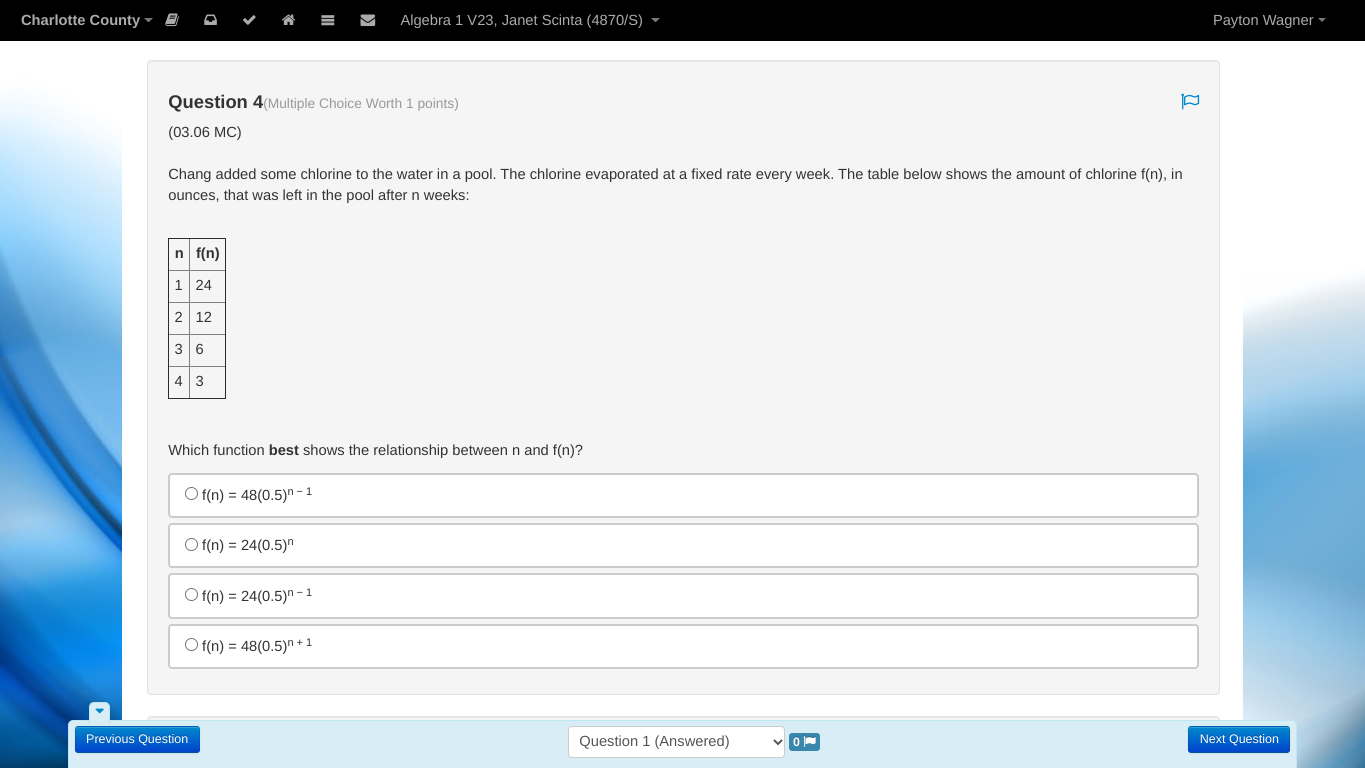
The coefficient term in an exponent represents the starting value, since f(n) = 24 when n=1, the function has to have 24 in the coefficient term. So we can eliminate options A and D
darkknight:
Now from here, we see that f(n) is getting cut in half everytime we go from 1 to 2 to 3... right? We see F(n) go from 24 to 12 to 6... So basically we can say that our base is 1/2
payton:
would my answer be c then?
ramen:
@darkknight are you done?
darkknight:
Anyways, why did you say that c is correct?
payton:
because it seemed to be the best result
payton:
or am i wrong?
ramen:
The answer is C you are correct.
ramen:
The only thing you need to understand now is why it is n-1 and not just n.
darkknight:
... thats not how math works, but you are correct. So since the initial value given to us in the table is 24, when n=1. We have to have the function 24(.5)^(x-1) because at x=1 is when the value = 24. So if we plug in 1 to that equation (the one on c) we will end up with an output of 24, and if you plug in other numbers for x, such as 2, 3, 4, you will end up getting 12, 6, 3... respectively
ramen:
Agreed Good job darkknight
payton:
\(\color{#0cbb34}{\text{Originally Posted by}}\) @darkknight ... thats not how math works, but you are correct. So since the initial value given to us in the table is 24, when n=1. We have to have the function 24(.5)^(x-1) because at x=1 is when the value = 24. So if we plug in 1 to that equation (the one on c) we will end up with an output of 24, and if you plug in other numbers for x, such as 2, 3, 4, you will end up getting 12, 6, 3... respectively \(\color{#0cbb34}{\text{End of Quote}}\) okay
Join our real-time social learning platform and learn together with your friends!
 Demon25:
For a hoco proposal with a cheerleader and football player, what else should be a
Demon25:
For a hoco proposal with a cheerleader and football player, what else should be a

 Breathless:
TOC: "MGF any confirmation on the commander? we require confirmation as soon as[radio static].
Breathless:
TOC: "MGF any confirmation on the commander? we require confirmation as soon as[radio static].
 EdwinJsHispanic:
I wrote something that I don't know if I want it as a poem or song, Please let me know on yours thoughts about it, I'm still doing this! "Broken promises an
EdwinJsHispanic:
I wrote something that I don't know if I want it as a poem or song, Please let me know on yours thoughts about it, I'm still doing this! "Broken promises an
 thehearken:
hi um I don't know if this is the right section for this, but can someone go over my poem and tell me if its good enough to give my English professor for a
thehearken:
hi um I don't know if this is the right section for this, but can someone go over my poem and tell me if its good enough to give my English professor for a
 heartlessprophet:
Aye what's 19z%u00f74p=9u03c0 my teacher thinking of impossible questions for us
heartlessprophet:
Aye what's 19z%u00f74p=9u03c0 my teacher thinking of impossible questions for us
 kippppp:
does anyone have any good tips for writing stories? i'm trying to write a dnd campaign but i'm not that great of a writer yet.
kippppp:
does anyone have any good tips for writing stories? i'm trying to write a dnd campaign but i'm not that great of a writer yet.
 GRIZZLEY19:
Y'all let me know what y'all think about this beat I made I took me like a hour maybe rate it 0/10 https://drive.
GRIZZLEY19:
Y'all let me know what y'all think about this beat I made I took me like a hour maybe rate it 0/10 https://drive.
 Ultrilliam:
Welcome to the 10th Anniversary Update! (Part 2) Sorry this one passed the date a
Ultrilliam:
Welcome to the 10th Anniversary Update! (Part 2) Sorry this one passed the date a
 Twaylor:
was walking downtown and my adhd brain wanted to make some (rock?) lyrics: There'
Twaylor:
was walking downtown and my adhd brain wanted to make some (rock?) lyrics: There'