
 darkknight:
Photosynthesis and Cellular Respiration (simple) review Contains a quick overview of Photosynthesis: * Light-Dependent Reactions * Calvin Cycle Cellular Respiration: * Glycolysis * Krebs Cycle * Electron Transport Chain
darkknight:
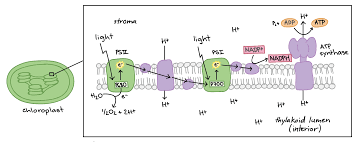
Photosynthesis Light dependent reactions: So autotrophs use this. Okay, starting with the light-dependent reactions, basically how the reaction starts is that H20 Molecules hit a place inside the thylakoid membrane (this in the chloroplast) called Photosystem II (don't ask why the first isn’t called Photosystem I, ¯\_(ツ)_/¯ ). What power’s this reaction that is happening in Photosystem II is light, (which is absorbed through proteins, containing pigments like chlorophyll). Light energy is used to split water (H20). Also note that without light, this reaction can’t occur. Anyways, from there, what happens is that the H20 molecules split up into hydrogen and oxygen molecules, I am going to use the example of 2H20 molecules entering Photosystem II and they break up into 4 H + (superscript plus, to represent positive charge) and 1 O2 molecule (a property of oxygen is that is doesn’t like being by itself so that’s why it combines with another oxygen atom). So the hydrogen ions are floating in the inner thylakoid space for the time being. Anyways back to it, so after the reaction happens in photosystem II, what happens are electrons that are produced (these electrons initially have low energy but are energized by Photosystem II), these electrons travel to photosystem I (in the process of moving between the Photosystems’ they lose energy, so they are re-energized by Photosystem I) (through the electron transport chain), where they are used in a reaction in Photosystem I, Basically this electron reacts (in the reaction) with 2NADP + (superscript + to represent a positive charge) and 2H + and produce 2NADPH (which will then be used to make sugars in the Calvin Cycle (or the light-independent cycle). Back to the hydrogen ions that were floating around the inner thylakoid space, they enter the ATP synthase. What happens here is that in the ATP synthase, ADP that was floating around combined with the H+ ion outputs ATP, which is a form of usable energy. So from this cycle, we can say that it is to produce NADPH and ATP which are forms of high usable energy, and these NADPH and ATP are passed on to the next place (Calvin Cycle) where they fuel the assembly of sugar molecules. A way to visualize the light-dependent reactions is through this image:
 darkknight:
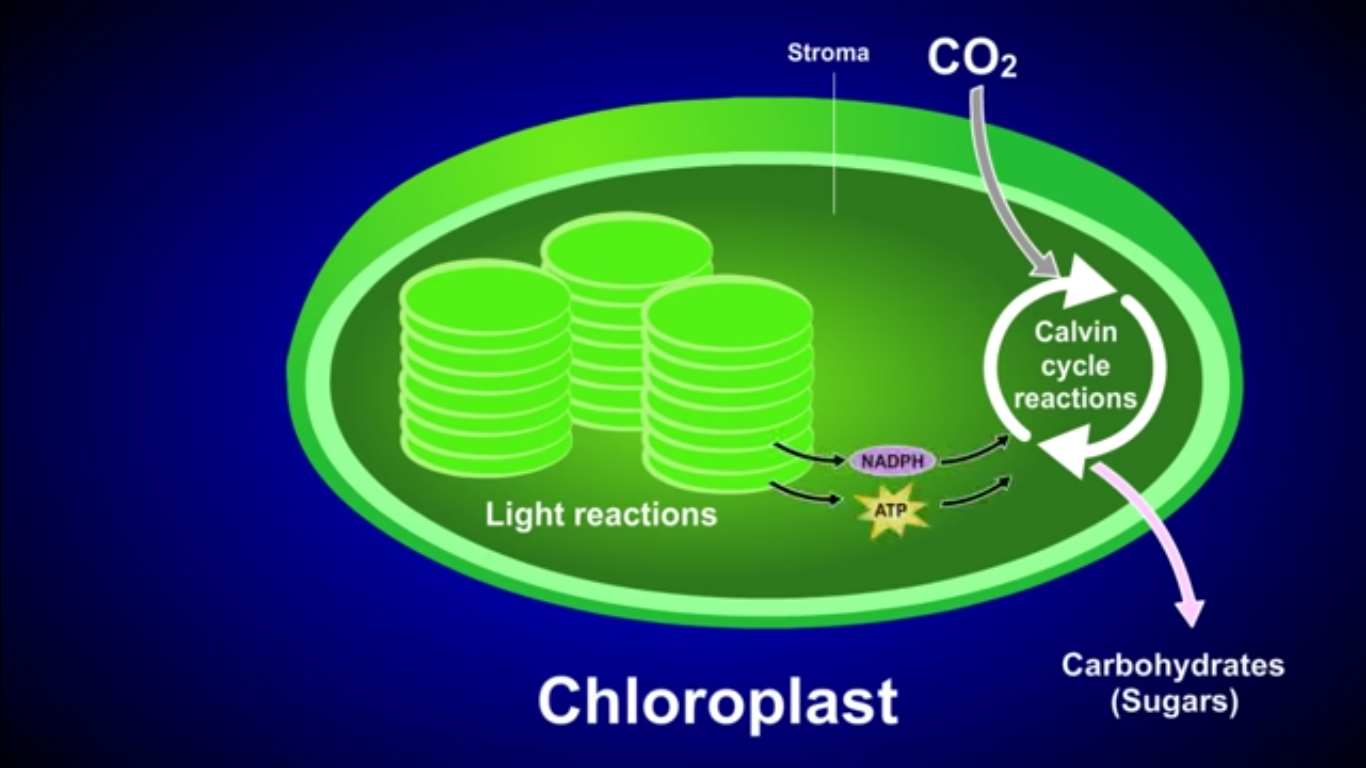
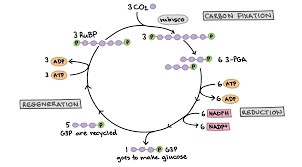
Calvin Cycle Image 1shows that NADPH and ATP that came from Light-dependent reactions are used in the Calvin cycle reactions. In the Calvin cycle (also called the light-independent reaction/cycle) the ATP and NADPH (that was produced in the light-dependent reaction) along with CO2 are used (this Calvin cycle occurs in the Stroma). 6 5-carbon molecules are combined with 6CO2 and form 12 3-carbon molecules. 12 ATP turn into 12 ADP and 12 NADPH turn into 12 NADP+ (these molecules supply the needed electrons/energy for CO2 reduction. The NADP+ and ADP return to the thylakoid to be converted back to NADPH and ATP respectively. In the 12 3-Carbon groups, 2 are outputted and they form sugars and other compounds, so we are left with 10 3-carbon molecules in the cycle. Now 6 ATP are used (turn into 6 ADP) to convert the 10 3-carbon groups, into a 6-5carbon group, and the cycle begins again. The second picture is the picture for reference: Note 2 cycles per glucose molecule.
 darkknight:
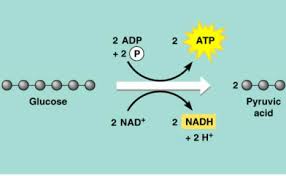
Cellular Respiration Glycolysis In glycolysis (occurs in the cytoplasm), what happens is that a 6 carbon molecule is broken into 2 3-carbon groups, Basically, 2 ATP are put in for this and 2 ADP come out, (the ATP is like an investment that pays back interest). What happens next is that in the ending phases of glycolysis, 4 ATP are produced (a net gain of 2 ATP molecules in glycolysis). Also 2 NAD + turn into 2 NADH, and the byproduct is 2 pyruvic acids. Picture for reference included: Note this (picture) doesn’t consider the Phosphorus and Hydrogen atoms that are just floating around, basically it is assumed that they are there. Also note that it says 2 ADP go in and 2ATP come out, this is only the net gain, there is a net gain of 2 ATP in glycolysis but... (I explained in the paragraph above).
 darkknight:
Krebs cycle: The Krebs cycle takes place in the mitochondrial matrix. 2 Acetyl co-enzyme A adds onto a 4-carbon group (Oxaloacetic avid) to form Citric acid (6-carbon molecule). What happens next is that a CO2 molecule is released from the 6-carbon compound and turns it into a 5-carbon compound. This happens again and turns it into a 4 carbon molecule. This 4-carbon molecule goes through a series of steps (converting from one type of 4-carbon molecule to another). Finally, the produced 4-carbon molecule is converted back into Oxaloacetic Acid, so the cycle can begin again. NADH is reloaded during the conversion from the 6-carbon compound to the 5-carbon compound, the 5 carbon-compound to the 4-carbon compound, and the step right before the substance is converted back into Oxaloacetic Acid. 1 ATP is produced from 1 ADP while the 4-carbon group is going through processes, 1 FAD into FADH2. All of this above is per pyruvate, so this cycle goes twice per glucose molecule. So all in all, per glucose, 2 molecules of ATP, 6 NADH, and 2 FADH2 are produced.
darkknight:
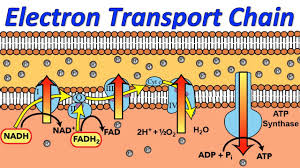
Electron Transport Chain Basically, the Electron transport chain (occurs in the mitochondria) (cellular respiration) is similar to the light-dependent reaction (photosynthesis). In the mitochondria, the electrons are taken and put into the inner membrane, and these electrons are used to power ”pump” protons (they travel through the electron transport chain). Hydrogen atoms make it into the intermembrane space and the only way out is through the ATP synthase. Anyways, the NADH (2NADH if we are talking in a ratio) and the FADH2 (talking in the same ratio) release the electrons, turning into 2NAD + and FAD respectively. Those electrons after they are used to “pump” protons (they fuel the reaction) leave and join hydrogen/oxygen atoms and form H20. Anyways, you can think of the ATP synthase as something that grabs ADP, P, and the hydrogen atom and outputs ATP. Alone ADP doesn’t naturally join with ADP. Picture for reference: Just note that the numbers I used when I explained are a bit different than the picture, but the picture gets a general idea.
Join our real-time social learning platform and learn together with your friends!
 KBaby:
Verse 1 We left our names in the dust of the driveway Watched the old town shrink
KBaby:
Lyrics Generator Use AI to write the lyrics for a song. Suggested Genres: Pop Hip
KBaby:
Verse 1 We left our names in the dust of the driveway Watched the old town shrink
KBaby:
Lyrics Generator Use AI to write the lyrics for a song. Suggested Genres: Pop Hip

 aitexturegenerator:
How are you all handling AI-generated textures for 3D models and game assets without losing the hand-made feel? I've been doing a small stylized environment
aitexturegenerator:
How are you all handling AI-generated textures for 3D models and game assets without losing the hand-made feel? I've been doing a small stylized environment

 Demon25:
Woke up feeling like that girl and that dude well he still aint crap pluse the du
Demon25:
Woke up feeling like that girl and that dude well he still aint crap pluse the du
 playtsec:
how do I get rid of stress from teachers... I just feel like running out the classroom and leaving on my own.
playtsec:
how do I get rid of stress from teachers... I just feel like running out the classroom and leaving on my own.
 JohnnyLFowler0812:
What type of gamer would play something and then get off for a while. Why not sta
JohnnyLFowler0812:
Which is better? Metallica Rap Country R&B hiphop Medal Gospel Chill Which 3 opti
JohnnyLFowler0812:
What type of gamer would play something and then get off for a while. Why not sta
JohnnyLFowler0812:
Which is better? Metallica Rap Country R&B hiphop Medal Gospel Chill Which 3 opti