
 jakfishman:
ok i need help
 Laylalyssa:
k
 ramen:
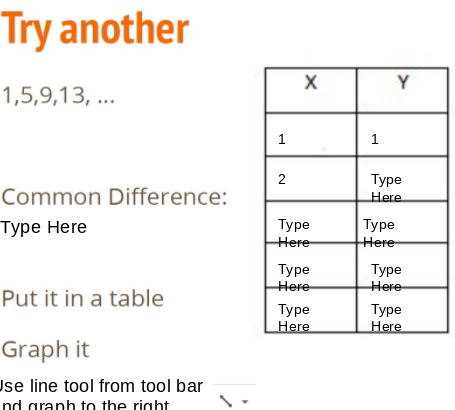
Well we know that X always goes up by 1, so for the x column, it would be 1,2,3,4,5 but for the y column, what is the pattern that you see between the numbers 1,5,9, and 13? I am also pretty sure you can include 1,5,9,and 13 into the y column.
jakfishman:
wait what
ramen:
What part are you confused on?
jakfishman:
I am also pretty sure you can include 1,5,9,and 13 into the y column. this part
ramen:
So you see how Y has 1 already filled out in the first row? You can add 5,9, and 13 in the following rows because that is given.
jakfishman:
ohhhh okk
ramen:
|dw:1606695014866:dw|
ramen:
Now we just need to know what value follows 13. What is the answer when you get 13-9? This is the number you add to 13 to get to the next y value.
jakfishman:
(5,17)
ramen:
Yes that is correct. Now you know what the common difference is between each of the y values, we just need to graph it now. When graphing can you just plot all the points from the table and draw a line through them?
jakfishman:
ye hold on
 ramen:
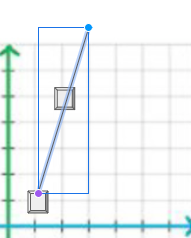
Not quite, from you got the point (1,1) right, but the next point (2,5) is a bit off. Right now instead of (2,5) you have (2,4). And also please make sure that the dot on (1,1) is directly on (1,1)
jakfishman:
the second one is on 2,5
jakfishman:
the lines not tho
ramen:
It just looks a bit off to me. I think it is because the point (1,1) where the dot is is a bit to high when you graphed it.
ramen:
\(\color{#0cbb34}{\text{Originally Posted by}}\) @jakfishman the lines not tho \(\color{#0cbb34}{\text{End of Quote}}\) Oh like the software you are using says the second point is on (2,5) and the first point is on (1,1)?
 jakfishman:
yea
ramen:
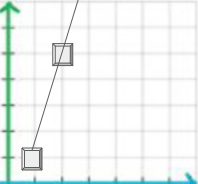
Ok that image looks a lot better and it looks correct to me.
 ramen:
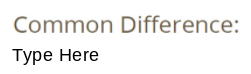
Common difference is just the difference between the y values. The difference between all y values is the same, so what is 13-9? That is the common difference.
jakfishman:
4
jakfishman:
only thing is the last one says the slope
ramen:
Remember the average rate of change formula? so y2-y1/x2-x1. Pick any 2 coordinates for example (1,1) and (2,5). Fill in the blanks of the formula. So Y2-y1 would just be subtracting both y values from the 2 coordinates which would be 5-1. For x2-x1, that would just be subtracting the x values from both the 2 coordinats which would be 2-1. What is (5-1)/(2-1)?
jakfishman:
4
ramen:
Yes that is correct. The slope is 4 which is also the same as your common difference.
jakfishman:
thank you @ramen for helping me.
ramen:
Np. Did you get it right?
Join our real-time social learning platform and learn together with your friends!
 VERNEISH:
Two objects are moving along separate linear paths where each path is described by position, d, and time, t.
VERNEISH:
Two objects are moving along separate linear paths where each path is described by position, d, and time, t.

 Maci:
what are the best stock apps for people who want to start investing?
Maci:
what are the best stock apps for people who want to start investing?
 Twaylor:
genuienly how do i get better self control i keep watcing youtube and theres this
Twaylor:
genuienly how do i get better self control i keep watcing youtube and theres this
 IzzyCookie:
|dw:1792074056138:dw| Uhm, I don't know where to ask this, but I'm in college welding at my community college, and I need help learning vertical welding for
IzzyCookie:
|dw:1792074056138:dw| Uhm, I don't know where to ask this, but I'm in college welding at my community college, and I need help learning vertical welding for

 thehearken:
not sure if this is considered spam, im sorry if it is, but does anyone have tips
thehearken:
not sure if this is considered spam, im sorry if it is, but does anyone have tips