
 mathpass:
How did President Andrew Jackson's administration perceive the Five Civilized Tribes?
 SavageHailey:
isnt he the one who dies in a bathtub?
 mathpass:
\(\color{#0cbb34}{\text{Originally Posted by}}\) @SavageHailey isnt he the one who dies in a bathtub? \(\color{#0cbb34}{\text{End of Quote}}\) omg
SavageHailey:
but he is tho right?
mathpass:
idk
mathpass:
After completing his second term in the White House, Jackson returned to Tennessee, where he died on June 8, 1845, at the age of 78. The cause of death was lead poisoning caused by the two bullets that had remained in his chest for several years.Mar 12, 2020
 xxDeppressionxx:
✨What do you mean? ✨
SavageHailey:
i thought he died in a bathtub though
xxDeppressionxx:
*source
SavageHailey:
nvm William Howard Taft is the president im thinking about
mathpass:
sorry spelt it wrong
jimthompson5910:
You might be thinking of President Taft, who was rumored to have gotten stuck in a bathtub. Though many people think the rumors aren't true.
 MxxnLight:
Before becoming president, Andrew Jackson had distinguished himself as a champion of white settlers against indigenous people. In the War of 1812, Jackson had led an offensive against the Creek nation in an attempt to clear the Mississippi Territory for white settlement, and under President James Monroe, he had participated in the First Seminole War, which devastated the Seminole tribe of Florida
SavageHailey:
Taft was the most obese president. He was 5 feet, 11.5 inches tall and his weight was between 335 and 350 pounds toward the end of his presidency. He is thought to have had difficulty getting out of the White House bathtub, so he had a 7-foot (2.1 m) long, 41-inch (1.04 m) wide tub installed.
MxxnLight:
By the time Jackson entered the White House, white settlers in Georgia had been complaining for some time about the continued presence of Cherokee and Creek people on the lands they wished to inhabit. These white settlers were emboldened by the election of Jackson in 1828 and revoked the constitution of the Cherokee nation in Georgia, declaring that indigenous people were subject to the laws of the state of Georgia. In 1830, the Cherokee nation took the state of Georgia to the Supreme Court, arguing that it was an independent nation and as such, was not subject to the authority of the state of Georgia. Chief Justice of the Supreme Court John Marshall agreed that the Cherokee nation was a distinct society but not that it was a foreign nation.
mathpass:
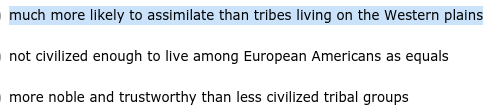
\(\color{#0cbb34}{\text{Originally Posted by}}\) @MxxnLight By the time Jackson entered the White House, white settlers in Georgia had been complaining for some time about the continued presence of Cherokee and Creek people on the lands they wished to inhabit. These white settlers were emboldened by the election of Jackson in 1828 and revoked the constitution of the Cherokee nation in Georgia, declaring that indigenous people were subject to the laws of the state of Georgia. In 1830, the Cherokee nation took the state of Georgia to the Supreme Court, arguing that it was an independent nation and as such, was not subject to the authority of the state of Georgia. Chief Justice of the Supreme Court John Marshall agreed that the Cherokee nation was a distinct society but not that it was a foreign nation. \(\color{#0cbb34}{\text{End of Quote}}\) so is it much more likely to assimilate than tribes living on the Western plains
MxxnLight:
In Worcester v. Georgia, Chief Justice Marshall expanded on this argument, declaring that the state of Georgia had no authority over the Cherokee, which as a sovereign nation could only be subject to the authority of the federal government. The ruling established the nature of relations between the federal government and indigenous peoples as that between sovereign nations. But President Jackson refused to enforce the ruling and pursued a policy of genocide. The Indian Removal Act of 1830 authorized the voluntary relocation of Native Americans to the lands west of the Mississippi River but was frequently abused by government officials and resulted in some forced removals
MxxnLight:
\(\color{#0cbb34}{\text{Originally Posted by}}\) @mathpass \(\color{#0cbb34}{\text{Originally Posted by}}\) @MxxnLight By the time Jackson entered the White House, white settlers in Georgia had been complaining for some time about the continued presence of Cherokee and Creek people on the lands they wished to inhabit. These white settlers were emboldened by the election of Jackson in 1828 and revoked the constitution of the Cherokee nation in Georgia, declaring that indigenous people were subject to the laws of the state of Georgia. In 1830, the Cherokee nation took the state of Georgia to the Supreme Court, arguing that it was an independent nation and as such, was not subject to the authority of the state of Georgia. Chief Justice of the Supreme Court John Marshall agreed that the Cherokee nation was a distinct society but not that it was a foreign nation. \(\color{#0cbb34}{\text{End of Quote}}\) so is it much more likely to assimilate than tribes living on the Western plains \(\color{#0cbb34}{\text{End of Quote}}\) Yes.
MxxnLight:
\(\color{#0cbb34}{\text{Originally Posted by}}\) @mathpass thank you \(\color{#0cbb34}{\text{End of Quote}}\) Np.
Join our real-time social learning platform and learn together with your friends!
VERNEISH:
Two objects are moving along separate linear paths where each path is described by position, d, and time, t.

 Maci:
what are the best stock apps for people who want to start investing?
Maci:
what are the best stock apps for people who want to start investing?
 Twaylor:
genuienly how do i get better self control i keep watcing youtube and theres this
Twaylor:
genuienly how do i get better self control i keep watcing youtube and theres this
 IzzyCookie:
|dw:1792074056138:dw| Uhm, I don't know where to ask this, but I'm in college welding at my community college, and I need help learning vertical welding for
IzzyCookie:
|dw:1792074056138:dw| Uhm, I don't know where to ask this, but I'm in college welding at my community college, and I need help learning vertical welding for

 thehearken:
not sure if this is considered spam, im sorry if it is, but does anyone have tips
thehearken:
not sure if this is considered spam, im sorry if it is, but does anyone have tips