
 Aliannaaaaaaaa:
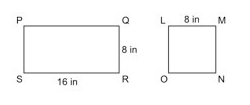
Look at the rectangle and the square: A rectangle PQRS and square LMNO are drawn side by side. The length SR of the rectangle is labeled as 16 inches, and the width QR is labeled as 8 inches. The side LM of the square is labeled as 8 inches Ada says that the length of diagonal SQ is two times the length of diagonal OM. Is Ada correct? Justify your answer and show all your work. Your work should state the theorem you used to find the lengths of the diagonals.
 Laylalyssa:
Welcome to QC! Do you think she is correct or no?
Aliannaaaaaaaa:
yes
Laylalyssa:
And why do u think that?
 Aliannaaaaaaaa:
if you look at the picture the rectangle is half of the square which would make it 2 times bigger
Laylalyssa:
What was the length of SQ
Aliannaaaaaaaa:
17.89 I think
Laylalyssa:
The length of SQ 16^2 + 8^2 = SQ^2
Laylalyssa:
right
Aliannaaaaaaaa:
yep
Laylalyssa:
So how did u get that, like show the steps bc it says u have to show work
Laylalyssa:
@Aliannaaaaaaaa ^
Aliannaaaaaaaa:
Ok I know how to do it Thanks!
Laylalyssa:
Your welcome!, but do you still think shes correct?
Aliannaaaaaaaa:
idk yet Id have to do the math with both answers and see
Laylalyssa:
ok lmk if u need more help
 supie:
Rectangle A PQRS First, we must get the information from the problem of what the length and width was labeled. Length SR is labeled 14 inches Width QR is labeled as 7 inches Now I've got some explaining to do so, When a diagonal line goes through a rectangle, it splits the rectangle into 2 triangles. So now, you may have heard of The Pythagorean Theorem. We will be using it to solve the problem. So, According to The Pythagorean Theorem: \[c^2 = a^2 + b^2\] \[ c = length\ of\ the\ diagonal\] \[a = Length\ of\ the\ rectangle\ = 14 inches\] \[b = Width\ of\ the\ rectangle = 7 inches\] Using what is above, we will come to \[c^2 = 14^2 + 7^2\] \[c = √(14^2 + 7^2)\] So, I believe \[c = 15.65\ inches\] \[PQRS = SQ = 15.65\ inches\ (Length\ of\ the\ diagonal\ of\ Rectangle) \] Square B LMNO LM Square was labeled 7 inches. As we know, all of a square's sides are equal so, all the sides are the same (along with the width which is what we are looking for. As I stated before "When a diagonal line goes through a rectangle, it splits the rectangle into 2 triangles." Again, we have to use The Pythagorean Theorem: \[c^2 = a^2 + b^2\] \[ c = length\ of\ the\ diagonal\] \[a = Length\ of\ the\ rectangle\ = 14 inches\] \[b = Width\ of\ the\ rectangle = 7 inches\] \[c^2 = 7^2 + 7^2\]\[c = √(7² + 7²)\] So, I believe \[c = 9.9 inches\] \[LMNO = OM = 9.9 inches\ (Length\ of\ the\ diagonal\ of\ Square)\] So, basically what Anna is saying is the length of diagonal SQ is 2x the length of diagonal OM
supie:
Anna's calculations are absolutely incorrect. \[SQ ≠ 2OM\] \[15.65\ inches ≠ 19.8\ inches\]
Laylalyssa:
She already got the answer 3 days ago but good explanation 😄
supie:
ik i did it 4 fun
Join our real-time social learning platform and learn together with your friends!
 VERNEISH:
Two objects are moving along separate linear paths where each path is described by position, d, and time, t.
VERNEISH:
Two objects are moving along separate linear paths where each path is described by position, d, and time, t.

 Maci:
what are the best stock apps for people who want to start investing?
Maci:
what are the best stock apps for people who want to start investing?
 Twaylor:
genuienly how do i get better self control i keep watcing youtube and theres this
Twaylor:
genuienly how do i get better self control i keep watcing youtube and theres this
 IzzyCookie:
|dw:1792074056138:dw| Uhm, I don't know where to ask this, but I'm in college welding at my community college, and I need help learning vertical welding for
IzzyCookie:
|dw:1792074056138:dw| Uhm, I don't know where to ask this, but I'm in college welding at my community college, and I need help learning vertical welding for

 thehearken:
not sure if this is considered spam, im sorry if it is, but does anyone have tips
thehearken:
not sure if this is considered spam, im sorry if it is, but does anyone have tips