
 MiraAngel:
Math Question! I have quite a few to post so just hang with me! :) I'll just post one at a time tho! I'm really not understanding this unit. :P
 darkknight:
Still need help on this?
MiraAngel:
\(\color{#0cbb34}{\text{Originally Posted by}}\) @darkknight Still need help on this? \(\color{#0cbb34}{\text{End of Quote}}\) Yes please.
darkknight:
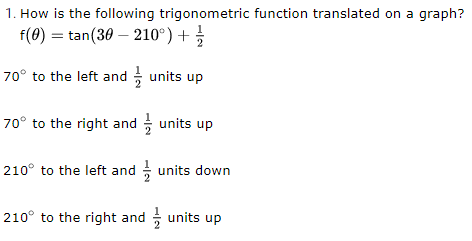
Okay, so since we are adding 1/2, we are shifting 1/2 units up. Now for the second part. \[f(\theta)=\tan(3\theta-210)+1/2\] \[f(\theta)=\tan(3(\theta-70))+1/2\] So it would be 70 degrees to the left, because we measure angles from the positive x-axis and move counter-clockwise, These are my initial thoughts on this but let me double check before you post anything
darkknight:
What are your thoughts on this @MiraAngel?
MiraAngel:
\(\color{#0cbb34}{\text{Originally Posted by}}\) @darkknight What are your thoughts on this @MiraAngel? \(\color{#0cbb34}{\text{End of Quote}}\) This all looks like it would be correct. But if it is negative 70 it does go to the left? Don't get me wrong, that totally makes sense and that's what I would put too. I just think I that I saw somewhere that if it's a negative it goes to the right. I can check rq. But other than that it all looks great! I really appreciate ur help!
darkknight:
np, so we have \[\theta-70\] inside the parenthesis right? For example when we have the graph of 2(x) and 2(x-3), remember that in the parenthesis everything is reversed, For example the graph of 2(x-3) is the graph of 2(x) but 3 units to the right not the left even though we are subtracting Now back to \[\theta-70\] when we substitute an angle measure for \[\theta\] we subtract that value by 70, Does this make any sense?
MiraAngel:
\(\color{#0cbb34}{\text{Originally Posted by}}\) @darkknight np, so we have \[\theta-70\] inside the parenthesis right? For example when we have the graph of 2(x) and 2(x-3), remember that in the parenthesis everything is reversed, For example the graph of 2(x-3) is the graph of 2(x) but 3 units to the right not the left even though we are subtracting Now back to \[\theta-70\] when we substitute an angle measure for \[\theta\] we subtract that value by 70, Does this make any sense? \(\color{#0cbb34}{\text{End of Quote}}\) Yes! It makes a lot of sense. Thank you so much. That helps a lot. :)
darkknight:
np,
 jimthompson5910:
Here's a visual of why going from f(x) to f(x-3) shifts the curve three units to the right Let's say this is our function curve |dw:1607206322783:dw| Replacing every x with (x-3) will shift the xy axis three units to the left. This is because any given input is three less than what it used to be. Eg: x = 5 is now x-3 = 2.
jimthompson5910:
So this is what happens after we shift the xy axis three units to the left. Keep the function curve fixed in place. |dw:1607206548590:dw| Notice how we get the illusion of the curve shifting 3 units to the right if we were to hold the xy axis in place and rather let the function move instead
jimthompson5910:
Sorry I should relabel the new function |dw:1607206800206:dw|
darkknight:
Ah, thanks for the visual way of explaining it @jimthompson5910 Good Job!
jimthompson5910:
Thanks I appreciate the compliments. Your explanation is really good as well.
Join our real-time social learning platform and learn together with your friends!
VERNEISH:
Two objects are moving along separate linear paths where each path is described by position, d, and time, t.

 Maci:
what are the best stock apps for people who want to start investing?
Maci:
what are the best stock apps for people who want to start investing?
 Twaylor:
genuienly how do i get better self control i keep watcing youtube and theres this
Twaylor:
genuienly how do i get better self control i keep watcing youtube and theres this
 IzzyCookie:
|dw:1792074056138:dw| Uhm, I don't know where to ask this, but I'm in college welding at my community college, and I need help learning vertical welding for
IzzyCookie:
|dw:1792074056138:dw| Uhm, I don't know where to ask this, but I'm in college welding at my community college, and I need help learning vertical welding for

 thehearken:
not sure if this is considered spam, im sorry if it is, but does anyone have tips
thehearken:
not sure if this is considered spam, im sorry if it is, but does anyone have tips