
 simsharrison:
Geometry?
 jimthompson5910:
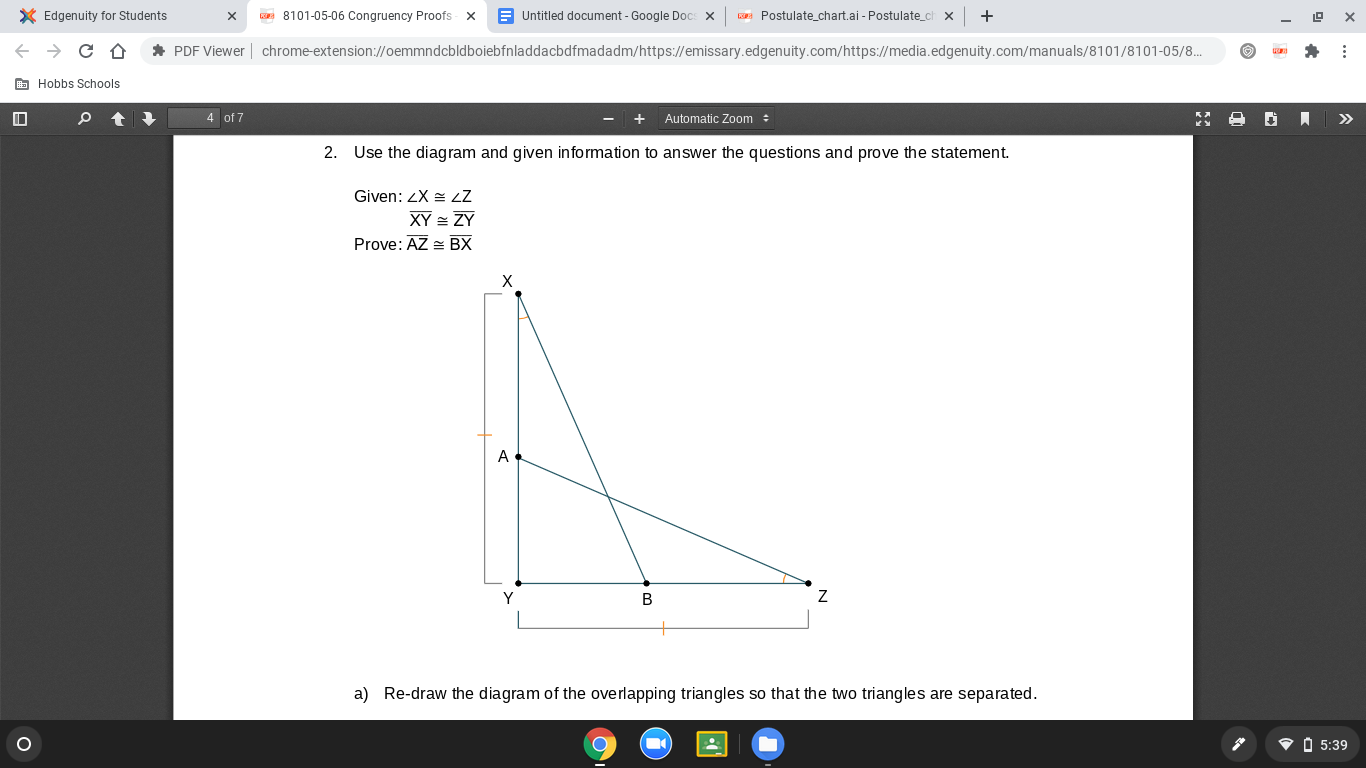
hint: XYZ is the shared overlapping angle between the two triangles
simsharrison:
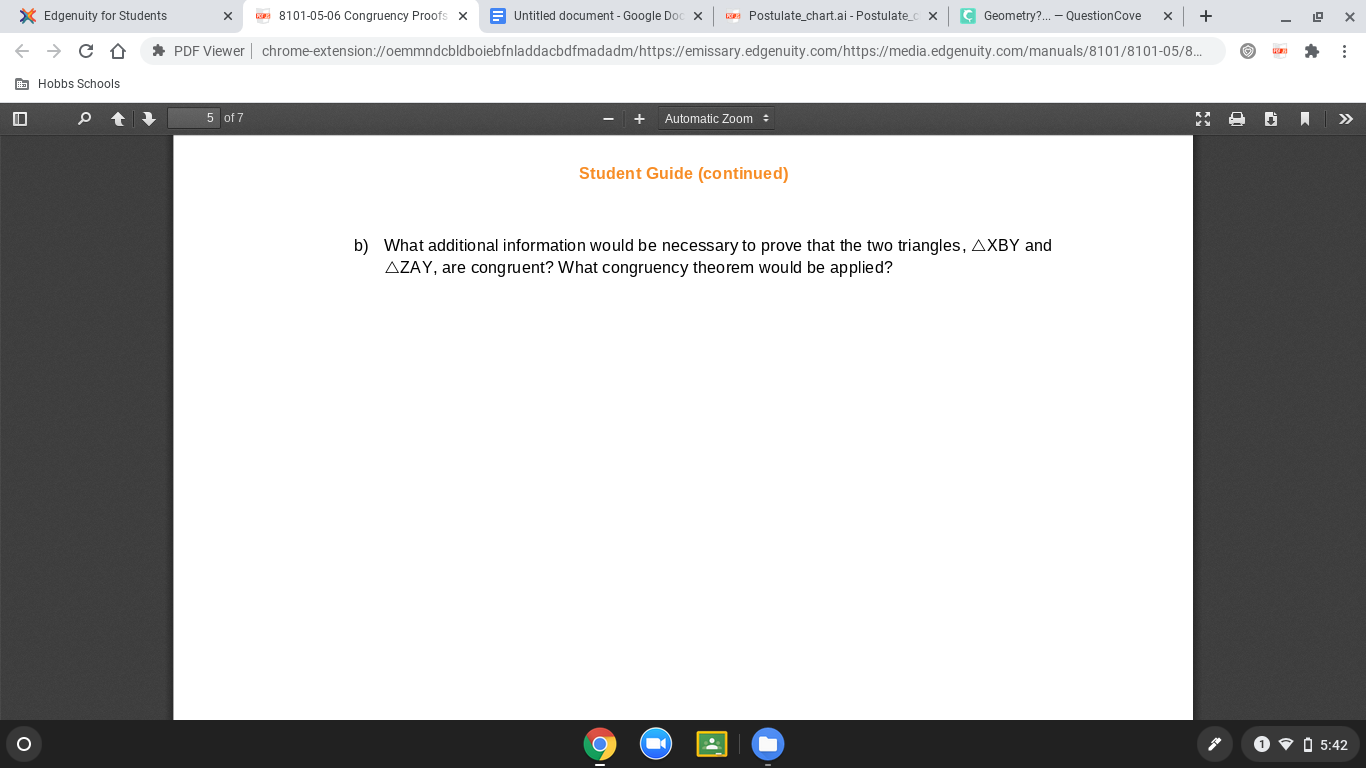
this is what I put in: The congruence theorem would be Side-Angle-Side proving triangle XBY is congruent to triangle ZAY.
simsharrison:
for 2b.
jimthompson5910:
We're already given \( \angle X \cong \angle Z\) and \( \overline{XY} \cong \overline{ZY}\) That takes care of the "A" and "S" respectively As mentioned with the overlapping angles, if we knew that \(\angle XYB \cong \angle ZYA\), then we would have enough information to use ASA.
jimthompson5910:
Once we've proven \(\triangle XBY \cong \triangle ZAY\), we use CPCTC to lead to \(\overline{AZ} \cong \overline{BX}\) CPCTC = corresponding parts of congruent triangles are congruent
simsharrison:
oh its ASA and not SAS?
jimthompson5910:
correct
jimthompson5910:
|dw:1607649552118:dw|
jimthompson5910:
We know angle X is congruent to angle Z |dw:1607649621800:dw| So that's one "A" of ASA
jimthompson5910:
and we know that XY and YZ are the same length That's "S" of ASA |dw:1607649695012:dw|
jimthompson5910:
If we knew that angle XYB = angle ZYA then we have enough for ASA |dw:1607649744356:dw|
jimthompson5910:
note how the marked sides (the sides with the double tickmarks) are between the marked angles |dw:1607649823980:dw| So that tells us we aren't using AAS but instead we use ASA
simsharrison:
ok thank you @jimthompson5910
jimthompson5910:
No problem
simsharrison:
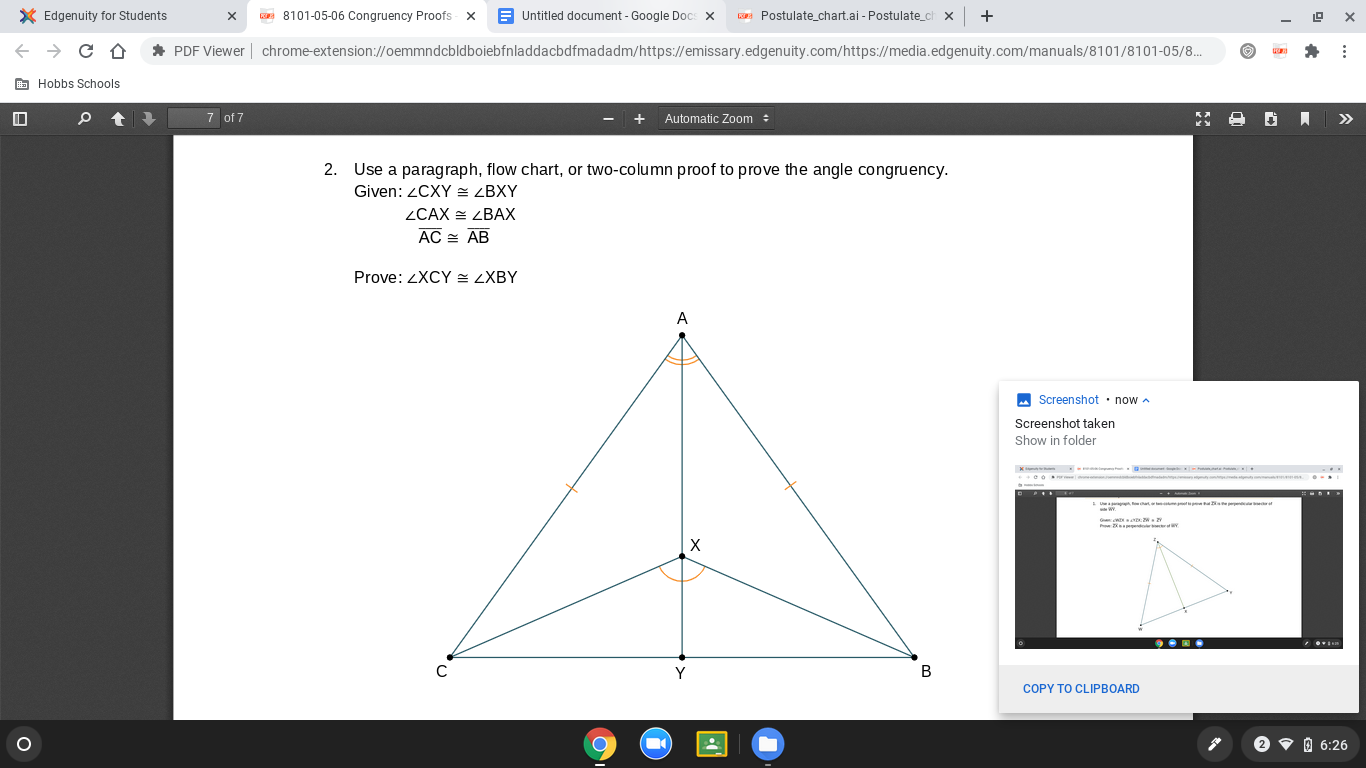
do you have time for 2 more? lol if not that ok.
jimthompson5910:
sure
 jimthompson5910:
how far did you get with problem 1?
simsharrison:
I have only done the given's, I haven't got farther than that I am stuck
jimthompson5910:
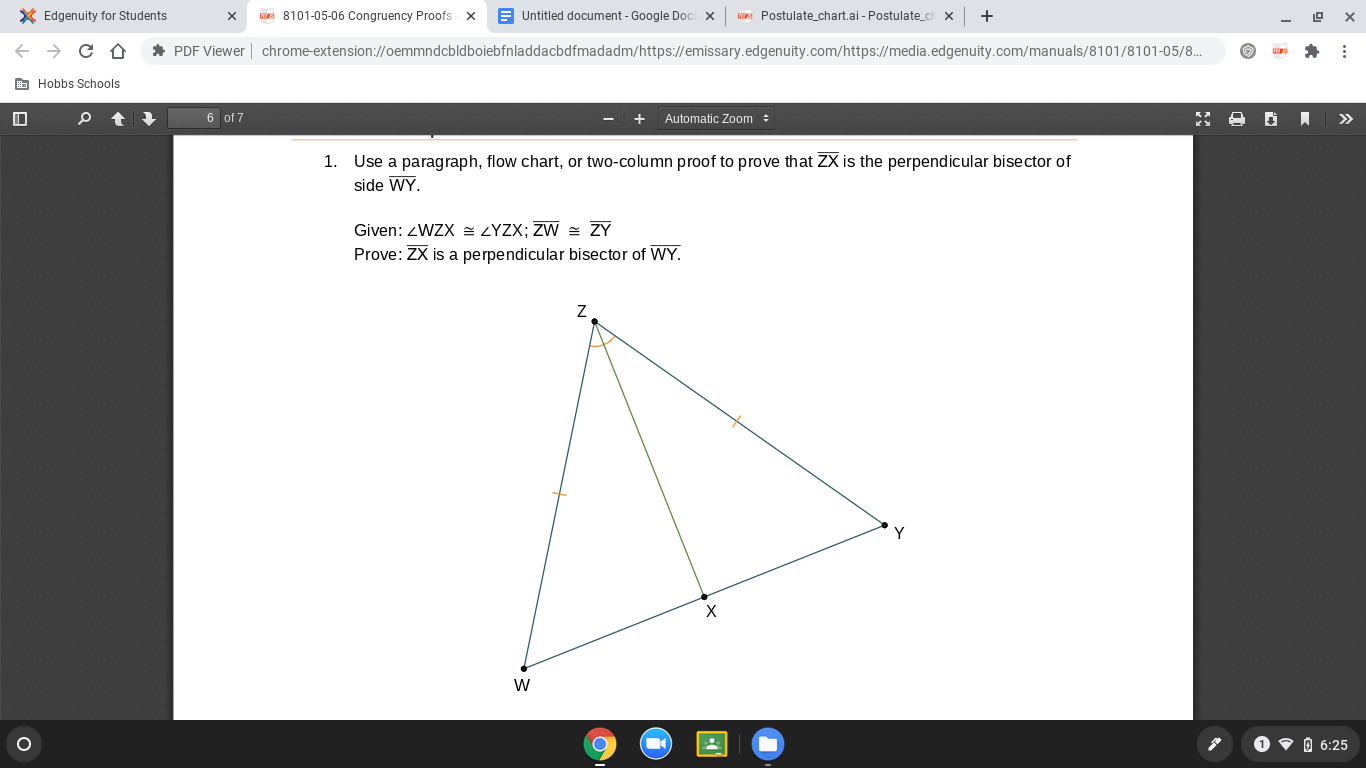
What do you notice about ZX?
simsharrison:
its in the middle but also a bisector. Is that what you mean?
jimthompson5910:
it might help to break up the triangles like so |dw:1607650121667:dw|
jimthompson5910:
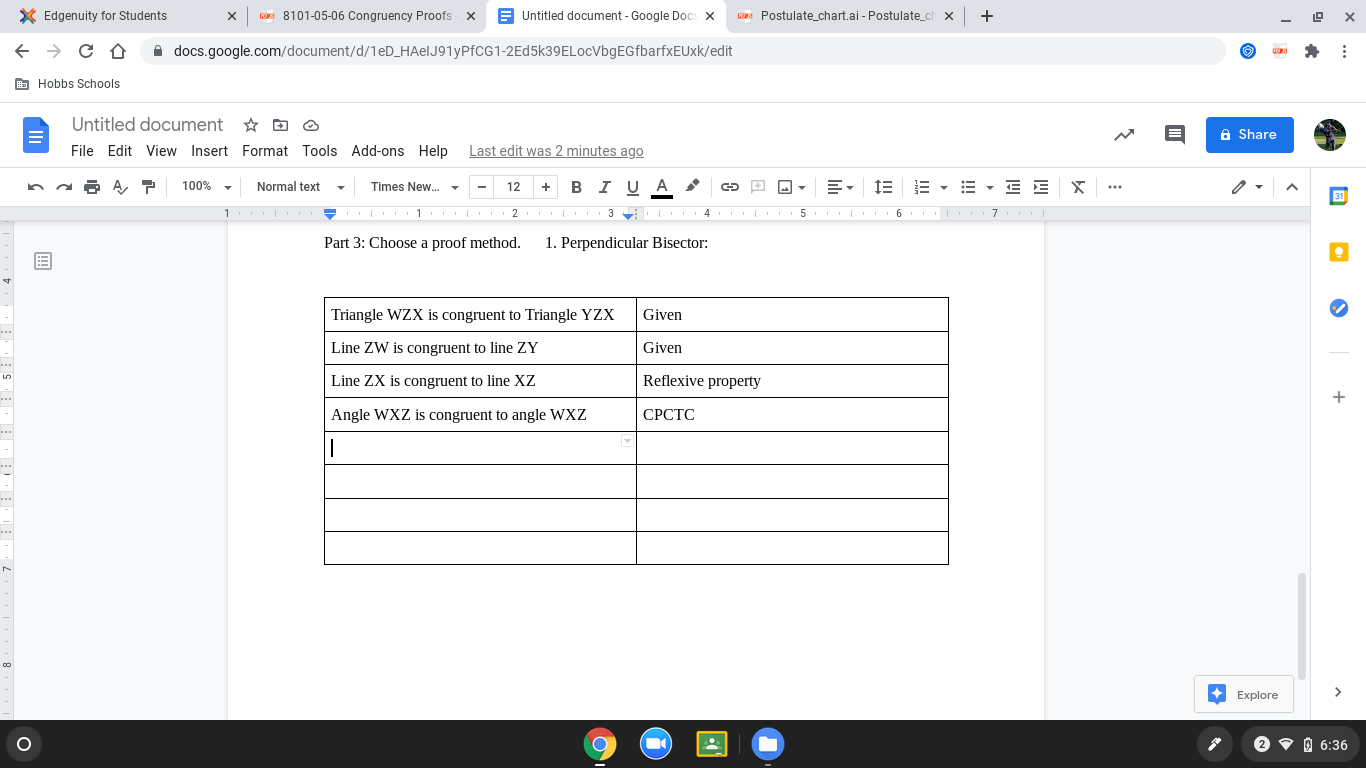
Would you agree that ZX = ZX?
simsharrison:
yes by reflexive prpperty
simsharrison:
property*
jimthompson5910:
yes
jimthompson5910:
|dw:1607650229356:dw|
jimthompson5910:
Do we have enough to prove these triangles congruent?
simsharrison:
yes by SAS
jimthompson5910:
yep
simsharrison:
But that was in the given already that those two trangles are congruent
jimthompson5910:
Then by CPCTC, we know that angle WXZ = angle YXZ |dw:1607650308530:dw|
jimthompson5910:
but those angles I just marked also add up to 180 since angle WXY of the original drawing is a straight angle let p = measure of angle WXZ = measure of angle YXZ You need to solve p+p = 180
simsharrison:
by triangle sum theorem
jimthompson5910:
what do you get when you solve for p in the equation p+p = 180
simsharrison:
ill be honest idk im lost...
jimthompson5910:
p+p turns into 2p, correct?
simsharrison:
oh.. yes sorry
jimthompson5910:
so if 2p = 180, then p = ??
 simsharrison:
p = 90
simsharrison:
oh so right angle
jimthompson5910:
that takes care of the "perpendicular" part
jimthompson5910:
to prove the "bisector" part, you need to show that WX = XY
jimthompson5910:
since "bisect" means "cut in half" or "cut into two smaller equal pieces"
simsharrison:
yes, sorry I went afk but im back
jimthompson5910:
its ok
jimthompson5910:
so how can you show that WX = XY ?
simsharrison:
transitive?
jimthompson5910:
go back to this drawing |dw:1607655359247:dw|
jimthompson5910:
We've proven the triangles to be congruent, so we know that the corresponding pieces WX and XY are the same length |dw:1607655379463:dw|
jimthompson5910:
Because WX = XY, this means segment ZX bisects (cuts in half) segment WY
simsharrison:
oh by the HL theorem
jimthompson5910:
no we proved the triangles congruent by SAS
simsharrison:
yes but isnt the last proof HL
simsharrison:
the bisector one
jimthompson5910:
you only use HL if you know the triangles are right triangles But we already proved them to be congruent using SAS. So using HL is unnecessary
simsharrison:
ok thank you
simsharrison:
that is all I needed, I went ahead and did the other one, thank you so much for your help
jimthompson5910:
You're welcome
Join our real-time social learning platform and learn together with your friends!
VERNEISH:
Two objects are moving along separate linear paths where each path is described by position, d, and time, t.

 Maci:
what are the best stock apps for people who want to start investing?
Maci:
what are the best stock apps for people who want to start investing?
 Twaylor:
genuienly how do i get better self control i keep watcing youtube and theres this
Twaylor:
genuienly how do i get better self control i keep watcing youtube and theres this
 IzzyCookie:
|dw:1792074056138:dw| Uhm, I don't know where to ask this, but I'm in college welding at my community college, and I need help learning vertical welding for
IzzyCookie:
|dw:1792074056138:dw| Uhm, I don't know where to ask this, but I'm in college welding at my community college, and I need help learning vertical welding for

 thehearken:
not sure if this is considered spam, im sorry if it is, but does anyone have tips
thehearken:
not sure if this is considered spam, im sorry if it is, but does anyone have tips