
 bri05:
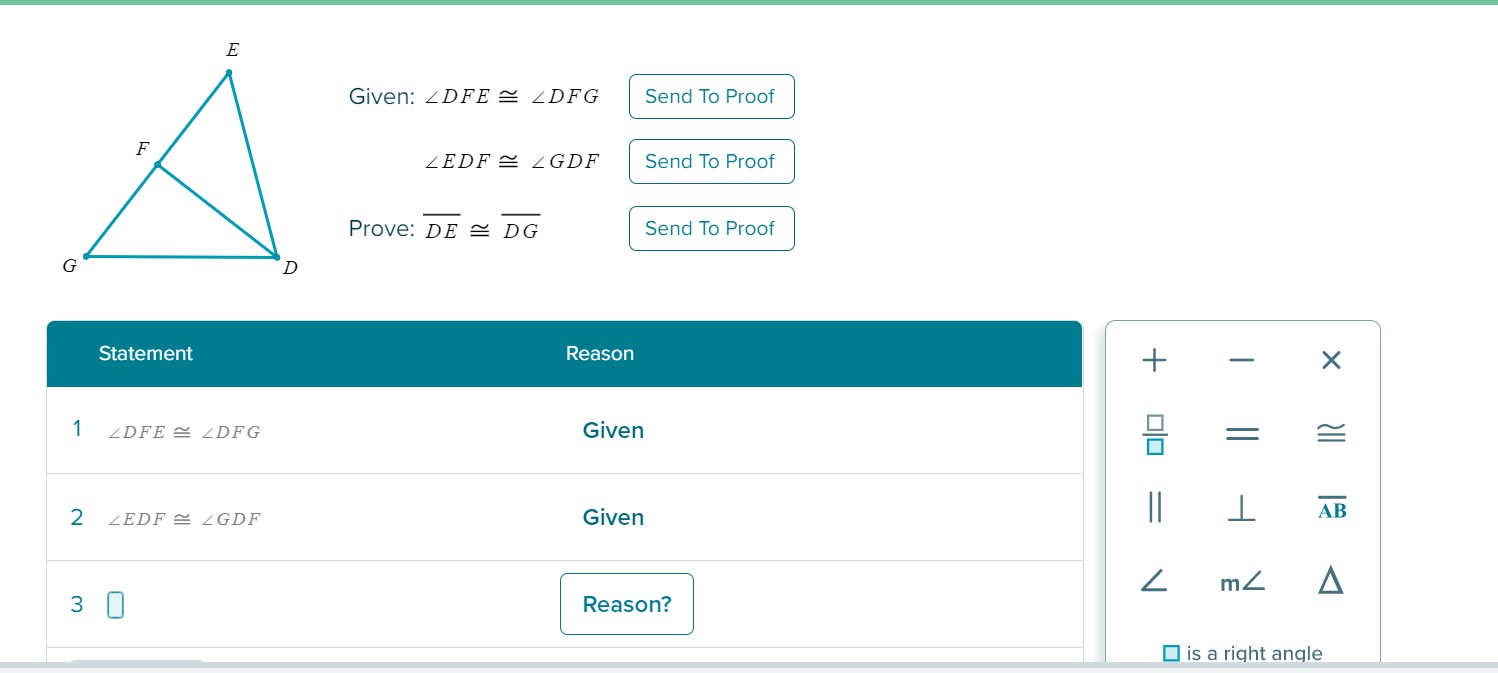
how do u do this
 Angle:
Have you learned about the Triangle Congruence Postulates? For example: ASA, AAS, SAS, SSS ?
bri05:
mhm i have
Angle:
Cool, our goal is to use one of those to be able to say that the two triangles are congruent. after we say that the triangles are congruent, then we can use CPCTC to say that the two sides that we want are also congruent
Angle:
^ this is just our game plan / outline of what we want to do
bri05:
i- ahhhh ok
Angle:
are you confused? I know I just used a lot of words there lol
bri05:
i just dont get triangles and proofs, and most of my hw is triangles
Angle:
yeah I know, this entire geometry unit is just that - you're gonna spent a lot of your school year on this
Angle:
ok so since we want to use one of these : ASA, AAS, SAS, SSS Tell me what information do we have so far? Do we have an Angle, a Side? Two angles? three sides? What do we know are congruent already?
bri05:
ahh ok uhhhhhh ok
bri05:
theres 4 sides but no angles
Angle:
whoops, not what I meant I'll rephrase: What information is GIVEN to us? Are they telling us about angles or sides (in the Given information)
bri05:
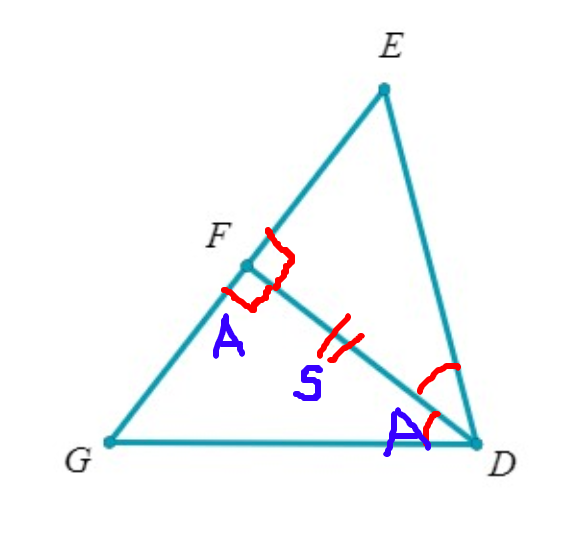
ummm it says that angle DFE is congruent to angle DFG
bri05:
and then the other given it says angel EDF is congruent to angle GDF
Angle:
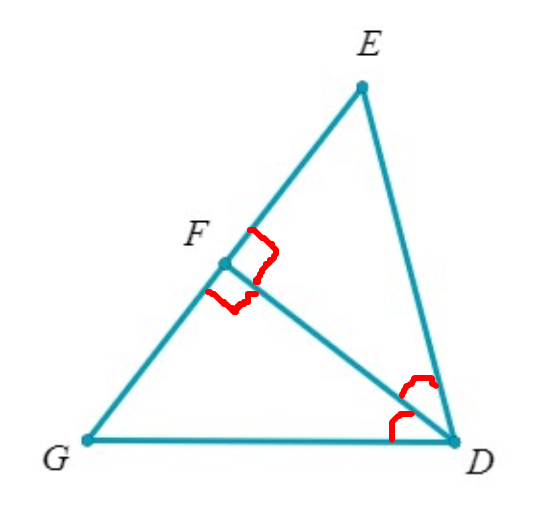
Perfect! So we know that TWO pairs of angles are already congruent. Which of the triangle congruence postulates can use two pairs of angles? ASA, AAS, SAS, SSS (aka, which of those combinations have to As in them?)
Angle:
*have TWO As in them
bri05:
there are no angles tho
 bri05:
ohhhhh
Angle:
you have to use what they told you to mark the angles yourself
Angle:
now tell me: which postulate should we use? ASA, AAS, SAS, SSS Which of these combinations has TWO As?
bri05:
would it be asa?
Angle:
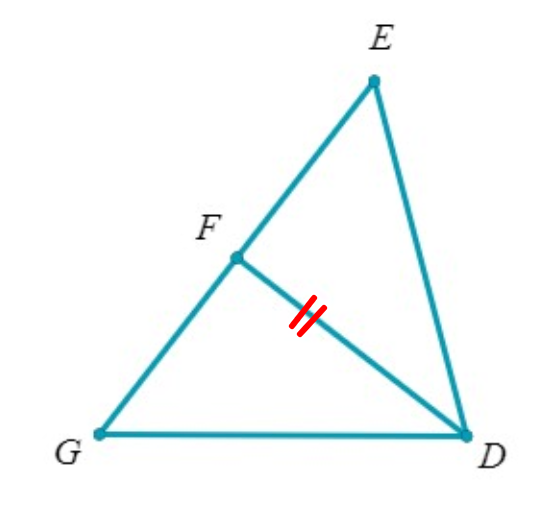
good good! ASA or AAS both have two As which means that either way, we want to name another pair of SIDES that are congruent in order to use ASA OR AAS what is a side that could potentially be equal to another side in your picture?
bri05:
what do u mean?
 bri05:
\(\color{#0cbb34}{\text{Originally Posted by}}\) @Angle Why would the side DF be equal to the side DF? \(\color{#0cbb34}{\text{End of Quote}}\) cuz they are reflected angles?
 jimthompson5910:
Be careful to note that ASA and AAS depend on the order With ASA, the sides are between the angles With AAS, the sides are not between the angles So they're slightly different ideas
Angle:
close @bri05 there is a reflection going on, but I was just talking about SIDE DF being equal to SIDE DF, why did you include angles in your answer?
bri05:
what not i didnt im lost againnnnn
Angle:
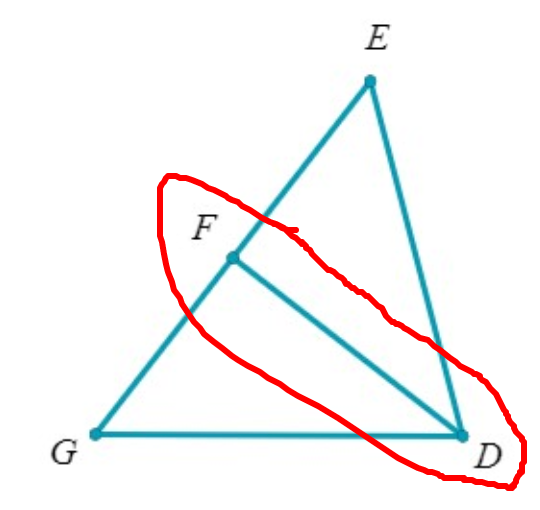
\(\color{#0cbb34}{\text{Originally Posted by}}\) @bri05 \(\color{#0cbb34}{\text{Originally Posted by}}\) @Angle Why would the side DF be equal to the side DF? \(\color{#0cbb34}{\text{End of Quote}}\) cuz they are reflected angles? \(\color{#0cbb34}{\text{End of Quote}}\) Side DF = Side DF because of the Reflexive Property of Equality
bri05:
yeah anddd im lost now
 Angle:
This line segment I just circled is called SIDE DF I am saying that Side DF is equal to Side DF
bri05:
ohhhhhhh ok
 bri05:
ohhh so its asa
Angle:
awesome! So just a recap of what we have figured out so far: DF = DF because of the Reflexive Property And triangle DFG = triangle DFE because of ASA
bri05:
\(\color{#0cbb34}{\text{Originally Posted by}}\) @Angle awesome! So just a recap of what we have figured out so far: DF = DF because of the Reflexive Property And triangle DFG = triangle DFE because of ASA \(\color{#0cbb34}{\text{End of Quote}}\) I got lost on that bottom part
Angle:
\(\color{#0cbb34}{\text{Originally Posted by}}\) bri05 ohhh so its asa \(\color{#0cbb34}{\text{End of Quote}}\) You just said that we can use ASA
Angle:
ASA says that the triangles are congruent
bri05:
ohhh ok i think i get it
Angle:
Ok then What does CPCTC mean?
bri05:
ummmmm i dont know
Angle:
Have you heard of: Corresponding Parts of Congruent Triangles are Congruent ?
bri05:
ohhhhhh mhm i have
bri05:
i just dont get what it means
Angle:
It means that: If we know that two triangles are congruent. Then we know that all of the corresponding angles and corresponding sides are also congruent.
bri05:
\(\color{#0cbb34}{\text{Originally Posted by}}\) @Angle It means that: If we know that two triangles are congruent. Then we know that all of the corresponding angles and corresponding sides are also congruent. \(\color{#0cbb34}{\text{End of Quote}}\) ohhh ok
Angle:
Alright, Are the sides DE and DG corresponding sides?
bri05:
mhm they are
jimthompson5910:
Imagine 2 houses that are identical. If that's the case, then the two front doors are the same houses = triangles front doors = piece of the triangle That's one possible analogy to think of to help remember how CPCTC works
Angle:
Are the two triangles DFE and DFG congruent triangles?
bri05:
\(\color{#0cbb34}{\text{Originally Posted by}}\) @jimthompson5910 Imagine 2 houses that are identical. If that's the case, then the two front doors are the same houses = triangles front doors = piece of the triangle That's one possible analogy to think of to help remember how CPCTC works \(\color{#0cbb34}{\text{End of Quote}}\) i- u got me more confused dude
bri05:
\(\color{#0cbb34}{\text{Originally Posted by}}\) @Angle Are the two triangles DFE and DFG congruent triangles? \(\color{#0cbb34}{\text{End of Quote}}\) mhm they are
jimthompson5910:
Sorry ignore my comment
Angle:
Then we are allowed to use CPCTC this means that DE = DG because of CPCTC
bri05:
ohhhhhhh so does that mean triangles DFE and DG are equal cuz of CPCTC
Angle:
NONO the triangles were equal because of ASA
bri05:
WHATTTTT
Angle:
ASA means: If we have a pair of Angles, a pair of Sides, and another pair of Angles that are all equal Then the two triangles are congruent
bri05:
ok i get that
Angle:
so recap: DF = DF because reflexive property Triangle DFE = triangle DFG because ASA DE = DG because CPCTC
Join our real-time social learning platform and learn together with your friends!
VERNEISH:
Two objects are moving along separate linear paths where each path is described by position, d, and time, t.

 Maci:
what are the best stock apps for people who want to start investing?
Maci:
what are the best stock apps for people who want to start investing?
 Twaylor:
genuienly how do i get better self control i keep watcing youtube and theres this
Twaylor:
genuienly how do i get better self control i keep watcing youtube and theres this
 IzzyCookie:
|dw:1792074056138:dw| Uhm, I don't know where to ask this, but I'm in college welding at my community college, and I need help learning vertical welding for
IzzyCookie:
|dw:1792074056138:dw| Uhm, I don't know where to ask this, but I'm in college welding at my community college, and I need help learning vertical welding for

 thehearken:
not sure if this is considered spam, im sorry if it is, but does anyone have tips
thehearken:
not sure if this is considered spam, im sorry if it is, but does anyone have tips