
 snowflake0531:
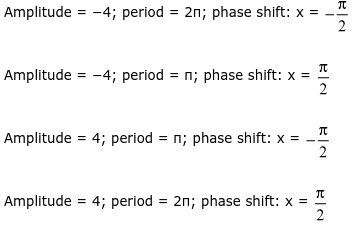
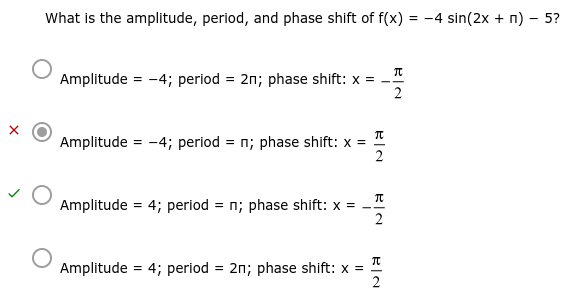
What is the amplitude, period, and phase shift of f(x) = −4 sin(2x + π) − 5?
 darkknight:
amplitude is the number in front, aka 4 the period is how much time it takes for one revolution, u can graph this if u wanna, the phase shift is i think how much up and down? that would be how much you shift the function up and down
darkknight:
@AZ ? i cant really think rn
snowflake0531:
well i just know it's either the first or second too
darkknight:
forgot the negative, my bad for the amplitude but pretty sure amplitude always positive
darkknight:
yea im being dumb phase shift isnt up or down, wait for AZ
snowflake0531:
lol
 AZ:
AZ:
y = A sin(B(x + C)) + D A is our amplitude \(\text{period} = \dfrac{2\pi}{B}\) phase shift is C. If it's +C then it's going to the left. If it's -C then it's going to the right D is our vertical shift
snowflake0531:
So which one is it, like, how is the period and phase shift determined then
snowflake0531:
okay then soooo, explain how to do it please?
AZ:
y = A sin(B(x + C)) + D is what I had written The equation they gave you is like this \( y = A \sin(Bx + BC) + D\) \(f(x) = -4(\sin(2x + \pi)) - 5\) So first, let's factor out the 2 from \(2x + \pi\) so we can find the phase shift and period
darkknight:
hmm but amplitude is how far from the center, |dw:1614108934807:dw| sorry if im being dumb xD
snowflake0531:
so.... AZ how do i figure out phase shift and period
snowflake0531:
can i guess the second one
AZ:
I think you're right, darkknight. Amplitude should be the positive value regardless :)
snowflake0531:
okay, i kinda need to turn this in soon, could you please explainnnnnnn what the answer is pleaseee
 XioGonz:
f(x) = A sin (B(x + C)) + D f(x) = -4 sin (2x + π) - 5 then take 2 from (2x + π) f(x) = -4 sin 2(x + π/2) - 5 A = 4 , B = 2 C = π/2 D = -5 A = the amplitude Amplitude = -4 Period = 2π/B The period = 2π/2 = π C is the phase shift The phase shift π/2 to the left Amplitude = -4 period = π phase shift: x = π/2 SO Amplitude = -4; period = π; phase shift: x = π/2 is your answer
XioGonz:
LOL I had forgotten to post
AZ:
\(\color{#0cbb34}{\text{Originally Posted by}}\) @snowflake0531 so.... AZ how do i figure out phase shift and period \(\color{#0cbb34}{\text{End of Quote}}\) So we have \(2x + \pi\) Let's factor out 2, what do we get? \( 2(x + \dfrac{\pi}{2})\)
AZ:
Now your original equation was \( f(x) = -4(\sin(2x + \pi)) - 5\) We factored out the 2 so we have \( f(x) = -4(\sin(2(x + \dfrac{\pi}{2})) - 5\) So now it's in the same form as this \(\color{#0cbb34}{\text{Originally Posted by}}\) @AZ y = A sin(B(x + C)) + D A is our amplitude \(\text{period} = \dfrac{2\pi}{B}\) phase shift is C. If it's +C then it's going to the left. If it's -C then it's going to the right D is our vertical shift \(\color{#0cbb34}{\text{End of Quote}}\)
AZ:
What is the phase shift of \( f(x) = -4(\sin(2(x + \dfrac{\pi}{2})) - 5\)
snowflake0531:
thank you xiogonz and i guess it would be x/2, AZ
XioGonz:
Np
AZ:
It's \(\Large\pi\) not x haha
 darkknight:
\(\color{#0cbb34}{\text{Originally Posted by}}\) @AZ What is the phase shift of \( f(x) = -4(\sin(2(x + \dfrac{\pi}{2})) - 5\) \(\color{#0cbb34}{\text{End of Quote}}\) when you do something like sin(x+1) that ^^^ actually shifts 1 to the left
darkknight:
in that context, if you shift +pi/2 it wouldnt shift to the right, so that is not the phase shift
AZ:
The font size, even in your question, is pretty small so the period looks like it's listed as x but it's \(\pi\)
snowflake0531:
ye lol
AZ:
looks like an n* but it's actually \(\pi\)
darkknight:
oh breh, amplitude always positive, also \(\color{#0cbb34}{\text{Originally Posted by}}\) @darkknight \(\color{#0cbb34}{\text{Originally Posted by}}\) @AZ What is the phase shift of \( f(x) = -4(\sin(2(x + \dfrac{\pi}{2})) - 5\) \(\color{#0cbb34}{\text{End of Quote}}\) when you do something like sin(x+1) that ^^^ actually shifts 1 to the left \(\color{#0cbb34}{\text{End of Quote}}\) \(\color{#0cbb34}{\text{Originally Posted by}}\) @darkknight in that context, if you shift +pi/2 it wouldnt shift to the right, so that is not the phase shift \(\color{#0cbb34}{\text{End of Quote}}\)
snowflake0531:
---welp
AZ:
Yes, since it's shifting to the left it's going to be negative
AZ:
and amplitude is always positive
darkknight:
@snowflake0531
snowflake0531:
i think i forgot how to do these things again o-O
snowflake0531:
at least i still have my notes 😔
Join our real-time social learning platform and learn together with your friends!
 VERNEISH:
Two objects are moving along separate linear paths where each path is described by position, d, and time, t.
VERNEISH:
Two objects are moving along separate linear paths where each path is described by position, d, and time, t.

 Maci:
what are the best stock apps for people who want to start investing?
Maci:
what are the best stock apps for people who want to start investing?
 Twaylor:
genuienly how do i get better self control i keep watcing youtube and theres this
Twaylor:
genuienly how do i get better self control i keep watcing youtube and theres this
 IzzyCookie:
|dw:1792074056138:dw| Uhm, I don't know where to ask this, but I'm in college welding at my community college, and I need help learning vertical welding for
IzzyCookie:
|dw:1792074056138:dw| Uhm, I don't know where to ask this, but I'm in college welding at my community college, and I need help learning vertical welding for

 thehearken:
not sure if this is considered spam, im sorry if it is, but does anyone have tips
thehearken:
not sure if this is considered spam, im sorry if it is, but does anyone have tips