
 gokrazy223:
If ABCD is dilated by a scale factor of 2 about point E, which of the following is true about line E prime F prime? Square ABCD is shown with line EF running horizontally through the center of the figure. line E prime F prime is perpendicular to line EF. line E prime F prime is parallel to line EF. line E prime F prime intersects with point B′. line E prime F prime passes through the center of dilation.
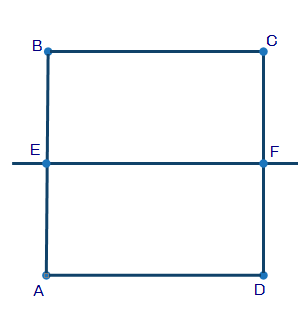 gokrazy223:
what about this one
gokrazy223:
@az
 AZ:
AZ:
For this question, you have to know dilation means. Just like in your previous question- when we dilate a shape, you're keeping all the sides proportional and the angles will stay the same. The shape won't be rotating either
gokrazy223:
everything will stay the same?
AZ:
The sides will get bigger or they could get smaller depending on our scale factor. In this case, it's 2 so the new figure will be bigger
gokrazy223:
im listening
AZ:
But the sides still point in the same way so like|dw:1614193633849:dw|
AZ:
when you dilate, it's not going to change the way the shape is |dw:1614193664444:dw|
AZ:
do you see how the square got rotated
gokrazy223:
yes
AZ:
that's a rotation AND a dilation but this question, we only have a dilation
gokrazy223:
so it would pass through the center of dilation
AZ:
So going back to your question, let's say this is our original image |dw:1614193745106:dw|
AZ:
What happens when you dilate the rectangle, won't we get something like this: |dw:1614193818225:dw|
AZ:
(not drawn perfectly but you should get the rough idea)
gokrazy223:
yes i get it
AZ:
oh wait
gokrazy223:
what happen
AZ:
We're dilating, yes, but we're doing it at point E so that means all the other points will become bigger but point E is fixed
gokrazy223:
what all would stay the same
AZ:
Sorry I typed up something but it just would let me post it so I had to refresh the page
AZ:
|dw:1614194406019:dw| So what is the relationship between E'F' which is that new black line and the old EF (in red) are they parallel? perpendicular? Does E'F' go through point B'? or does it pass through the center of dilation
AZ:
remember parallel lines do NOT intersect perpendicular lines intersect at a 90 degree angle
gokrazy223:
it pass through the center of dilation
AZ:
Bingo!
gokrazy223:
yessss
gokrazy223:
i have to more then im done
Join our real-time social learning platform and learn together with your friends!
VERNEISH:
Two objects are moving along separate linear paths where each path is described by position, d, and time, t.

 Maci:
what are the best stock apps for people who want to start investing?
Maci:
what are the best stock apps for people who want to start investing?
 Twaylor:
genuienly how do i get better self control i keep watcing youtube and theres this
Twaylor:
genuienly how do i get better self control i keep watcing youtube and theres this
 IzzyCookie:
|dw:1792074056138:dw| Uhm, I don't know where to ask this, but I'm in college welding at my community college, and I need help learning vertical welding for
IzzyCookie:
|dw:1792074056138:dw| Uhm, I don't know where to ask this, but I'm in college welding at my community college, and I need help learning vertical welding for

 thehearken:
not sure if this is considered spam, im sorry if it is, but does anyone have tips
thehearken:
not sure if this is considered spam, im sorry if it is, but does anyone have tips