
 datgirltayy0904:
In two or more complete sentences, compare the number of x-intercepts in the graph of f(x) = x2 to the number of x-intercepts in the graph of g(x) = x2 -7. Be sure to include the transformations that occurred between the parent function f(x) and its image g(x).
 snowflake0531:
do you know the fundamental theorem of algebra?
snowflake0531:
bc that theorem says "The fundamental theorem of algebra tells us that this nth-degree polynomial is going to have n exactly n roots, or another way to think about it, there are going to be exactly n values for x, which will make this polynomial, make this expression on the right, be equal to zero." google
snowflake0531:
x^2 and x^2 -7 will have the same number of x intercepts/roots, bc they both have a power of 2
snowflake0531:
the transformation is that from x^2, move down 7 units, to get x^2-7
 Angle:
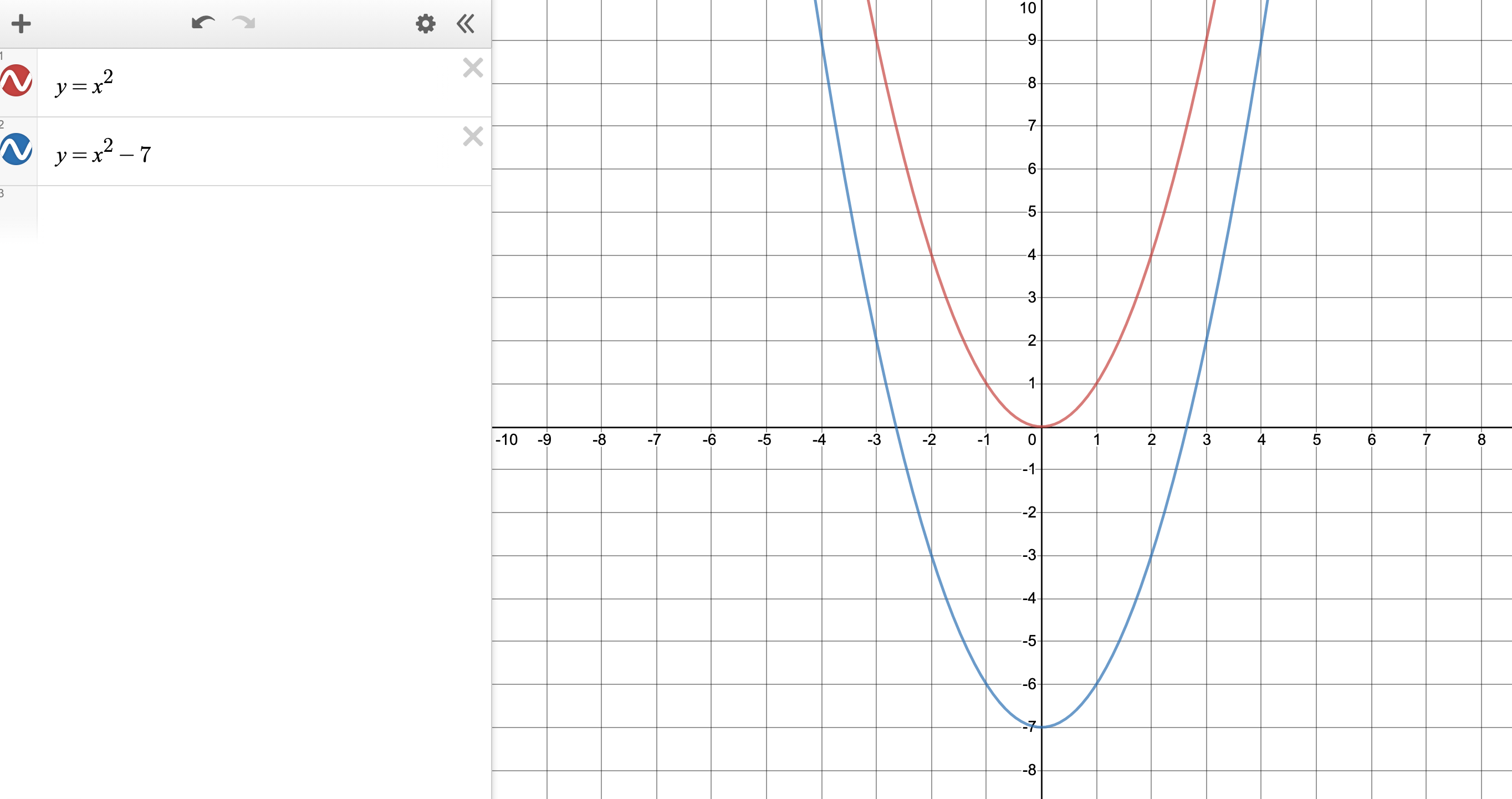
snowflake has overcomplicated this problem You do not need to know about the "fundamental theorem of algebra" in order to be able to do this problem. Yes, it is the behind-the-scenes reasons why you will get the correct answer. but there are easier ways to explain this. Firstly, here is a screenshot from desmos of both equations graphed. We can see that the x^2 equation touches the x-axis 1 time. We can see that the x^2 - 7 equation touches the x-axis 2 times.
 Angle:
Here is a general formula / format for how transformations for parabolas work: a ( x - h )^2 + k where "a" is a stretch or shrink h is how far right or left it moves and k is how far up or down it moves we can see in x^2 - 7 that it moves down 7 compared to x^2
snowflake0531:
\(\color{#0cbb34}{\text{Originally Posted by}}\) @Angle snowflake has overcomplicated this problem You do not need to know about the "fundamental theorem of algebra" in order to be able to do this problem. Yes, it is the behind-the-scenes reasons why you will get the correct answer. but there are easier ways to explain this. Firstly, here is a screenshot from desmos of both equations graphed. We can see that the x^2 equation touches the x-axis 1 time. We can see that the x^2 - 7 equation touches the x-axis 2 times. \(\color{#0cbb34}{\text{End of Quote}}\) but the person should know it, or else what if there is a different equation? s/he wont' know it then
Angle:
You need to understand that for these types of algebra problems, there are certain things that they have not learned yet and trying to teach them out of the blue is just going to confuse them more. But also, although x^2 does have two roots, technically, because of the fundamental theorem of algebra - you would have dragged the person towards an incorrect answer because x^2 only has 1 x-intercept
snowflake0531:
but everyone learns the fundamental theorem of algebra at some point of their math life.......... you can go tell the school people not to teach it then.....
Angle:
That's not what I'm saying. Yes, people will eventually learn the fundamental theorem of algebra. However, this person's question is phrased in a way that suggests that 1. this person has not yet learned the fundamental theorem YET 2. they will be able to use parent functions and transformations to get the correct answer
snowflake0531:
\(\color{#0cbb34}{\text{Originally Posted by}}\) @Angle That's not what I'm saying. Yes, people will eventually learn the fundamental theorem of algebra. However, this person's question is phrased in a way that suggests that 1. this person has not yet learned the fundamental theorem YET 2. they will be able to use parent functions and transformations to get the correct answer \(\color{#0cbb34}{\text{End of Quote}}\) Well, it's fun and good to learn things before it gets taught in school, it's easier to remember and memorize adn know forever
Angle:
Ok, so it's fun and good to learn things before it gets taught. But the purpose of someone asking a question on questioncove, especially on a question like this is not for that explicit purpose. We need to respect that they are currently learning a particular topic and we should try to help them on that particular topic. The particular topic this student is learning about is not the fundamental theorem of algebra.
snowflake0531:
\(\color{#0cbb34}{\text{Originally Posted by}}\) @Angle Ok, so it's fun and good to learn things before it gets taught. But the purpose of someone asking a question on questioncove, especially on a question like this is not for that explicit purpose. We need to respect that they are currently learning a particular topic and we should try to help them on that particular topic. The particular topic this student is learning about is not the fundamental theorem of algebra. \(\color{#0cbb34}{\text{End of Quote}}\) but it could be used. also, since it looks like the person's doing algebra anyways, so they're going to learn it this year anyway-
Join our real-time social learning platform and learn together with your friends!
VERNEISH:
Two objects are moving along separate linear paths where each path is described by position, d, and time, t.

 Maci:
what are the best stock apps for people who want to start investing?
Maci:
what are the best stock apps for people who want to start investing?
 Twaylor:
genuienly how do i get better self control i keep watcing youtube and theres this
Twaylor:
genuienly how do i get better self control i keep watcing youtube and theres this
 IzzyCookie:
|dw:1792074056138:dw| Uhm, I don't know where to ask this, but I'm in college welding at my community college, and I need help learning vertical welding for
IzzyCookie:
|dw:1792074056138:dw| Uhm, I don't know where to ask this, but I'm in college welding at my community college, and I need help learning vertical welding for

 thehearken:
not sure if this is considered spam, im sorry if it is, but does anyone have tips
thehearken:
not sure if this is considered spam, im sorry if it is, but does anyone have tips