
 Seafoam:
North American cities tend to differ from European cities in that European cities tend to have taller buildings than North American cities European cities are more spread out than North American cities European cities have more ethnic neighborhoods than North American cities European cities have more middle-class workers living closer to the city center than North American cities European cities are more auto-centric, whereas North American cities are more pedestrian orientated
Seafoam:
@AZ
Seafoam:
Did I already ask this?
Seafoam:
Im pretty sure I did
Seafoam:
But I'm just checking
 AZ:
AZ:
we had a similar question I think but not the exact one
Seafoam:
Oh really ok
Seafoam:
I chose European cities have more middle-class workers living closer to the city center than North American cities
AZ:
so what do you think it is? Remember that Europe is small compared to America They also really value their old architecture so it's not like they're destroying it to build new tall buildings. America was land found recently so we could build whatever on it
AZ:
yeah that's the only one that makes sense because I eliminated everything else
Seafoam:
Ok brilliant
Seafoam:
According to the concentric zone model, which of the following takes place? People first migrate to the center of a city and then migrate outward. The placement of transportation lines divides socioeconomic groups. Residential neighborhoods go through a cycle of decline and renewal. Squatter settlements develop along the periphery of the city. Wealthy neighborhoods cluster near cultural and educational facilities.
Seafoam:
I chose People first migrate to the center of a city and then migrate outward.
AZ:
I just googled for the previous question and our answer is definitely correct https://www.doralacademyprep.org/ourpages/auto/2016/5/12/41400191/Human%20Geo%20Practice%20Exam%20_3_.pdf
Seafoam:
How the heck do you find this stuff??
Seafoam:
Anyway, what do you think of my answer
AZ:
I just searched the question haha xD
Seafoam:
I try doing that and all I get is well nothing
AZ:
so for this question, you can only select one response right?
Seafoam:
Yes
AZ:
I don't know, I'm trying to read about this concentric zone model but none of the answer choices really make much sense
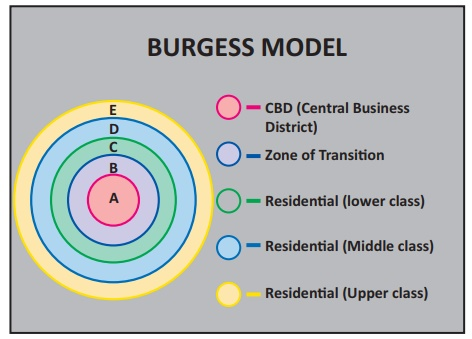 Seafoam:
Social scientists first developed a model to use in the study of urban areas in the 1920s. Designed by American sociologist Ernest Burgess (1886–1966), this concentric zone model relied on the idea that cities expanded in a regular pattern through a series of circular concentric zones, or zones sharing the same center point. Each of these zones has a specific function. Burgess argued that as cities grow, the addition of new rings takes place and causes the existing older rings to change somewhat in character and function. This may be partially attributed to the tendency of arriving populations to settle near the center of a city and then slowly migrate to the outer rings. Burgess also noted that the functions and characteristics of each zone tended to merge somewhat at the edges of each ring. While the precise number and width of rings varies from city to city, the types of rings appear in each city. Learn more about the concentric zone model in the interactive below.
Seafoam:
Thats from my lesson
Seafoam:
Not sure if it helps but there you go
AZ:
ooh okay that makes sense
Seafoam:
his may be partially attributed to the tendency of arriving populations to settle near the center of a city and then slowly migrate to the outer rings.
Seafoam:
This part helps right?
AZ:
I had found this question: According to the concentric zone model, which of the following takes place? -People first migrate to the center of a city and then migrate outward. -The placement of transportation lines divides socioeconomic groups. -Residential neighborhoods go through a cycle of decline and renewal. -Wealthy neighborhoods cluster near cultural and educational facilities. I only III only I and IV II and III I, III, and IV
AZ:
and so like if only answer can be right, it would have to be between 1 and 3 and 1 is the only one that's listed in like choice C and E so your initial answer makes sense haha
Seafoam:
Ok ok only one more!
AZ:
I'm just over here trying to use reverse psychology based on how they write these questions x'D
Seafoam:
In which of the following zones is this family in Jakarta, Indonesia, MOST LIKELY living? The squatter and new suburban zone of the McGee Model The periferico of the Griffin-Ford Model The informal satellite townships of the deBlij Model The low-class residential area of Hoyt's Sector Model The Zone of Transition of the Concentric Zone Model
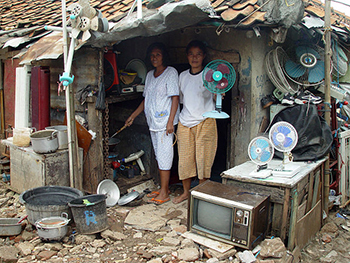 Seafoam:
I chose The low-class residential area of Hoyt's Sector Model
Seafoam:
I searched them all up and it seemed to be the only that fit
AZ:
so for D Low-Class Residential Next to the industrial corridors are the lower- or working-class residential zones. People who live here tend to be factory workers and live in low-income housing. Housing is cheap due to its proximity to industry where pollution, traffic, railroads, and environmental hazards make living conditions poor. Those who live in this sector do so to reduce the cost to commute to work. They are sometimes stereotyped as living on the “other side of the tracks,” and may experience discrimination. https://www.albert.io/blog/hoyt-sector-model-ap-human-geography-crash-course/
AZ:
I don't know, I feel like the image shows worse conditions
AZ:
mhmm check this out, it focuses on Southeast Asia http://what-when-how.com/Tutorial/topic-646k6fs7p/Human-Geography-People-Place-and-Culture-340.html
Seafoam:
Yeah I had just come across that
Seafoam:
Oh!
Seafoam:
Okk I see
Seafoam:
Ok then
Seafoam:
Thats all 20 questions
Seafoam:
Time to see if I failed
AZ:
yeah and squatter settlements seems to match the image better
AZ:
pls pass
Seafoam:
I feel so done with this thing, even if I fail I know I tried really hard
AZ:
we did spend a lot of time!
Seafoam:
I just hope I dont fail so I didn't waste your time
Seafoam:
But thank you a million times for your help
AZ:
no no, that's very nice of you But I enjoy helping others out :)
AZ:
I'm hoping I didn't mislead you on any questions that you would have otherwise gotten it right on your assignment
Seafoam:
OH MY GOD
Seafoam:
ITS A 90
AZ:
PLS SAY 100
AZ:
AYY
AZ:
Do you know which ones you got wrong?
Seafoam:
HEEYY TWO WRONG THANK SOMETHING
Seafoam:
The one about european cities surprisingly, and the one with the rail map
AZ:
Is the European cities the first question on this post?
Seafoam:
Yup that one
Seafoam:
When we were sure it was right though...
AZ:
that's so weird because the link I shared was a scan of the answer from CollegeBoard
Join our real-time social learning platform and learn together with your friends!
 VERNEISH:
Two objects are moving along separate linear paths where each path is described by position, d, and time, t.
VERNEISH:
Two objects are moving along separate linear paths where each path is described by position, d, and time, t.

 Maci:
what are the best stock apps for people who want to start investing?
Maci:
what are the best stock apps for people who want to start investing?
 Twaylor:
genuienly how do i get better self control i keep watcing youtube and theres this
Twaylor:
genuienly how do i get better self control i keep watcing youtube and theres this
 IzzyCookie:
|dw:1792074056138:dw| Uhm, I don't know where to ask this, but I'm in college welding at my community college, and I need help learning vertical welding for
IzzyCookie:
|dw:1792074056138:dw| Uhm, I don't know where to ask this, but I'm in college welding at my community college, and I need help learning vertical welding for

 thehearken:
not sure if this is considered spam, im sorry if it is, but does anyone have tips
thehearken:
not sure if this is considered spam, im sorry if it is, but does anyone have tips