
 jhonyy9:
as the sum of the exponential numbers of the numbers two and three, all prime numbers greater than three can be written ? ex. 2+3=5 , 2^2 +3 = 7 , 2 +3^2 = 11 ,2^2 +3^2 = 13, 2^3 +3^2 = 17 ,2^4 +3 = 19 , 2^2 +2^4 +3 = 23 ,... . how can be this proven ?
 snowflake0531:
@AZ
 simsharrison:
@angle
jhonyy9:
\(\color{#0cbb34}{\text{Originally Posted by}}\) @snowflake0531 @AZ \(\color{#0cbb34}{\text{End of Quote}}\) any idea ? opinions ??? ty.
jhonyy9:
like an idea : 2^n = always an even number 3^n = always an od number 2^n + 3^n = always an od number >= 5
jhonyy9:
or an other idea we know that every primes greater or equal 5 are the form of 6n +/-1 so 2^n +3^n is posibil have always this form of 6n +/-1 ?
jhonyy9:
@AZ any idea here pls. ? or opinion ? ty.
jhonyy9:
\(\color{#0cbb34}{\text{Originally Posted by}}\) @Florisalreadytaken I am kinda confused — not sure what you are asking for; is your question that why every prime number can be writen as the sum of 2 and 3 in exponential form? \(\color{#0cbb34}{\text{End of Quote}}\) ,,why" no not is this my question
jhonyy9:
ok - ty - i know this - but my posted question is how can you prove that every primes greater then 3 can be written like a sum of 2 and 3 exponential numbers ? look on my examples
 MxxnLight:
Is this a question, or are you asking for a opinion?
jhonyy9:
every two
 supie:
@hero
 Angle:
I'm not sure exactly on the approach to this specific problem but I do know of an allegory where any number can be represented in mod 2 because 2^k and 2^0=1 sum combinations can be used to write any number. For example 23 = 2^4 + 2^2 + 2^1 + 2^0 I guess this mod idea can be applied to this question in terms of mod 6 The idea being that you only need combinations of 2 and 3 to make 6 and can therefore make any number mod 6
Angle:
I'm not too good at explaining this thought, sorry
jhonyy9:
ok @Angle so then i understand your words right so you said any numbers has a form of mod6 - true ?
Angle:
exactly every number can be represented as a form of mod 6 0 mod 6 1 mod 6 2 mod 6 3 mod 6 4 mod 6 5 mod 6
Angle:
every form of mod 6 can also be created by adding a combination of 2 mod 6 and 3 mod 6
jhonyy9:
ok but i ve asked about how can you prove that every primes can be expressed like a sum of the exponential numbers of 2 and 3
jhonyy9:
ok primes greater then 3
Angle:
I am also slightly confused about the restrictions on your question you included the example of: 2^2 +2^4 +3 = 23 however, this then becomes a problem where any number can be written as a sum of 2s and 3s 7 = 2^1 + 2^1 + 3^1 unless you mean that we should be limited to representing numbers as only a 2^k term plus a 3^m term
jhonyy9:
,,as the sum of the exponential numbers of the numbers two and three " how many times use the exponential number of 2 or/and 3 not specified
Angle:
perfect, then this problem as been reduced to whether all numbers can be written as a sum of 2s and 3s 2k can be used to represent all of: 0 mod 6 2 mod 6 4 mod 6 3m can be used to represent all of: 3 mod 6 2 mod 6 + 3 mod 6 = 5 mod 6 and 4 mod 6 + 3 mod 6 = 1 mod 6 since every number in mod 10 can be rewritten in mod 6 it is possible to write every possible number as a sum of multiples of 2 mod 6 and 3 mod 6
Angle:
we don't even need exponents if we are not limited by how many terms we can use
jhonyy9:
ok understand your idea - but a proof in this way ?
Angle:
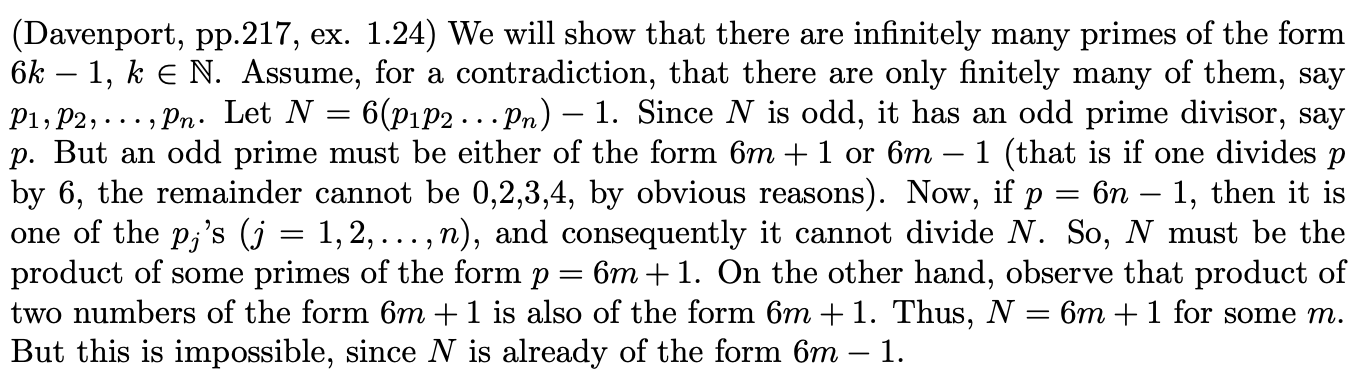
ah my apologies, I misunderstood something along the way: I thought you were asking whether every number can be written in such a way - which is true primes are also included in this "every" but primes specifically can also be written a 1 mod 6 and 5 mod 6 there is a proof of this somewhere, but I forget where I saw it
 Angle:
then we can use what I stated before that 1 mod 6 can be a sum of 4 mod 6 and 3 mod 6 and 5 mod 6 can be a sum of 2 mod 6 and 3 mod 6
jhonyy9:
wwooaahhhwww - ty so much - this above posted - attached proof explain for me so much - and i think i can use it on my more idea about primes - @Angle can i collaborate with you in future in this subject - please !
Angle:
I would be happy to collaborate in the future :) primes are an interesting topic - I'm not too good at them, but I'm glad that the proof I found online was able to help you!
jhonyy9:
ok ty so much - you will see - i have a lot of ideas - new ideas - from the world of primes but till today - till now i havent somebody with /to collaborate - talking about this - idk you was on OS too ? - so sorry i dont remember -
Angle:
I was the moderator called jigglypuff314 when on OpenStudy I just finished getting my bachelors in Mathematics and a masters degree in Education I'm not too fond of primes, but my math classes taught me a lot. I had a great professor while at university who was also from Hungary. https://en.wikipedia.org/wiki/J%C3%B3zsef_Beck He taught me a lot about combinatorics, which I am also not good at, but it was really fun.
jhonyy9:
ohhww really ?
Angle:
yeah, I'm a middle school math teacher now in the US
jhonyy9:
do you see how little is the world ? you ve had a hungarian professor - nice very
Angle:
indeed it is a small world! haha
jhonyy9:
what is interesting that i loved so much the combinatorics in my high school
jhonyy9:
then i remember right to solve a problem of combinatorics you needed 2-3 pages of A4
Angle:
my favorite subject in high school was geometry so representing the intersections of circles and lines was my favorite combinatorics topic
jhonyy9:
ok ty so much all your helps and ideas and you said i can tag write you in future when i like - i have posted questions in this subject of - about primes - yes ?
Angle:
yes :) I do have a job during the day, but I will take a look at your prime questions when I can
jhonyy9:
ok ty so much - hnd - cya
 aquire:
IDK if I am reiterating the same thing that Angle and the OP discussed. But just to be clear I thought of posting here. Plus I'm not super familiar with modular arithmetic. I assume that only positive exponents are allowed. First we can prove that any even number \(\in\mathbb N\) can be represented in \(2n=\sum_{k=1}^{L}a_k2^k\) form where \(a_k\in\{0,1\}\) and some \(L\). Then the rest is easy. Any odd number greater than or equal to 5 can be represented in the form \(2n+3\). If a prime number is greater than 2, then it is odd. So any prime number greater than 3 can be represented as sum of exponents of 2 and 3.
jhonyy9:
Join our real-time social learning platform and learn together with your friends!
 VERNEISH:
Two objects are moving along separate linear paths where each path is described by position, d, and time, t.
VERNEISH:
Two objects are moving along separate linear paths where each path is described by position, d, and time, t.

 Maci:
what are the best stock apps for people who want to start investing?
Maci:
what are the best stock apps for people who want to start investing?
 Twaylor:
genuienly how do i get better self control i keep watcing youtube and theres this
Twaylor:
genuienly how do i get better self control i keep watcing youtube and theres this
 IzzyCookie:
|dw:1792074056138:dw| Uhm, I don't know where to ask this, but I'm in college welding at my community college, and I need help learning vertical welding for
IzzyCookie:
|dw:1792074056138:dw| Uhm, I don't know where to ask this, but I'm in college welding at my community college, and I need help learning vertical welding for

 thehearken:
not sure if this is considered spam, im sorry if it is, but does anyone have tips
thehearken:
not sure if this is considered spam, im sorry if it is, but does anyone have tips