
 Ahmad234:
physics Question
 ScamTheMan:
What's the question?
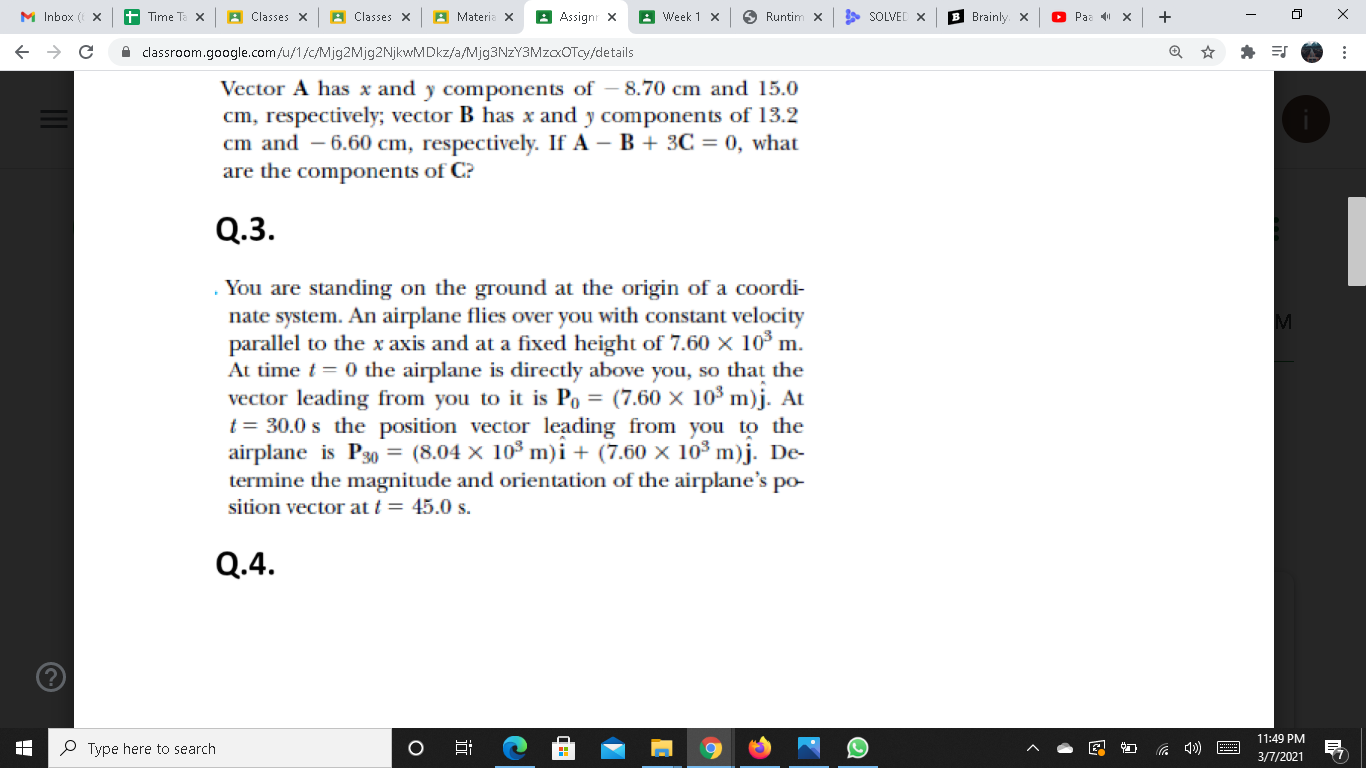 Ahmad234:
solve above numerical.@AZ
Ahmad234:
@AZ
 AZ:
AZ:
So the y-component stays the same since it's at a fixed height Do you agree?
AZ:
Now we're trying to figure out what the x-component is at t = 45 seconds we know that at t = 30, the x-component is 8.04 * 10^3 m we need to figure out how fast it is going and then use that to find the distance it would have travelled by 45 seconds
ScamTheMan:
Our first step should be to create a graph to represent our information. |dw:1615143661329:dw| We also have the information that at 0, or the most left side of where the plane is, the plane is 7.60 x 10, and 30 seconds later it's (8.04 x 10) + (7.60 x 10) Our first step is to find the velocity, wihch is the change in x over the change in time, x/t. Meaning, our first equation is (8.04 x 10^3)/30s. Which gives us 268 m/s. Since we know that the change in x over the change in time can give us v, we can reverse engineer the equation to gives us the change in x when we use 45 as the change in time. Something like this: x=V(t) x=(45)(268) x=12,060m Now just square "12,060^2 + 7600^2 which gives us our magnitude of 1.43 x 10m
AZ:
and to find the orientation/direction \(\Large \theta = tan^{-1} \left( \dfrac{ P_{45y} } {P_{45x} } \right)\) remember that \( \vec{P_{45y}}\) remained the same as 7.60 * 10^3
Ahmad234:
thanks
AZ:
You're welcome!
Join our real-time social learning platform and learn together with your friends!
 VERNEISH:
Two objects are moving along separate linear paths where each path is described by position, d, and time, t.
VERNEISH:
Two objects are moving along separate linear paths where each path is described by position, d, and time, t.

 Maci:
what are the best stock apps for people who want to start investing?
Maci:
what are the best stock apps for people who want to start investing?
 Twaylor:
genuienly how do i get better self control i keep watcing youtube and theres this
Twaylor:
genuienly how do i get better self control i keep watcing youtube and theres this
 IzzyCookie:
|dw:1792074056138:dw| Uhm, I don't know where to ask this, but I'm in college welding at my community college, and I need help learning vertical welding for
IzzyCookie:
|dw:1792074056138:dw| Uhm, I don't know where to ask this, but I'm in college welding at my community college, and I need help learning vertical welding for

 thehearken:
not sure if this is considered spam, im sorry if it is, but does anyone have tips
thehearken:
not sure if this is considered spam, im sorry if it is, but does anyone have tips