
 xXMarcelieXx:
can someone help me
xXMarcelieXx:
@jhonyy9
 snowflake0531:
@AZ
 babygirlimarie:
@dude
snowflake0531:
@Angle
 AZ:
AZ:
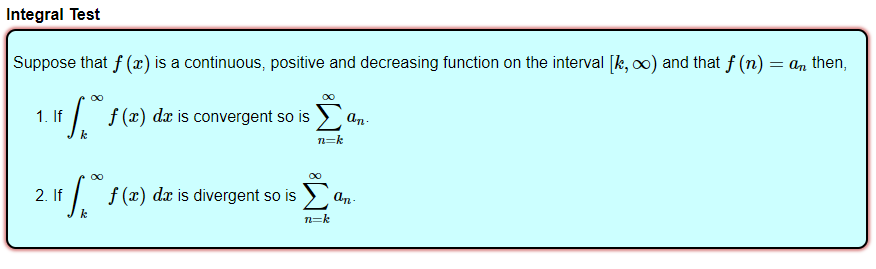
so it's been years since I've done this but until someone more competent can assist, I shall try my best with whatever I remember/ have just reviewed right now while using the assistance of today's technology (: We first need to determine if the series converges or diverges. If it converges, then we need to determine if it absolutely converges or conditionally converges. For the first question, does it converge or diverge? Try using the integral test.
 AZ:
AZ:
So does this integral diverge or converge? \[\int\limits_{2}^{\infty}\left(\frac{1}{x\log\left(x\right)\log\left(\log\left(x\right)\right)}\right)dx\]
AZ:
going to tag other users who might remember this material much better than me to take a look/take over whenever (or if) they're available @Hero @imqwerty @jimthompson5910 @Vocaloid
xXMarcelieXx:
i was able to do part a already
AZ:
mhmm well I guess for part A, you could have just done the comparison test like it said so since \(\sum\limits_{n = 2}^\infty {\frac{1}{{n\ln n}}}\) is divergent, then your series in (a) is also divergent but anyway, which part are you doing right now?
 jhonyy9:
try for k=1 what you get ?
xXMarcelieXx:
wouldnt we plugin k = 0?
 imqwerty:
\(\color{#0cbb34}{\text{Originally Posted by}}\) @xXMarcelieXx im stuck on c \(\color{#0cbb34}{\text{End of Quote}}\) have you tried checking for absolute convergence?
jhonyy9:
and write what you get for k=2 assume the first 2 terms try for k=3 what you get add to the sum of first 2 terms and see the sum go to a fixed value or not (\color{#0cbb34}{\text{Originally Posted by}}\) @xXMarcelieXx wouldnt we plugin k = 0? \(\color{#0cbb34}{\text{End of Quote}}\) yes the first term will be for k=0
imqwerty:
\(\color{#0cbb34}{\text{Originally Posted by}}\) @AZ So does this integral diverge or converge? \[\int\limits_{2}^{\infty}\left(\frac{1}{x\log\left(x\right)\log\left(\log\left(x\right)\right)}\right)dx\] \(\color{#0cbb34}{\text{End of Quote}}\) ++ this integrates to \(log(log(log(x)))\) which approaches infinity as x -> infinity.
xXMarcelieXx:
for k = 0 i got 1 and k = 1 we get -1/2
jhonyy9:
for k=2 ?
xXMarcelieXx:
k-=2 is 1/4
jhonyy9:
ok we start with 1 the first term 1+(-1/2)=1/2 the sum of first two terms the 3rd term is 1/4 1/2 +1/4 = 3/4 the sum of first 3 terms do you see where go the sum ? and from this what you think divergent or convergent ?
xXMarcelieXx:
convergent?
jhonyy9:
so what is the difference between a convergent and a divergent line ?
xXMarcelieXx:
convergent means that it approaches to a number and divergent approaches close to infinity
jhonyy9:
yes exactly so this sum where you see that go - approaches - ?
jhonyy9:
to a fix number or infinity ?
jhonyy9:
\(\color{#0cbb34}{\text{Originally Posted by}}\) @jhonyy9 ok we start with 1 the first term 1+(-1/2)=1/2 the sum of first two terms the 3rd term is 1/4 1/2 +1/4 = 3/4 the sum of first 3 terms do you see where go the sum ? and from this what you think divergent or convergent ? \(\color{#0cbb34}{\text{End of Quote}}\) look here pls
jhonyy9:
1/2 3/4 are fix numbers ?
xXMarcelieXx:
hmm yes
jhonyy9:
so then ?
jhonyy9:
\(\color{#0cbb34}{\text{Originally Posted by}}\) @xXMarcelieXx convergent? \(\color{#0cbb34}{\text{End of Quote}}\) you answered it here
jhonyy9:
but you not was sure in this
xXMarcelieXx:
it would be convergent right?
jhonyy9:
exactly
jhonyy9:
bc has a fix value
jhonyy9:
bc this sum is a fix number
jhonyy9:
do you understand it now ?
xXMarcelieXx:
yes, but how can i show this in proof form?
jhonyy9:
how i ve wrote above first term is 1 second is -1/2 so the sum will be 1 + (-1/2) = 1/2 3rd term is 1/4 so the sum of first 3 terms will be 1/2 + 1/4 = 3/4 do you need - wan - continue ? then you need calcule the 4th term the 5th term the 6th term and so ... but dont forget to assume them
xXMarcelieXx:
what do you mean by assume them
jhonyy9:
add them bc. you need calcule the sum of them
jhonyy9:
@AZ any idea pls ?
imqwerty:
For c, Use the root test on the absolute series
imqwerty:
A series \(\sum a_n\) is absolutely convergent if \(\sum \left|a_n\right|\) is convergent.
imqwerty:
|dw:1615695593995:dw|
Join our real-time social learning platform and learn together with your friends!
 VERNEISH:
Two objects are moving along separate linear paths where each path is described by position, d, and time, t.
VERNEISH:
Two objects are moving along separate linear paths where each path is described by position, d, and time, t.

 Maci:
what are the best stock apps for people who want to start investing?
Maci:
what are the best stock apps for people who want to start investing?
 Twaylor:
genuienly how do i get better self control i keep watcing youtube and theres this
Twaylor:
genuienly how do i get better self control i keep watcing youtube and theres this
 IzzyCookie:
|dw:1792074056138:dw| Uhm, I don't know where to ask this, but I'm in college welding at my community college, and I need help learning vertical welding for
IzzyCookie:
|dw:1792074056138:dw| Uhm, I don't know where to ask this, but I'm in college welding at my community college, and I need help learning vertical welding for

 thehearken:
not sure if this is considered spam, im sorry if it is, but does anyone have tips
thehearken:
not sure if this is considered spam, im sorry if it is, but does anyone have tips