
 b1az3:
Evaluate: C(14, 10)

 AZ:
AZ:
so which answer choice is your answer
b1az3:
can you show me how that works please
AZ:
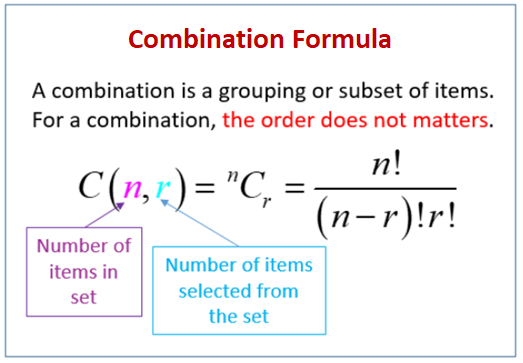
Do you see your question It says C(14, 10) the formula is C(n, r) = \(\dfrac{n!}{(n-r)!r!}\) Do you know what `!` means? what factorial means?
b1az3:
no i don't
AZ:
huh so if you have 4! that means you're multiplying 4*3*2*1 you just keep multiply down until 1 so like 10! = 10*9*8*7*6*5*4*3*2*1
AZ:
does that make sense?
b1az3:
ok that makes sense
b1az3:
!14= 14 13 12 11 10 9 8 7 6 5 4 3 2 1 like this?
AZ:
you forgot all the multiplication signs in between
AZ:
but yeah, you don't really need to multiply it out though look at the formula and look at the answer choices \(\color{#0cbb34}{\text{Originally Posted by}}\) @AZ Do you see your question It says C(14, 10) the formula is C(n, r) = \(\dfrac{n!}{(n-r)!r!}\) \(\color{#0cbb34}{\text{End of Quote}}\)
b1az3:
what number is n and r ?
AZ:
sometimes I really wish you were joking like idk how to make it any more obvious to you
AZ:
I'll add colors for you once again It says C(\(\color{red}{14}, \color{orange}{10}\)) the formula is \( \text{C} (\color{red}{n}, \color{orange}{r}) = \dfrac{\color{red}{n}!}{(\color{red}{n}-\color{orange}{r})!\color{orange}{r}!}\) can you at least use the colors to put the numbers where they belong?
b1az3:
ok thanks
b1az3:
so it's the second option?
AZ:
and then simplify the parenthesis remember if it was 14! - 10! then it can't be simplified without multiplying the two numbers out and doing the subtraction but our equation has (14-10)! so you can do the subtraction inside the parenthesis to get 4!
AZ:
yeah the second one is correct but that's only because they calculated it and got to the right answer. The third one has it correctly set up but the final answer is incorrect
b1az3:
ok thanks as
AZ:
no problem Kyle
Join our real-time social learning platform and learn together with your friends!
 VERNEISH:
Two objects are moving along separate linear paths where each path is described by position, d, and time, t.
VERNEISH:
Two objects are moving along separate linear paths where each path is described by position, d, and time, t.

 Maci:
what are the best stock apps for people who want to start investing?
Maci:
what are the best stock apps for people who want to start investing?
 Twaylor:
genuienly how do i get better self control i keep watcing youtube and theres this
Twaylor:
genuienly how do i get better self control i keep watcing youtube and theres this
 IzzyCookie:
|dw:1792074056138:dw| Uhm, I don't know where to ask this, but I'm in college welding at my community college, and I need help learning vertical welding for
IzzyCookie:
|dw:1792074056138:dw| Uhm, I don't know where to ask this, but I'm in college welding at my community college, and I need help learning vertical welding for

 thehearken:
not sure if this is considered spam, im sorry if it is, but does anyone have tips
thehearken:
not sure if this is considered spam, im sorry if it is, but does anyone have tips