
 kamachavis:
Can I get some Chemistry help?
kamachavis:
@AZ
 AZ:
AZ:
sure, post your question and I can take a look at it
 supie:
@az
AZ:
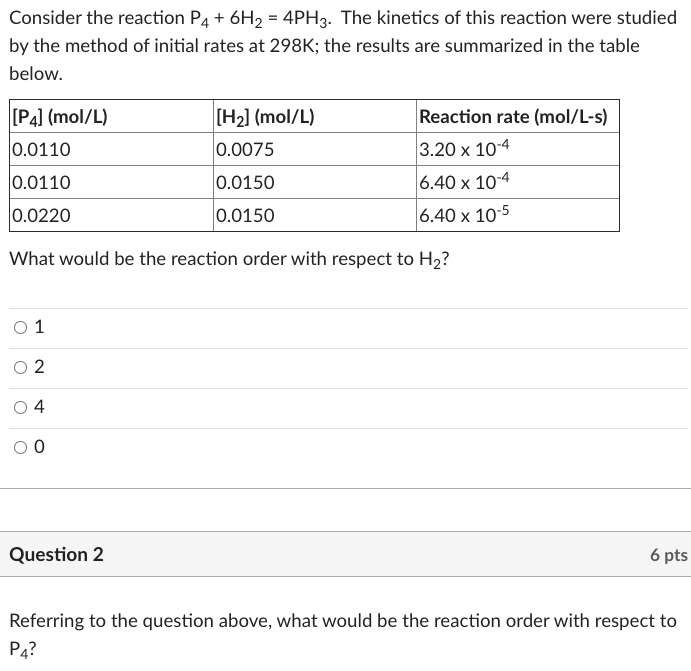
so we're looking for the reaction order for H2 so look at the reaction rate we want the amount of [P4] to stay the same but the [H2] to change so we can determine the reaction order for H2
AZ:
so look at the ratio when we keep [P4] the same H2 goes from 0.0075 to 0.0150 and the reaction rate goes from 3.20*10^-4 to 6.40*10^-4
kamachavis:
Yes
kamachavis:
So would it be 2?
AZ:
so remember we're trying to find the reaction order for this equation, we would write it as \(\Large\text{rate = k [P}_4]^x\text{ [H}_2]^y\)
AZ:
we're trying to find what y is so we kept P4 the same and so that means we're only looking at H2
AZ:
and so you divided the rate and the H2 levels and you get 2 = 2^y what would 'y' be ?
kamachavis:
0.0150?
AZ:
so we divided the two numbers so we could figure out what power H2 is at so now 2 to the power of what will give you 2
kamachavis:
1
AZ:
so that would be your reaction order for \(\text{H}_2\)
AZ:
Does that make sense? How you're supposed to solve questions like this? When they're asking about H2, you want to keep the other reactant constant so you see that when we chose 0.0075 and 0.0150 values for H2 the P4 values remain the same at 0.0110
kamachavis:
I believe so
kamachavis:
So with respect to H2 the answer would be 1.
AZ:
ohhh now I remember your username, you're the one taking college chemistry xD
AZ:
yes
AZ:
so when we have a reaction A + B --> Products the rate law is written as Rate = k [A]^x ^y
kamachavis:
yes xD
kamachavis:
the second one should be 1 as well right?
AZ:
k is a constant and when we keep one of the reactants constant we can then determine the ratio between the rate and the other reactant to determine the order (or the exponent of it)
AZ:
\(\color{#0cbb34}{\text{Originally Posted by}}\) @kamachavis the second one should be 1 as well right? \(\color{#0cbb34}{\text{End of Quote}}\) no no so be careful here
AZ:
so P4 goes from 0.011 to 0.022 and the rate remains the same
AZ:
so \( \dfrac{6.40\times 10^{-4}}{6.40\times 10^{-4}} = \left(\dfrac{0.022}{0.011}\right)^{\large{x}}\)
AZ:
P4 's reaction order would be the value of 'x'
kamachavis:
It would be 0
AZ:
exactly!
AZ:
that's why the rate stays the same- because the reaction order is 0 for P4
kamachavis:
thank you that helped me out a lot
 smurkio:
big smart smh
kamachavis:
i will probably post a few more questions today but you can get back to me whenever i am just practicing for an exam tomorrow.
AZ:
Of course! If it's multiple questions and I'm not online, feel free to close the question to post another one and just tag me so I can take a look at it
 AZ:
AZ:
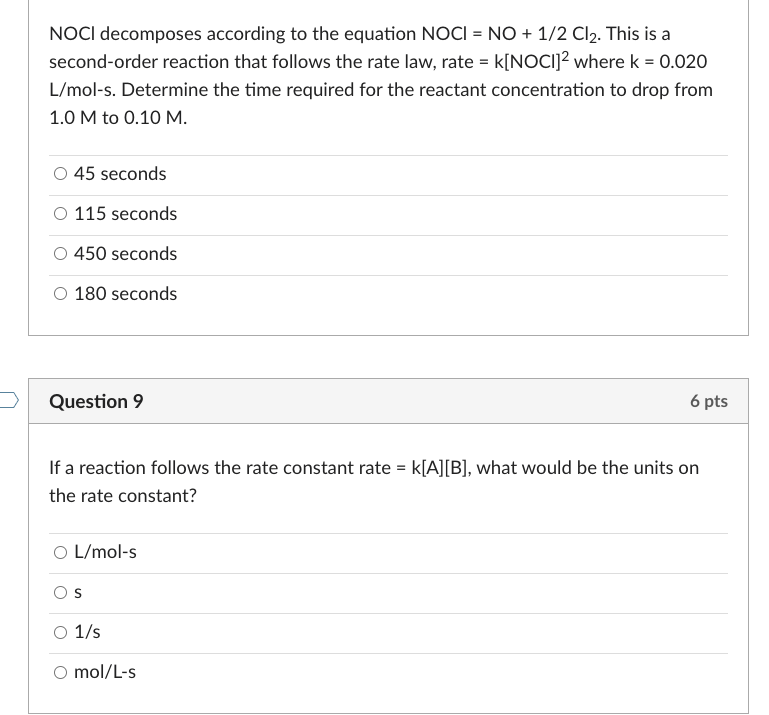
so you need to know the equations to solve this and you're going to have to memorize them If it was a first order reaction: \(ln[A_t] = -kt + ln[A_0] \) and half life \(t_{1/2} = \dfrac{0.693}{k}\) For second order reactions: \( \dfrac{1}{[A_t]} = kt + \dfrac{1}{[A_0]}\) and half life \(t_{1/2} = \dfrac{1}{k[A_0]} \)
 AZ:
AZ:
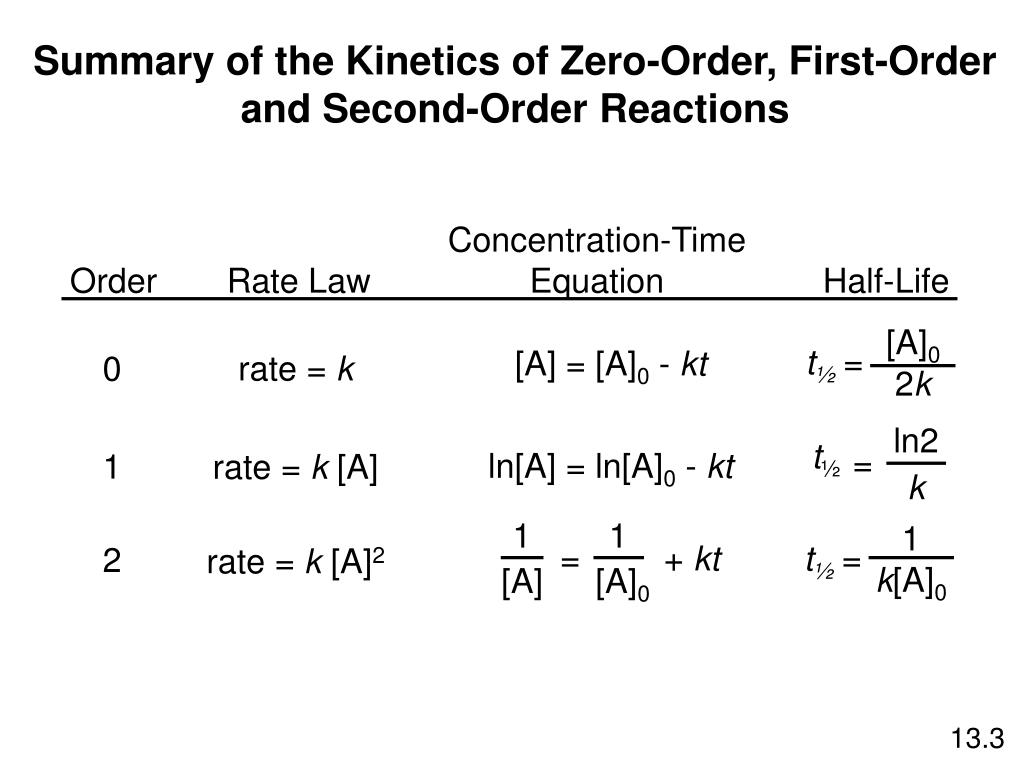
since the equation is a second order, just plug in the numbers they gave you \( [A_t]\) = 0.1 \( [A_0]\) = 1 k = 0.02 and you solve for t so plug them in \( \dfrac{1}{[A_t]} = kt + \dfrac{1}{[A_0]}\)
AZ:
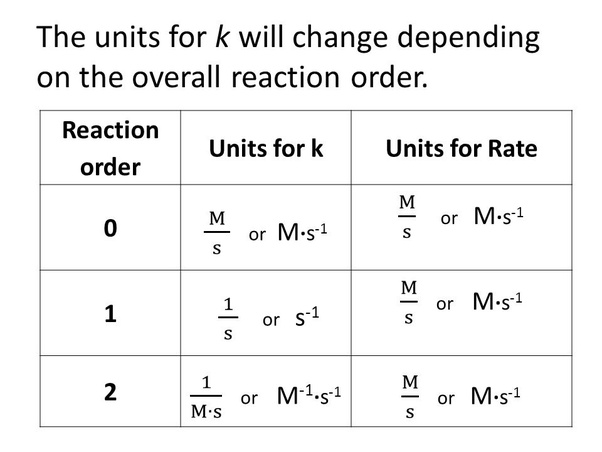
For #9 (if you need help with that as well), it's also something you need to understand and then figure it out or you can memorize it reaction rate has units of M/s but the units for the constant, k, will depend on the order of the reaction so if was a zero order rate = k * [A]^0 rate = k so k has the same units as the rate so it would be M/s (that's Molar which is moles/liter, just in case you weren't aware) if it was first order, now you have rate = k * [A]^1 we know the units for rate are M/s and [A] has units of M so the units for K has to be just 1/s and similarly for second order rate = k * [A]^2 M/s = ?? * M^2 and if you divide M^2 on both sides to determine the units of k in a second order reaction, you'll see that the units are 1/(M*s) so it's just something you need to memorize or if you understand it, something you can just derive and figure out
 AZ:
AZ:
remember that M = moles of liter so you can replace that but be careful when dealing with the fractions
Join our real-time social learning platform and learn together with your friends!
VERNEISH:
Two objects are moving along separate linear paths where each path is described by position, d, and time, t.

 Maci:
what are the best stock apps for people who want to start investing?
Maci:
what are the best stock apps for people who want to start investing?
 Twaylor:
genuienly how do i get better self control i keep watcing youtube and theres this
Twaylor:
genuienly how do i get better self control i keep watcing youtube and theres this
 IzzyCookie:
|dw:1792074056138:dw| Uhm, I don't know where to ask this, but I'm in college welding at my community college, and I need help learning vertical welding for
IzzyCookie:
|dw:1792074056138:dw| Uhm, I don't know where to ask this, but I'm in college welding at my community college, and I need help learning vertical welding for

 thehearken:
not sure if this is considered spam, im sorry if it is, but does anyone have tips
thehearken:
not sure if this is considered spam, im sorry if it is, but does anyone have tips