
 artlover03:
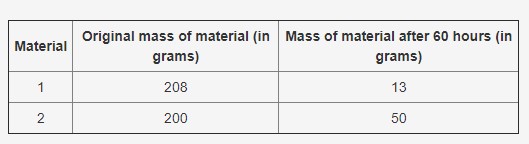
The table below compares the radioactive decay rates of two materials. Based on the table, which of these conclusions is most likely correct? The half-life of Material 1 and Material 2 are equal. The half-life of Material 2 is double the half-life of Material 1. The half-life of Material 2 is 30 hours more than the half-life of Material 1. The half-life of Material 1 is 30 hours more than the half-life of Material 2.
 artlover03:
@snowflake0531 wanna give it a try lol
 jhonyy9:
ok so like a first step do you now what mean the half life of a material ?
artlover03:
i dont :(
jhonyy9:
but you need to know to solve this your problem @supie any idea ?
jhonyy9:
@AZ can you explain here please - ? ty
jhonyy9:
any idea @AZ ? how you explain what is a half-life of a material ? hope you know what mean
 AZ:
AZ:
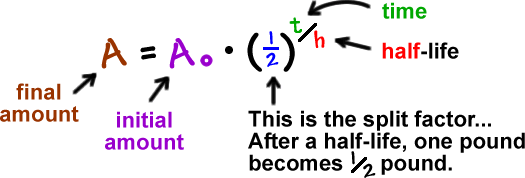
so for material A final amount = 13 initial amount = 208 time = 60 hours half-life = x we're calculating half life can you plug it into the equation and solve? we will have to use ln on both sides so we can solve for 'x'
AZ:
and then you similarly find the half life of the second material and then compare the half-lives
AZ:
half-life of a material is the amount of time it takes for a material to become half so if you had 100 grams of something the amount of time it takes for that 100 grams to decay to 50 grams is called the half life and that's how much time it would take for it to go from 50 grams to 25 grams and from 25 grams to 12.5 grams
jhonyy9:
\(\color{#0cbb34}{\text{Originally Posted by}}\) @AZ half-life of a material is the amount of time it takes for a material to become half so if you had 100 grams of something the amount of time it takes for that 100 grams to decay to 50 grams is called the half life and that's how much time it would take for it to go from 50 grams to 25 grams and from 25 grams to 12.5 grams \(\color{#0cbb34}{\text{End of Quote}}\) ty @AZ perfect explained
artlover03:
i got 13=208 (1/2) 60/x... what do i do from here?
AZ:
divide 208 on both sides
AZ:
what is 13/208 =
artlover03:
.0625
AZ:
good so now we have \( 0.0625 = \left(\dfrac{1}{2}\right)^{\dfrac{60}{x}}\) if we take the natural log on both sides, we can bring down the exponent because \( ln(a^b) = b ~ln(a)\)
AZ:
so if we take the natural log on both sides, we get \( ln (0.0625 )= \dfrac{60}{x} ln\left(\dfrac{1}{2}\right)\)
AZ:
can you use a calculator and do ln(0.0625) divided by ln(0.5)
AZ:
we want to get x all by itself
artlover03:
.125?
AZ:
did you understand what I did?
AZ:
with the whole ln thing If they're teaching you it, I'm sure they expect you to know it
AZ:
\(\color{#0cbb34}{\text{Originally Posted by}}\) @artlover03 .125? \(\color{#0cbb34}{\text{End of Quote}}\) no https://www.google.com/search?q=ln(0.0625)+%2F+ln(0.5)
artlover03:
oh.. 4
AZ:
yes so we divided by ln(1/2) or ln(0.5) on both sides so now we get 4 = 60/x can you solve for x? that's going to be the half life of material 1
artlover03:
.0666 repeating?
AZ:
no if you divide 60 by 0.0666 do you get 4? so we have 4 = 60/x so multiply x on both sides and you'll get 4x = 60 to get x all by itself, you need to divide 4 on both sides
AZ:
your silence worries me 4x = 60 so x = 60/4 60/4 = ??
artlover03:
15
AZ:
so that's the half life for the first material we need to do it all over again for the second material so for material 2 final amount = 50 initial amount = 200 time = 60 hours half-life = x \( 50 = 200\left(\dfrac{1}{2}\right)^{\dfrac{60}{x}}\)
AZ:
so first things first, divide by 200 on both sides
artlover03:
.25?
AZ:
good and what do you get when take ln of both sides? can you write the equation out
artlover03:
.25=200 (1/2) ^ 60/x
AZ:
no, there would be no 200 because we divided the 200 on both sides
AZ:
0.25 = (1/2) ^ (60/x)
AZ:
1/2 is the same thing as 0.5 so let's re-write it 0.25 = (0.5)^ (60/x)
AZ:
can you take the natural log on both sides?
AZ:
\(\color{#0cbb34}{\text{Originally Posted by}}\) @AZ good so now we have \( 0.0625 = \left(\dfrac{1}{2}\right)^{\dfrac{60}{x}}\) if we take the natural log on both sides, we can bring down the exponent because \( ln(a^b) = b ~ln(a)\) \(\color{#0cbb34}{\text{End of Quote}}\) \(\color{#0cbb34}{\text{Originally Posted by}}\) @AZ so if we take the natural log on both sides, we get \( ln (0.0625 )= \dfrac{60}{x} ln\left(\dfrac{1}{2}\right)\) \(\color{#0cbb34}{\text{End of Quote}}\) remember this?
artlover03:
.5=60x?
AZ:
uhhh no
AZ:
we have \( 0.25 = 0.5^{\left(\dfrac{60}{x}\right)}\)
AZ:
if we take ln on both sides we get \( ln(0.25) = \dfrac{60}{x}~ ln(0.5)\)
AZ:
you should be able to solve for x
AZ:
Follow all the steps I've already told you before.
artlover03:
umh.. 60/x (.5)= 30x?
artlover03:
i know im hard to teach, sorry
artlover03:
@AZ I THINK I GOT IT! I GOT 4 FOR THE SECOND PART.. SO IS THE ANSWER A) THEY ARE BOTH THE SAME?!?!
AZ:
@artlover03 sorry, I had to step away- but no they are not both the same what is ln(0.25) divided by ln(0.5) = ln(0.25) / ln(0.5) = just use a calculator https://www.google.com/search?q=ln(0.25)+%2F+ln(0.5)+%3D and then you know that number = 60/x so just divide 60 by that number and tat's the half life of the second material
Join our real-time social learning platform and learn together with your friends!
 VERNEISH:
Two objects are moving along separate linear paths where each path is described by position, d, and time, t.
VERNEISH:
Two objects are moving along separate linear paths where each path is described by position, d, and time, t.

 Maci:
what are the best stock apps for people who want to start investing?
Maci:
what are the best stock apps for people who want to start investing?
 Twaylor:
genuienly how do i get better self control i keep watcing youtube and theres this
Twaylor:
genuienly how do i get better self control i keep watcing youtube and theres this
 IzzyCookie:
|dw:1792074056138:dw| Uhm, I don't know where to ask this, but I'm in college welding at my community college, and I need help learning vertical welding for
IzzyCookie:
|dw:1792074056138:dw| Uhm, I don't know where to ask this, but I'm in college welding at my community college, and I need help learning vertical welding for

 thehearken:
not sure if this is considered spam, im sorry if it is, but does anyone have tips
thehearken:
not sure if this is considered spam, im sorry if it is, but does anyone have tips