
 carmelle:
Factor x^2 − 2x + 3. (x − 3)(x − 1) (x + 3)(x + 1) (x − 3)(x + 1) Prime
 AZ:
AZ:
what two numbers multiply to give you 3 and add up to -2
AZ:
since 3 is a positive number and it has to add up to a negative number that means both the numbers have to be negative
carmelle:
uh, idk
carmelle:
wait.. -3 x -1
 jhonyy9:
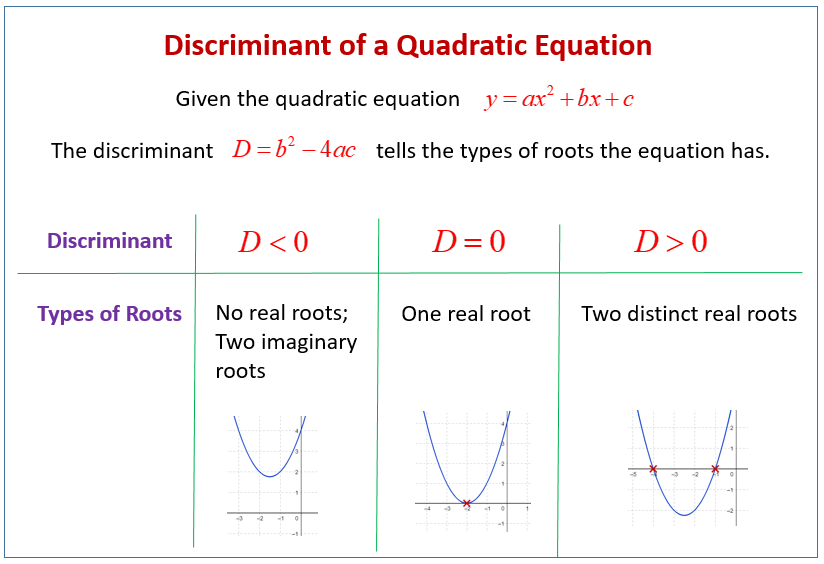
x^2 -2x +3 = 0 this quadratic has the discriminant smaller then zero so has non real roots
carmelle:
im confused ._.
carmelle:
\(\color{#0cbb34}{\text{Originally Posted by}}\) @jhonyy9 x^2 -2x +3 = 0 this quadratic has the discriminant smaller then zero so has non real roots \(\color{#0cbb34}{\text{End of Quote}}\) so its prime?
carmelle:
what's wrong @snowflake0531 ?
jhonyy9:
@AZ do you see it now ?
 snowflake0531:
Like, you can't factor it out the regular way
snowflake0531:
I just saw it too lol.
carmelle:
oh :/
carmelle:
ok, so its prime... thanks for the help :>
carmelle:
ok
AZ:
\(\color{#0cbb34}{\text{Originally Posted by}}\) @jhonyy9 x^2 -2x +3 = 0 this quadratic has the discriminant smaller then zero so has non real roots \(\color{#0cbb34}{\text{End of Quote}}\) ahh, you are correct
AZ:
so what Jhonyy is saying- you can use the discriminant to tell you about the roots the discriminant is \( b^2 - 4ac\) when the equation is written as \( ax^2 + bx + c = 0\)
 carmelle:
ah, ok I get it now
AZ:
so (-2)^2 - 4(1)(3) = 4 - 12 = -8 since it's negative, we would have imaginary roots
carmelle:
okay I get it
AZ:
Good :) Thank you @jhonyy9 for pointing that out, I completely missed it :))
AZ:
you would have also realized, there are no 2 numbers that can multiply to give you 3 and add up to -2 -3 and -1 would add up to -4 not -2
carmelle:
oh yeah
jhonyy9:
\(\color{#0cbb34}{\text{Originally Posted by}}\) @AZ Good :) Thank you @jhonyy9 for pointing that out, I completely missed it :)) \(\color{#0cbb34}{\text{End of Quote}}\) np
Join our real-time social learning platform and learn together with your friends!
 VERNEISH:
Two objects are moving along separate linear paths where each path is described by position, d, and time, t.
VERNEISH:
Two objects are moving along separate linear paths where each path is described by position, d, and time, t.

 Maci:
what are the best stock apps for people who want to start investing?
Maci:
what are the best stock apps for people who want to start investing?
 Twaylor:
genuienly how do i get better self control i keep watcing youtube and theres this
Twaylor:
genuienly how do i get better self control i keep watcing youtube and theres this
 IzzyCookie:
|dw:1792074056138:dw| Uhm, I don't know where to ask this, but I'm in college welding at my community college, and I need help learning vertical welding for
IzzyCookie:
|dw:1792074056138:dw| Uhm, I don't know where to ask this, but I'm in college welding at my community college, and I need help learning vertical welding for

 thehearken:
not sure if this is considered spam, im sorry if it is, but does anyone have tips
thehearken:
not sure if this is considered spam, im sorry if it is, but does anyone have tips