
 kamachavis:
Can I get some Math help?
 Katrin369:
I will try, what is the question?
kamachavis:
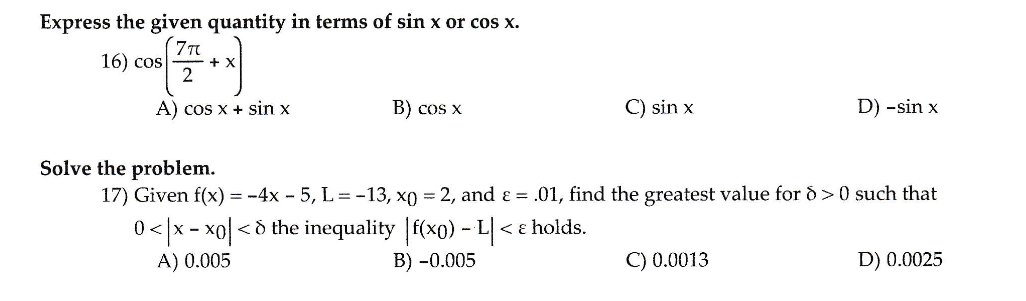
I have two.
 Katrin369:
Okay. If I can't, then I will tag some people.
Katrin369:
Okay. I can't sorry. Umm, ask. @AZ and @Hoodmemes
kamachavis:
@AZ @Hoodmemes
 AZ:
AZ:
For the first one, you can use \(\cos (A \pm B) = \cos A \cos B \mp \sin A \sin B\) we know that sin and cos have periods of 2\(\pi\) so \( \dfrac{7\pi}{2} + x\) is the same thing as \(\dfrac{\pi}{2} + x\)
AZ:
Does that help you get the correct answer? I know usually in calc classes, you aren't even allowed a normal calculator but for homework, you can always graph it out to make sure I particularly recommend https://www.desmos.com/calculator
kamachavis:
I'm still a little confused.
kamachavis:
It would be sin x!
AZ:
careful there when it's cos(A\(\bf +\)B) then it's going to be cosA cosB \(\bf - \) sin A sin B
AZ:
so basically 2pi is the period for cos and sin curves that means we can get rid of 6pi/2 from 7pi/2 because it's basically making the graph the same that's how we got pi/2
AZ:
and then cos(pi/2) = 0 so you don't have to worry about that but you still have the minus -sinA sin B and A would be `pi/2` and B is `x`
kamachavis:
So would it be -sinx?
AZ:
there you go!
kamachavis:
can you help with the next problem as well?
Join our real-time social learning platform and learn together with your friends!
VERNEISH:
Two objects are moving along separate linear paths where each path is described by position, d, and time, t.

 Maci:
what are the best stock apps for people who want to start investing?
Maci:
what are the best stock apps for people who want to start investing?
 Twaylor:
genuienly how do i get better self control i keep watcing youtube and theres this
Twaylor:
genuienly how do i get better self control i keep watcing youtube and theres this
 IzzyCookie:
|dw:1792074056138:dw| Uhm, I don't know where to ask this, but I'm in college welding at my community college, and I need help learning vertical welding for
IzzyCookie:
|dw:1792074056138:dw| Uhm, I don't know where to ask this, but I'm in college welding at my community college, and I need help learning vertical welding for

 thehearken:
not sure if this is considered spam, im sorry if it is, but does anyone have tips
thehearken:
not sure if this is considered spam, im sorry if it is, but does anyone have tips