
 kamachavis:
Can I get some Math help?
 kamachavis:
Any idea on how to do it?
kamachavis:
calculus
 Vocaloid:
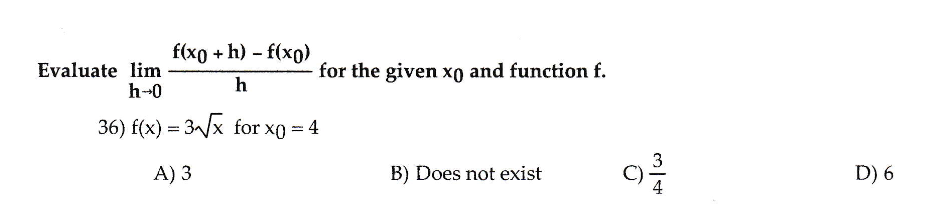
when you're calculating limits this way, simply evaluate what's in the expression so when it says f(x0 + h), plug x0 + h into the function f(x) to get 3sqrt(x0 + h), etc. and continue with f(x0) when you expand/simplify the expression, you should be able to cancel out h from the denominator, which lets you plug in h = 0 and get the final limit
kamachavis:
would it be undefined?
Vocaloid:
no, there's definitely a finite limit on this one \[{ \lim_{h \rightarrow 0} }{ \frac{ f(x_{0}+h)-f(x_{0}) }h }\] plugging in f(x) = 3sqrt(x) \[{ \lim_{h \rightarrow 0} }{ \frac{3\sqrt{x_{0}+h}-3\sqrt{x_{0}} }h }\] plugging in x0 = 4 \[{ \lim_{h \rightarrow 0} }{ \frac{3\sqrt{4+h}-6 }h }\]
Vocaloid:
to make the arithmetic simpler, factor out the 3 from the numerator to get \[{ \lim_{h \rightarrow 0} }{ \frac{ 3 }{ h }(\sqrt{4+h}-2) }\] rationalize the numerator by multiplying the expression by the conjugate of sqrt(4+h)-2, which is sqrt(4+h) - 2 \[{ \lim_{h \rightarrow 0} }{ \frac{ 3 }{ h }(\sqrt{4+h}-2) }\frac{ \sqrt{4+h}+2 }{ \sqrt{4+h}+2 }\]\] simply the numerator using difference of squares. if done correctly, you'll notice that the numerator loses all of its radicals, and you're left with an h you can cancel out from the numerator and denominator. from there, you can plug in h = 0 and get your final limit.
kamachavis:
thank you I got it 3/4
kamachavis:
could you help me with one more problem please
Vocaloid:
I'll give it a try sure
 Vocaloid:
I'm sure there's a smarter way to do this, but you could calculate the slope between points (5,-8) and (2,4) using the slope formula, then use the point-slope equation to get the full equation of that line in y = mx + b form from there you could re-write 20y - kx = 4 as y = (k/20)x - (1/5) and then set the slopes equal to each other since they're parallel
kamachavis:
k would equal -82?
Vocaloid:
hmm I got something a bit different slope formula: \[\frac{ (y_{2}-y_{1}) }{ (x_{2}-x_{1} }=\frac{ (4-(-8) }{ (2-5) }=-4\] so the slope is -4. since both lines are parallel, both slopes are -4 so if y = (k/20)x - (1/5) has a slope of -4, then (k/20) = -4, should be straightforward what k is.
Join our real-time social learning platform and learn together with your friends!
VERNEISH:
Two objects are moving along separate linear paths where each path is described by position, d, and time, t.

 Maci:
what are the best stock apps for people who want to start investing?
Maci:
what are the best stock apps for people who want to start investing?
 Twaylor:
genuienly how do i get better self control i keep watcing youtube and theres this
Twaylor:
genuienly how do i get better self control i keep watcing youtube and theres this
 IzzyCookie:
|dw:1792074056138:dw| Uhm, I don't know where to ask this, but I'm in college welding at my community college, and I need help learning vertical welding for
IzzyCookie:
|dw:1792074056138:dw| Uhm, I don't know where to ask this, but I'm in college welding at my community college, and I need help learning vertical welding for

 thehearken:
not sure if this is considered spam, im sorry if it is, but does anyone have tips
thehearken:
not sure if this is considered spam, im sorry if it is, but does anyone have tips