
 villy:
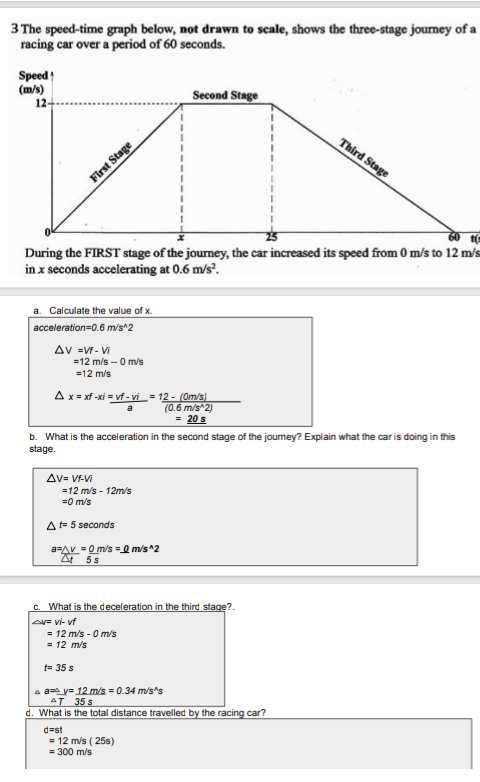
Umm just want u all to check my work if it's right or not
 AZ:
AZ:
Part A and part B are correct
AZ:
for part C, we're looking at the deceleration stage \(\Delta\)v = Vf - Vi you got that backwards The final speed is 0 The initial speed in the deceleration stage is 12 m/s so Vf = 0 Vi = 12 so recalculate \(\Delta v\) and the final units you should get are m/s / s = m/s * 1/s = m/s^2
AZ:
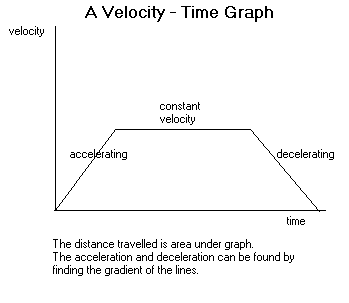
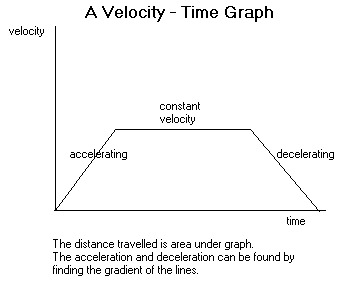
Part D is also wrong We need to calculate the distance travelled in each stage Or since we have a graph of speed vs time since distance = speed * time the area under the graph is the total distance travelled
 AZ:
AZ:
So we know x = 20 We have a triangle with a base of 20 and height of 12 We have a rectangle with a length of 5 (because 25-20 = 5) and a width of 12 We have a triangle with a base of 35 and height of 12 Can you find the area of each shape and add them all up together? That is going to be the total distance travelled.
AZ:
@villy
 AZ:
AZ:
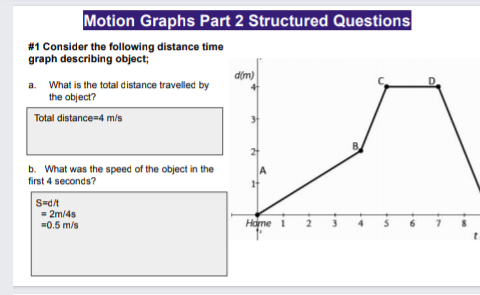
part A is wrong they travelled 4 meters and then they travelled 4 meters back so the total distance is 4 + 4
AZ:
the second part is correct :)
 jhonyy9:
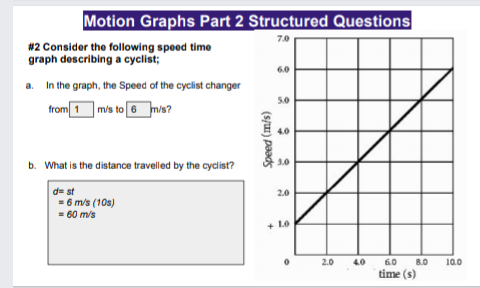
on the last part d = 60 m not 60 m/s
jhonyy9:
\[d = (6 m/s) * (10 s) = 60 (ms/s) = 60 (m)\]
AZ:
Part b) is wrong 6 m/s was her speed at the end but it was constantly changing so you can't use 6 m/s you have to find the average velocity first average velocity = (1+5)/2 and then use that distance travelled = velocity * time
AZ:
alternatively, if you remember the distance travelled by the cyclist is the area under the graph you can break the area underneath into two shapes a rectangle with a width of 1 and length of 10 and a triangle with a base of 10 and a height of 5 find the area of both shapes and add them
jhonyy9:
alternatively, if you remember the distance travelled by the cyclist is the area under the graph @AZ i think this can be so confusable to @villy bc. the distance traveled by a cyclist not can be an area like you expressed it above ? @Shadow opinion in this way pls ? ty
 Shadow:
I think you guys got this. AZ seems on point.
AZ:
It's a graph of speed by time and distance = speed * time so the area under the graph gives us the distance `The area under the line on a velocity-time graph is equal to the displacement of the object. If the shape of the graph can be broken into simple geometric shapes, the total area under the line can be calculated by adding the areas of those shapes. The area under a speed-time graph is the distance.` https://isaacphysics.org/pages/gcse_ch2_12_text#:~:text=The%20area%20under%20the%20line,the%20displacement%20of%20the%20object.&text=If%20the%20shape%20of%20the,time%20graph%20is%20the%20distance.
 jhonyy9:
ok i accept this all but how you explain to a student that a cyclist when go on a distance of 300 m in a line (way) that the distance graphed not is this line - really is the area - this is so absurd
Join our real-time social learning platform and learn together with your friends!
 VERNEISH:
Two objects are moving along separate linear paths where each path is described by position, d, and time, t.
VERNEISH:
Two objects are moving along separate linear paths where each path is described by position, d, and time, t.

 Maci:
what are the best stock apps for people who want to start investing?
Maci:
what are the best stock apps for people who want to start investing?
 Twaylor:
genuienly how do i get better self control i keep watcing youtube and theres this
Twaylor:
genuienly how do i get better self control i keep watcing youtube and theres this
 IzzyCookie:
|dw:1792074056138:dw| Uhm, I don't know where to ask this, but I'm in college welding at my community college, and I need help learning vertical welding for
IzzyCookie:
|dw:1792074056138:dw| Uhm, I don't know where to ask this, but I'm in college welding at my community college, and I need help learning vertical welding for

 thehearken:
not sure if this is considered spam, im sorry if it is, but does anyone have tips
thehearken:
not sure if this is considered spam, im sorry if it is, but does anyone have tips