
 iuytyuioiuytyuiop:
math problem
 iuytyuioiuytyuiop:
@AZ
 AZ:
AZ:
Do you know how to find the domain and range for quadratic functions? What are all the possibly x-values that x could be? What about the y-values? Is there something that y cannot ever go past
iuytyuioiuytyuiop:
i dont
iuytyuioiuytyuiop:
im not sue
iuytyuioiuytyuiop:
@snowflake0531
 iuytyuioiuytyuiop:
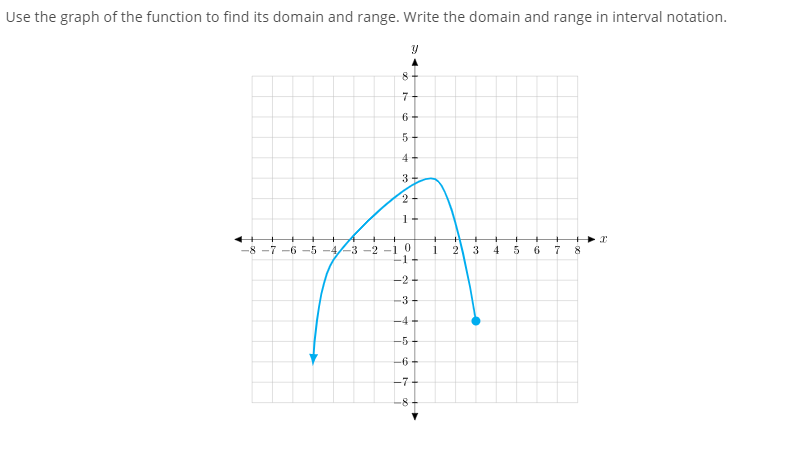
y < 3?
AZ:
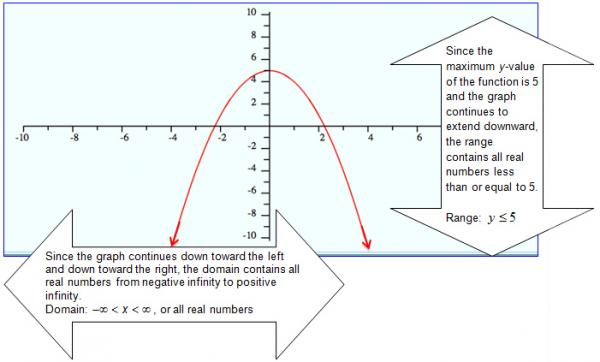
So for a quadratic function `the domain is all real numbers. if the parabola is opening upwards, i.e. a > 0 , the range is y ≥ k ; if the parabola is opening downwards, i.e. a < 0 , the range is y ≤ k .` https://www.khanacademy.org/math/algebra-home/alg-functions/alg-determining-the-range-of-a-function/v/domain-and-range-of-a-function-given-a-formula#:~:text=For%20every%20polynomial%20function%20(such,domain%20is%20all%20real%20numbers.&text=if%20the%20parabola%20is%20opening,range%20is%20y%20%E2%89%A4%20k%20.
AZ:
\(\color{#0cbb34}{\text{Originally Posted by}}\) @iuytyuioiuytyuiop y < 3? \(\color{#0cbb34}{\text{End of Quote}}\) are you sure it's \( <\) or would it be \(\le\)
iuytyuioiuytyuiop:
i cant type it on my keyboard
AZ:
look at that image I shared and even that quote ` if the parabola is opening downwards, i.e. a < 0 , the range is y ≤ k`
AZ:
\(\color{#0cbb34}{\text{Originally Posted by}}\) @iuytyuioiuytyuiop i cant type it on my keyboard \(\color{#0cbb34}{\text{End of Quote}}\) ah okay, as long as you write it in your answer box over there!
AZ:
so do you know how we would write that in interval notation?
iuytyuioiuytyuiop:
im not sure
iuytyuioiuytyuiop:
its alright i figured it out
AZ:
ah okay but just in case basically for domain, it would be \( (-\infty, \infty)\) and for range, it would be \( (-\infty, 3]\)
iuytyuioiuytyuiop:
alright
Join our real-time social learning platform and learn together with your friends!
VERNEISH:
Two objects are moving along separate linear paths where each path is described by position, d, and time, t.

 Maci:
what are the best stock apps for people who want to start investing?
Maci:
what are the best stock apps for people who want to start investing?
 Twaylor:
genuienly how do i get better self control i keep watcing youtube and theres this
Twaylor:
genuienly how do i get better self control i keep watcing youtube and theres this
 IzzyCookie:
|dw:1792074056138:dw| Uhm, I don't know where to ask this, but I'm in college welding at my community college, and I need help learning vertical welding for
IzzyCookie:
|dw:1792074056138:dw| Uhm, I don't know where to ask this, but I'm in college welding at my community college, and I need help learning vertical welding for

 thehearken:
not sure if this is considered spam, im sorry if it is, but does anyone have tips
thehearken:
not sure if this is considered spam, im sorry if it is, but does anyone have tips