
 TheOfficialDaya:
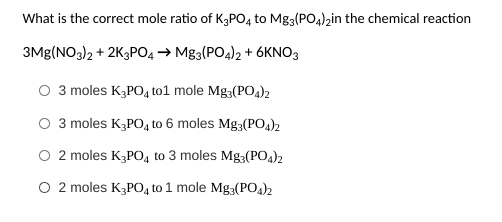
I need help (Stoichiometry)
 KynxKatz:
Which one you think it is
TheOfficialDaya:
\(\color{#0cbb34}{\text{Originally Posted by}}\) @KynxKatz Which one you think it is \(\color{#0cbb34}{\text{End of Quote}}\) idk that's why I'm asking
KynxKatz:
Well i cant just give u the answer
TheOfficialDaya:
okay, so are you going to help me?
KynxKatz:
Yes
TheOfficialDaya:
okay
KynxKatz:
Gimme few minutes
TheOfficialDaya:
okay
KynxKatz:
@AZ
 Vocaloid:
The equation is already balanced (always be sure to check) So looking at the equation, how many moles of K3PO4 and Mg3(PO4)2 are there? Look at the coefficients in front of these compounds
TheOfficialDaya:
\(\color{#0cbb34}{\text{Originally Posted by}}\) @Vocaloid The equation is already balanced (always be sure to check) So looking at the equation, how many moles of K3PO4 and Mg3(PO4)2 are there? Look at the coefficients in front of these compounds \(\color{#0cbb34}{\text{End of Quote}}\) K-3, P-0, O-4 | Mg-3 or 6 idk , P-0 ,O-4 (idk if I'm right)
KynxKatz:
\(\color{#0cbb34}{\text{Originally Posted by}}\) @TheOfficialDaya \(\color{#0cbb34}{\text{Originally Posted by}}\) @Vocaloid The equation is already balanced (always be sure to check) So looking at the equation, how many moles of K3PO4 and Mg3(PO4)2 are there? Look at the coefficients in front of these compounds \(\color{#0cbb34}{\text{End of Quote}}\) K-3, P-0, O-4 | Mg-3 or 6 idk , P-0 ,O-4 (idk if I'm right) \(\color{#0cbb34}{\text{End of Quote}}\) Do you think your right?
Vocaloid:
Keep in mind we’re talking about compounds, not individual elements Notice how there’s a 2 at the front of K3PO4 which means 2 moles K3PO4 Can you repeat this logic with Mg3(PO4)2?
TheOfficialDaya:
\(\color{#0cbb34}{\text{Originally Posted by}}\) @KynxKatz \(\color{#0cbb34}{\text{Originally Posted by}}\) @TheOfficialDaya \(\color{#0cbb34}{\text{Originally Posted by}}\) @Vocaloid The equation is already balanced (always be sure to check) So looking at the equation, how many moles of K3PO4 and Mg3(PO4)2 are there? Look at the coefficients in front of these compounds \(\color{#0cbb34}{\text{End of Quote}}\) K-3, P-0, O-4 | Mg-3 or 6 idk , P-0 ,O-4 (idk if I'm right) \(\color{#0cbb34}{\text{End of Quote}}\) Do you think your right? \(\color{#0cbb34}{\text{End of Quote}}\) yea lol
Vocaloid:
\(\color{#0cbb34}{\text{Originally Posted by}}\) @Vocaloid Keep in mind we’re talking about compounds, not individual elements Notice how there’s a 2 at the front of K3PO4 which means 2 moles K3PO4 Can you repeat this logic with Mg3(PO4)2? \(\color{#0cbb34}{\text{End of Quote}}\)
Vocaloid:
Remember that no coefficient = implies a 1
TheOfficialDaya:
\(\color{#0cbb34}{\text{Originally Posted by}}\) @Vocaloid \(\color{#0cbb34}{\text{Originally Posted by}}\) @Vocaloid Keep in mind we’re talking about compounds, not individual elements Notice how there’s a 2 at the front of K3PO4 which means 2 moles K3PO4 Can you repeat this logic with Mg3(PO4)2? \(\color{#0cbb34}{\text{End of Quote}}\) \(\color{#0cbb34}{\text{End of Quote}}\) ohh okay, there are 2 moles of K3 or would I not need the 3... there are no moles for P and O unless its 2? i really don't know what to do
TheOfficialDaya:
ohhh i get it now the answer is D the last bubble
Vocaloid:
Try to think of Mg3(PO4)2 and K3PO4 as one big chunk of atoms instead of individual K P O atoms There’s no coefficient (no number in front of) the whole chunk, so there’s only 1 mole. If we had 2(K3PO4) that would be 2 moles, 3(K3PO4) would be 3 moles, etc.
Vocaloid:
So, we have 2K3PO4 (so 2 moles K3PO4) and 1 mole Mg3(PO4)2 so that’s your mole ratio
TheOfficialDaya:
\(\color{#0cbb34}{\text{Originally Posted by}}\) @Vocaloid Try to think of Mg3(PO4)2 and K3PO4 as one big chunk of atoms instead of individual K P O atoms There’s no coefficient (no number in front of) the whole chunk, so there’s only 1 mole. If we had 2(K3PO4) that would be 2 moles, 3(K3PO4) would be 3 moles, etc. \(\color{#0cbb34}{\text{End of Quote}}\) right okay
KynxKatz:
So do you still need help with any Subject?
TheOfficialDaya:
\(\color{#0cbb34}{\text{Originally Posted by}}\) @KynxKatz So do you still need help with any Subject? \(\color{#0cbb34}{\text{End of Quote}}\) no just this one I have another problem
TheOfficialDaya:
But ill let yk if i get stuck
KynxKatz:
Mk
Join our real-time social learning platform and learn together with your friends!
 VERNEISH:
Two objects are moving along separate linear paths where each path is described by position, d, and time, t.
VERNEISH:
Two objects are moving along separate linear paths where each path is described by position, d, and time, t.

 Maci:
what are the best stock apps for people who want to start investing?
Maci:
what are the best stock apps for people who want to start investing?
 Twaylor:
genuienly how do i get better self control i keep watcing youtube and theres this
Twaylor:
genuienly how do i get better self control i keep watcing youtube and theres this
 IzzyCookie:
|dw:1792074056138:dw| Uhm, I don't know where to ask this, but I'm in college welding at my community college, and I need help learning vertical welding for
IzzyCookie:
|dw:1792074056138:dw| Uhm, I don't know where to ask this, but I'm in college welding at my community college, and I need help learning vertical welding for

 thehearken:
not sure if this is considered spam, im sorry if it is, but does anyone have tips
thehearken:
not sure if this is considered spam, im sorry if it is, but does anyone have tips