
 lorena123:
I need help
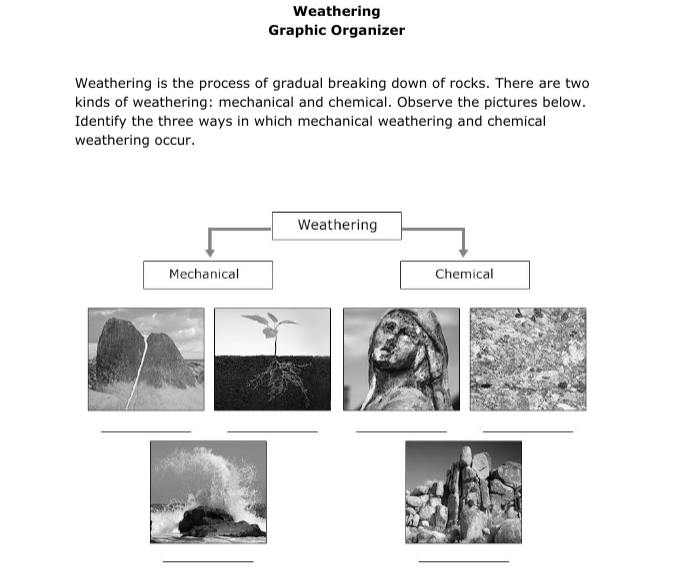 lorena123:
Is the 3rd picture on the 1st row weathering?
 QuestionCoveBot:
\(\color{#0cbb34}{\text{Originally Posted by}}\) @lorena123 Is the 3rd picture on the 1st row weathering? \(\color{#0cbb34}{\text{End of Quote}}\) What is the image of? That will explain it.
lorena123:
Is this one chemical weathering? I have to label each picture either mechanical weathering or chemical weathering
 QuestionCoveBot:
Yes. That is chemical weathering.
lorena123:
Identify the three ways in which mechanical weathering and chemical weathering occur.
lorena123:
Thats what they are asking for actually
QuestionCoveBot:
@snowflake0531 - she will know this then.
QuestionCoveBot:
I tried helping. I ain't strong in this.
lorena123:
i asked her too
lorena123:
she said not science
QuestionCoveBot:
@Astrid1 - She could know this then.
lorena123:
ok
lorena123:
@Astrid1
lorena123:
Is it a hard question?? lol sorry if it is
lorena123:
nvm ill just put something
 Astrid1:
Well, first I had to take a look at the image and then I didn't know any of the crap, so I did some research. Mechanical weathering reduces the size of rocks without altering their structure. Chemical weathering decomposes rocks by creating new minerals that are stable at the surface of the Earth. Chemical weathering is supported by the presence of water, carbon dioxide, and oxygen. Source: https://courses.lumenlearning.com/geology/chapter/reading-weathering/#:~:text=Mechanical%20weathering%20breaks%20rocks%20into%20smaller%20pieces%20without%20changing%20their%20composition.&text=Chemical%20weathering%20breaks%20down%20rocks,important%20agents%20of%20chemical%20weathering. On the first picture in the first row, we see a rock image. This rock seems to have fractured on its own, perhaps as a result of an earthquake or simply due to age. It seems to have changed the structure slightly. However, I believe it is Mechanical Weathering. On the second image we see a plant in the process of growing, the soil is healthy which tells us that the rocks must've done their job, which leaves us with the answer of Chemical weathering. Like you thought so, on number three there is a possible chance it could be chemical weathering but the rock was broken down and it altered the structure so, I believe you are correct on that. The fourth image is hard to see and it looks as if there is dirt and maybe rocks, so Looks like chemical, again. Our fifth image seems to be water on a rock, Chemical weathering. The sixth looks like mechanical weathering because of the rock being broken down into a smaller size overtime but the structure isn't altered. I hope that helps. If I am wrong, Sorry.
lorena123:
Thank you so much @Astrid1 :)
Astrid1:
You're very welcome, hun. I am happy to have helped you.
Join our real-time social learning platform and learn together with your friends!
 VERNEISH:
Two objects are moving along separate linear paths where each path is described by position, d, and time, t.
VERNEISH:
Two objects are moving along separate linear paths where each path is described by position, d, and time, t.

 Maci:
what are the best stock apps for people who want to start investing?
Maci:
what are the best stock apps for people who want to start investing?
 Twaylor:
genuienly how do i get better self control i keep watcing youtube and theres this
Twaylor:
genuienly how do i get better self control i keep watcing youtube and theres this
 IzzyCookie:
|dw:1792074056138:dw| Uhm, I don't know where to ask this, but I'm in college welding at my community college, and I need help learning vertical welding for
IzzyCookie:
|dw:1792074056138:dw| Uhm, I don't know where to ask this, but I'm in college welding at my community college, and I need help learning vertical welding for

 thehearken:
not sure if this is considered spam, im sorry if it is, but does anyone have tips
thehearken:
not sure if this is considered spam, im sorry if it is, but does anyone have tips