
 Ahmad234:
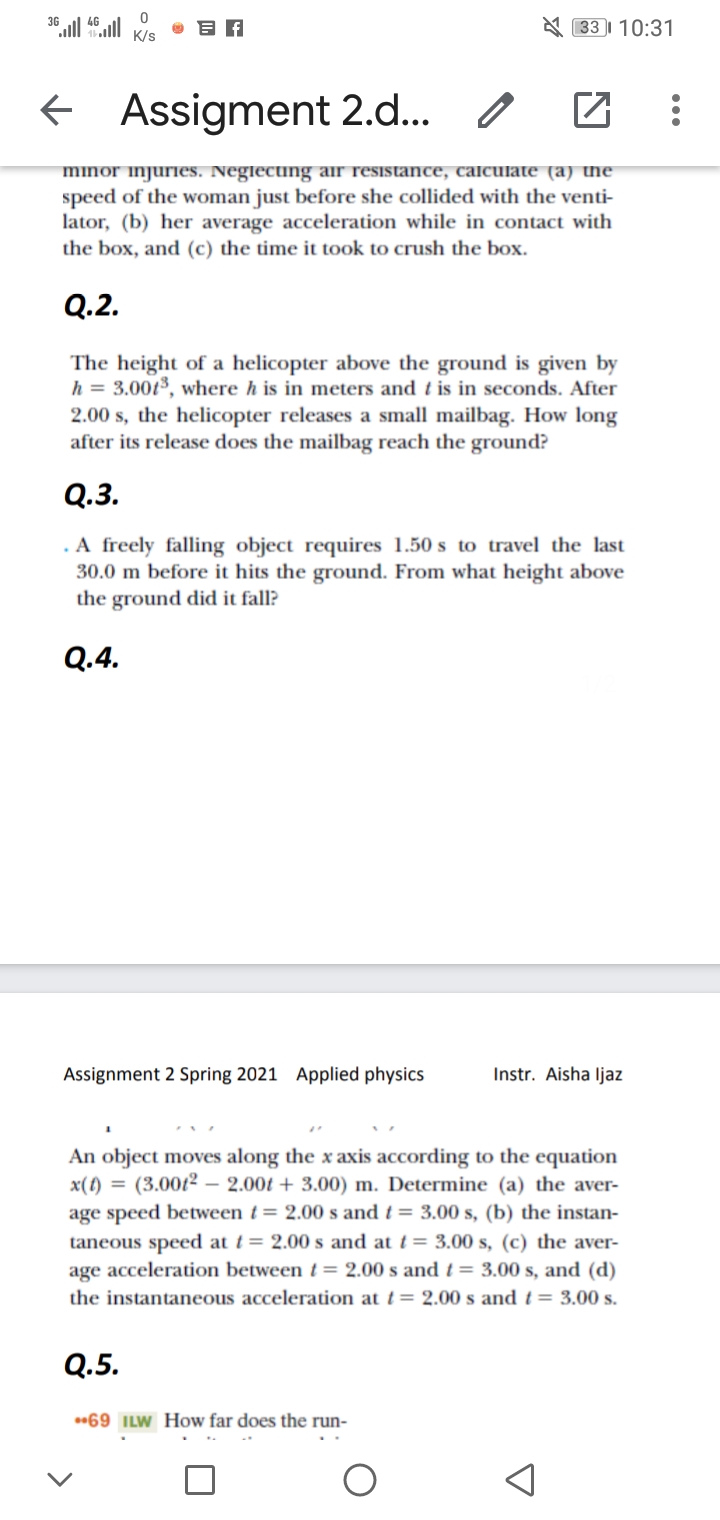
physics problem
 Ahmad234:
@AZ see it
 imqwerty:
Have you tried? Where are you stuck
Ahmad234:
yes. i have tried
 AZ:
AZ:
What exactly did you try? We have an object that's dropped from a height h The last 30 meters of descent take it 1.5 seconds to reach the ground. |dw:1617027705229:dw|
Ahmad234:
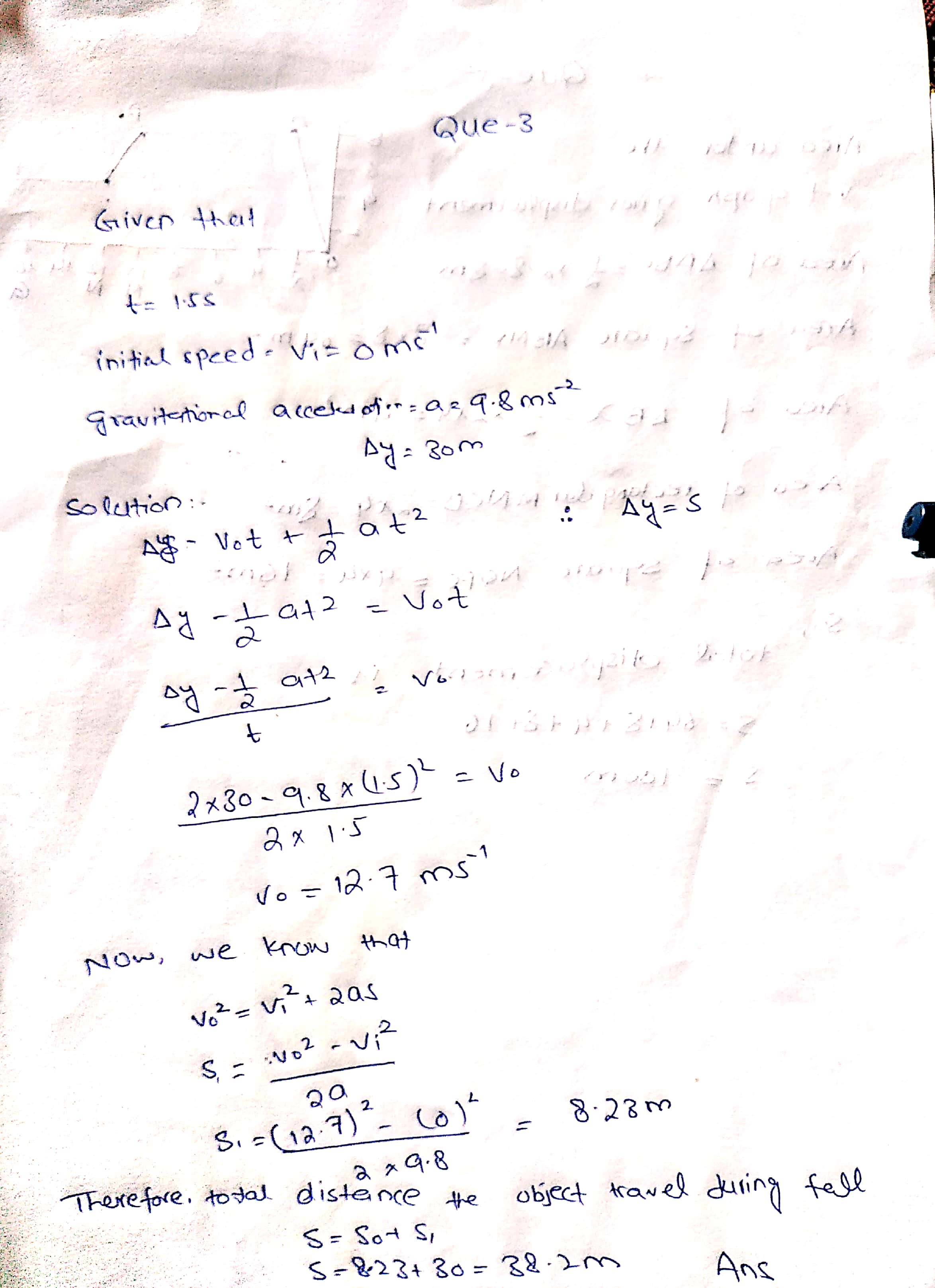
Yes, I have tried. After 45 mins I solved it.
AZ:
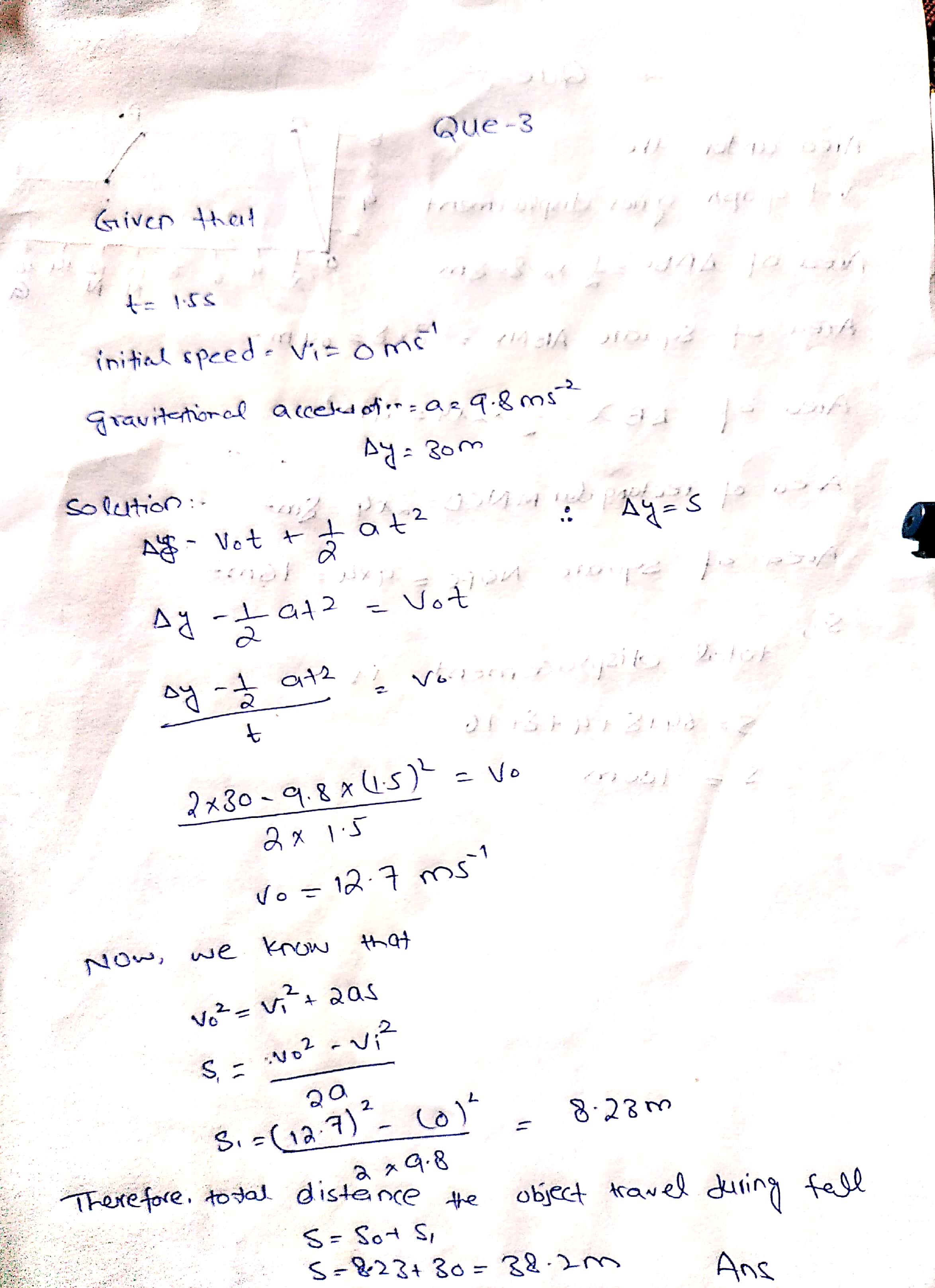
So first, calculate the velocity of the ball when it is 30 meters above the ground \( \Delta x = v_0t + \dfrac{1}{2}at^2\) We know that \(\Delta x = 30\) and that t = 1.5 s a is going to be 9.8 m/s^2 since it's freefall \( v_0\) will be the velocity when the ball is 30 meters high
 AZ:
AZ:
once you calculate the velocity of the ball at 30 meters, we can use the fact that when the ball is initially dropped- the velocity is 0 and then by the time it's 30 meters from the ground, you have that velocity which you just calculated so we have this formula \( v = v_0 + at\) your \( v\) is going to be the velocity you calculated when it's 30 meters above the ground \( v_0\) is going to be 0 since that is the initial velocity when you drop the ball so now you solve for t which is the total time it took for the ball to drop from a height of 'h'
AZ:
and finally you'd use this formula again \(\Delta x = v_0t + \dfrac{1}{2}at^2\) \(\Delta x\) is going to be the 'h' we are looking for the initial velocity of the ball \(v_0\) when it was dropped it 0 a = 9.8 m/s^2 t is the time it took for the ball to drop from the height of h which you just calculated previously
 Ahmad234:
@AZ
AZ:
I think you shouldn't round 12.65 to 12.7 for the velocity of the object when it is 30 m high \( v_0 = 12.65~ ms^{-1}\) But yes, your method works too. It's actually shorter than what I suggested haha
Ahmad234:
Yes, you are right in round off method
Ahmad234:
I am thankfull to you @AZ for help.
AZ:
It was my pleasure!
Join our real-time social learning platform and learn together with your friends!
 VERNEISH:
Two objects are moving along separate linear paths where each path is described by position, d, and time, t.
VERNEISH:
Two objects are moving along separate linear paths where each path is described by position, d, and time, t.

 Maci:
what are the best stock apps for people who want to start investing?
Maci:
what are the best stock apps for people who want to start investing?
 Twaylor:
genuienly how do i get better self control i keep watcing youtube and theres this
Twaylor:
genuienly how do i get better self control i keep watcing youtube and theres this
 IzzyCookie:
|dw:1792074056138:dw| Uhm, I don't know where to ask this, but I'm in college welding at my community college, and I need help learning vertical welding for
IzzyCookie:
|dw:1792074056138:dw| Uhm, I don't know where to ask this, but I'm in college welding at my community college, and I need help learning vertical welding for

 thehearken:
not sure if this is considered spam, im sorry if it is, but does anyone have tips
thehearken:
not sure if this is considered spam, im sorry if it is, but does anyone have tips