
 kamachavis:
Can I get chemistry help?
 kamachavis:
@AZ
 AZ:
AZ:
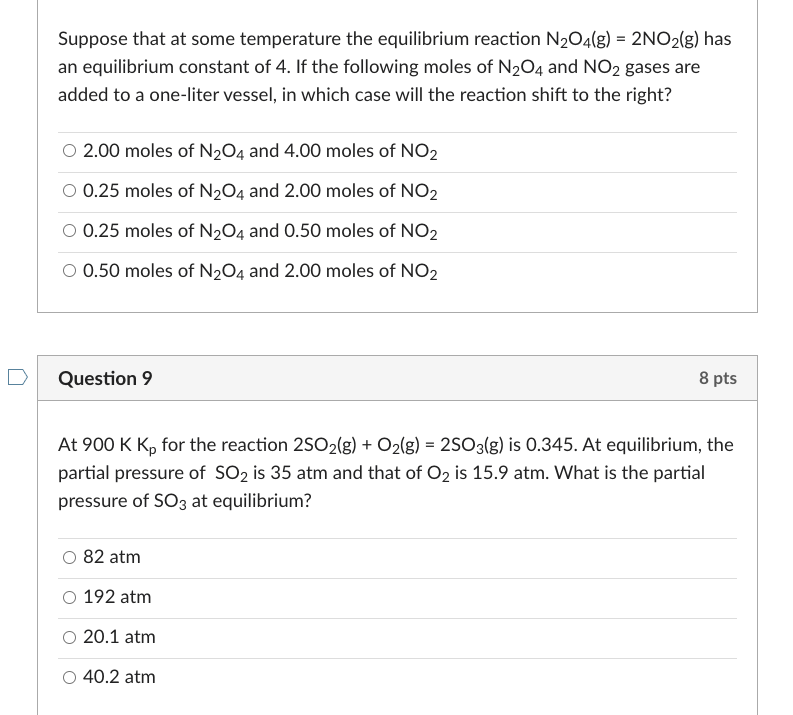
I have no idea for #8 I want to say there's something wrong with the answer choices given For #9, they gave us the equation \(\sf 2~SO_2(g) + O_2(g) \rightleftharpoons 2 ~SO_3(g)\) So if you have the reaction \( aA + bB \rightleftharpoons cC + dD\) Then \(\sf K_p\) can be calculated using the partial pressures of the reactants and products \( K_p = \dfrac{(P_C)^c(P_D)^d}{(P_A)^a(P_B)^b} \) And so for your question \(\sf K_p = \dfrac{(P_{SO_3})^2}{(P_{SO_2})^2(P_{O_2})}\) Plug in the values they gave you \(\sf K_p = 0.345\) \(\sf P_{SO_2} = 35\) \(\sf P_{O_2} = 15.9\) and solve for \(\sf P_{SO_3}\)
kamachavis:
82 atm
AZ:
You got it
kamachavis:
Okay if you could help me with one more and Ill be done for the day haha
kamachavis:
Which of the following statements is true? Group of answer choices An equilibrium can be established only from reactants An equilibrium can be established from any combination of products and rectants An equilibrium can be established only from products An equilibrium can be established only from an equimolar mixture of products and reactants
AZ:
So what do you think it is? What do you know about reactions reaching equilibrium? Do you need to have only reactants or only products? Can it reach equilibrium with both?
kamachavis:
I think its the last choice
AZ:
equimolar means you're adding the same amount of moles think about it you have a reaction x \(\leftrightharpoons\) y you add a bunch of x, and the reaction will move to the right to get to equilibrium you add a bunch of y, and the reaction will move to the left to get to equilibrium
kamachavis:
So the second choice?
AZ:
D is way too specific and not true because yup, you got it :)
kamachavis:
Thank you
AZ:
No problem!
kamachavis:
Now on the question that we couldn't figure out. I thought there would be an answer choice with more moles going to N2O4 than NO2 which would make it go right but there isn.t
kamachavis:
The only thing that may have a piece for that is the equilibrium constant of 4 of the professor just had a typo.
kamachavis:
@AZ
kamachavis:
Or it could be the last answer choice just because 0.50 x 4 is 2.00 but I'm not sure why the constant means
AZ:
OHHHHHH thank you, your last comment made the lightbulb go off in my head
AZ:
we have to calculate \(\sf Q_{c}\) and then compare that to \(\sf K_{eq}\) which is equal to 4 \( aA +bB \rightleftharpoons cC +dD\) \(Q_{c}= \dfrac{[C]_{init}^c[D]_{init}^d}{[A]_{init}^a\text{[}B]_{init}^b} \)
AZ:
so for each answer choice they gave you the moles, and it's in a 1 L vessel basically moles / liter gives you the concentration and since it's 1 L that means those numbers are the concentration
kamachavis:
So it would be the first option?
AZ:
So calculate the \(\sf Q_c\) for each answer choice if \(\sf Q_c > K\) then it shifts to the left if \(\sf Q_c < K\) then it shifts to the right
AZ:
\(\color{#0cbb34}{\text{Originally Posted by}}\) @kamachavis So it would be the first option? \(\color{#0cbb34}{\text{End of Quote}}\) no for your reaction, you have \( \sf Q_c = \dfrac{[NO_2]^2}{[N_2O_4]}\) plug in those values and then compare \(\sf Q_c\) with K which is 4
AZ:
the NO2 value gets squared
kamachavis:
So third option
AZ:
That's your answer!
Join our real-time social learning platform and learn together with your friends!
VERNEISH:
Two objects are moving along separate linear paths where each path is described by position, d, and time, t.

 Maci:
what are the best stock apps for people who want to start investing?
Maci:
what are the best stock apps for people who want to start investing?
 Twaylor:
genuienly how do i get better self control i keep watcing youtube and theres this
Twaylor:
genuienly how do i get better self control i keep watcing youtube and theres this
 IzzyCookie:
|dw:1792074056138:dw| Uhm, I don't know where to ask this, but I'm in college welding at my community college, and I need help learning vertical welding for
IzzyCookie:
|dw:1792074056138:dw| Uhm, I don't know where to ask this, but I'm in college welding at my community college, and I need help learning vertical welding for

 thehearken:
not sure if this is considered spam, im sorry if it is, but does anyone have tips
thehearken:
not sure if this is considered spam, im sorry if it is, but does anyone have tips