
 Hoodmemes:
Question
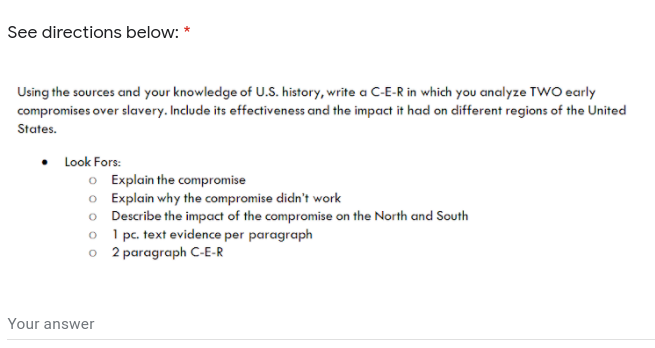
 JamesTDG:
Mind explaining what a C-E-R is?
Hoodmemes:
i was never taught that,i came like in the middle of the school year-can u explain it to me?
Hoodmemes:
Googled it means Claim + Evidence + Reasoning
Hoodmemes:
And i got like 4 topics i can write about too
JamesTDG:
Can't really write you 2 paragraphs...
Hoodmemes:
I need help honestly I got evidence no reasoning tho
Hoodmemes:
But this is what i got so far
Hoodmemes:
The Kansas-Nebraska act was an act created to let the citizens of Kansas and Nebraska choose if they wanted to ban slavery from their borders or allow it. "proslavery Missourians who felt deeply threatened by the possibility of a Free-State on their Western border, in addition to Iowa to the north and Illinois to the East. Border ruffians fought bitterly with Free-State “jayhawkers” and both carried out violent raids "
 snowflake0531:
Look at the bullet points If you include all of those, you have the CERs, well, kinda
Hoodmemes:
thats what im doing,thats what i need help :
snowflake0531:
I hear google is anice resource
Hoodmemes:
i cant use google
Hoodmemes:
I got passages i was told to find evidence from
snowflake0531:
did it specifically say that you can't go on google? or did it just say find teh stuff from textbooks?
Hoodmemes:
stuff from lesson plans
Hoodmemes:
only
snowflake0531:
When you did your lessons, did you ever use google? plus, questioncove is on google, so if we were to tell you anything, we're from google too
JamesTDG:
\(\color{#0cbb34}{\text{Originally Posted by}}\) @Hoodmemes i cant use google \(\color{#0cbb34}{\text{End of Quote}}\) Try using different search engines to locate resources, pretty sure your school can't persecute you for trying to use good resources
Hoodmemes:
I was given resources tho
Hoodmemes:
I found evidence
 QuestionCoveBot:
Could you share the resources?
Hoodmemes:
I need help writing reasoning
Hoodmemes:
he Missouri Compromise 1 During the early 1800s, the United States was a rapidly growing nation. During that time, many Americans were moving west in search of new opportunities. While most white Americans agreed that this expansion was crucial to the health of the nation, they couldn’t agree about what should be done about slavery in the West. As western territories became accepted into the United States as states, it made slavery an explicit concern of national politics. Balancing the interests of slave and free states had played a role from the very start of designing the federal government at the Constitutional Convention in 1787. In 1819, Missouri petitioned to join the United States as a slave state. 2 In 1819, the nation contained eleven free and eleven slave states, creating a balance in the U.S. Senate. Missouri’s entrance threatened to ruin this balance in favor of slave interests. Henry Clay, a leading congressman, played a crucial role in brokering a two-part solution known as the Missouri Compromise. First, Missouri would be admitted to the union as a slave state, but would be balanced by the admission of Maine, a free state. Slavery was to be excluded from all new states in the Louisiana Purchase north of the southern boundary of Missouri. People on both sides of the controversy saw the compromise as deeply flawed. Nevertheless, it lasted for over thirty years until the Kansas-Nebraska Act of 1854. 3 Even though the Missouri crisis ended peacefully for white Americans, it further highlighted the divide between northern and southern states. African Americans obviously opposed slavery and news of some congressiona (government) opposition to its expansion circulated widely within slave communities. Denmark Vesey, a free black man living in Charleston, South Carolina, made the most dramatic use of the white disagreement about the future of slavery in the west. Vesey organized a slave rebellion in 1822 that planned to capture the Charleston Saucenal and seize the city long enough for its black population to escape to the free black republic of Haiti. The rebellion was betrayed just days before its planned starting date and resulted in the execution of thirty-five organizers as well as the destruction of the black church where Vesey preached. 4 Slaveholders were clearly on the defensive with antislavery sentiment building in the north and undeniable opposition among African Americans in the south. Slaves thought that because slavery was being questioned, it could lead to their potential freedom. African Americans knew that they could not rely upon whites to end slavery, but they also recognized that the increasing divide between north and south and their battle over western expansion could open opportunities for blacks to take advantage of. The most explosive of these future black actions would be Nat Turner’s Virginia Slave Revolt in 1831.
Hoodmemes:
Prelude to Compromise 1. HENRY CLAY of Kentucky, JOHN C. CALHOUN of South Carolina, and DANIEL WEBSTER of Massachusetts dominated national politics from the end of the War of 1812 until their deaths in the early 1850s. There was one issue that loomed over the nation throughout their time in power — slavery and its expansion in the western territories. 2. Although the MISSOURI COMPROMISE had temporarily solved the issues over the expansion of slavery in the 1820s, the nation’s rapid expansion after the fact reopened old wounds. Sensing the inevitable acquisition of territory from the Mexican-American War, Congressman David Wilmot proposed an amendment to the peace treaty between the United States and Mexico. The WILMOT PROVISO, as the amendment became known, would have banned slavery in all the territories acquired from the Mexican-American War. Although the Southern-dominated Senate blocked the Wilmot Proviso, it’s admission to Congress reignited debates over the expansion of slavery. 3. There were other issues. The Gold Rush led to the rapid settlement of California which resulted in its imminent admission as the 31st state. Southerners recognized that there were few slaves in California because Mexico had prohibited slavery. Immediate admission would surely mean California would be the 16th free state, giving the non-slave-holding states an edge in the Senate. Already holding the House of Representatives, the free states could then dominate legislation. Texas was claiming land that was part of New Mexico. As a slave state, any expansion of the boundaries of Texas would be opening new land to slavery. northerners were opposed. The north was also appalled at the ongoing practice of slavery in the nation's capital — a practice the south was not willing to let go. The lines were drawn as the three Senatorial giants took the stage for the last critical time. Why did adding a new state to the union cause problems between the North & South? This caused problems between the North & South because in the South they wanted to make savery an ongoing thing the North apposed to their opinion wanting to abolish it.The cause of Texas a state in the south claiming a part of New Mexico with it,it would have made it harder for the North to end slavery. 4. Clay had brokered compromises before. He put forth a set of eight proposals, known as the COMPROMISE OF 1850, that he hoped would solve all the aforementioned issues in one fell swoop. The Compromise of 1850 5. Clay’s plan was set forth. Still the Congress debated the contentious issues well into the summer. Each time Clay's Compromise was set forth for a vote, it did not receive a majority. Clay himself had to leave in sickness, before the dispute could be resolved. In his place, Stephen Douglas worked tirelessly to end the fight. On July 9, President Zachary Taylor died of food poisoning. His successor, MILLARD FILLMORE, was much more interested in compromise. The environment for a deal was set. By September, Clay's Compromise became law. California was admitted to the Union as the 16th free state. In exchange, the south was guaranteed that no federal restrictions on slavery would be placed on Utah or New Mexico. Texas lost its boundary claims in New Mexico, but the Congress compensated Texas with $10 million. Slavery was maintained in the nation's capital, but the slave trade was prohibited. Finally, and most controversially, a FUGITIVE SLAVE LAW was passed, requiring northerners to return runaway slaves to their owners under penalty of law. What is the Fugitive Slave Law? How did this law divide the nation? The fugitive slave law was a law passed that required nother people to return all runaway slaves.This divided the nation between Notherns and Southerns because northern people wanted to abolish slavery and southern people did not. North Gets South Gets California admitted as a free state No slavery restrictions in Utah or New Mexico territories Slave trade prohibited in Washington D.C. Slaveholding permitted in Washington D.C. Texas loses boundary dispute with New Mexico Texas gets $10 million Fugitive Slave Law 6. Who won and who lost in the deal? Although each side received benefits, the north seemed to gain the most. The balance of the Senate was now with the free states, although California often voted with the south on many issues in the 1850s. The major victory for the south was the Fugitive Slave Law. In the end, the north refused to enforce it. Massachusetts even called for its nullification, stealing an argument from John C. Calhoun. Northerners claimed the law was unfair. The flagrant violation of the Fugitive Slave Law set the scene for the tempest that emerged later in the decade. But for now, Americans hoped against hope that the fragile peace would prevail. Why was the Compromise of 1850 ineffective in dealing with the issue of slavery?
Hoodmemes:
1 In 1854, amid sectional tension over the future of slavery in the Western territories, Senator Stephen A. Douglas proposed the Kansas-Nebraska Act, which he believed would serve as a final compromise measure. Through the invocation of popular sovereignty, Douglas’s proposal would allow the citizens of the Kansas and Nebraska Territories, rather than the federal government, to decide whether to permit or prohibit slavery within their borders. Who proposed the Kansas-Nebraska Act and what was the purpose of it? Stephan Douglass proposed the act it was to let the citizens of Kansas Nebraska choose if they wanted to ban slavery from their borders or allow it. Define “popular sovereignty” and explain how the concept was different from previous compromises. Popular sovereignty was power given to the people.In previous compromises they didn't let citizens choose they let those of higher power such as governments choose. 2 In response to the Kansas-Nebraska Act, pro- and antislavery forces descended on Kansas, followed by an outburst of violence and intimidation. Dissent in the North and West was so profound that the antislavery Republican Party formed even before the law’s enactment and quickly peeled Northern, antislavery members away from the Democratic, Whig, and Free-Soil Parties, with the latter two parties formally dissolving by the end of 1854 and 1860, respectively. How did the Kansas-Nebraska Act lead to the formation of the Republican Party? There was a disagreement in the north and west due to the Kansas-Nebraska Act.This resulted in the birth of the Republican party. 3 During the 1840s, the push to organize the Kansas and Nebraska Territories was inspired by the prospects of a Transcontinental Railroad and Western settlement. The problem of determining the railway’s route—whether it would pass through northern (free) or southern (slave) territory—was hotly debated and prevented any construction.The primary argument against a Northern route was the Missouri Compromise of 1820, which banned slavery north of Missouri’s southern border at the 36 30’ parallel. 4 Without the support of slave-state Senators, the likelihood of completing the railroad remained very low. Hoping to bridge the divide, Stephen Douglas stepped in and argued that the rule of popular sovereignty had effectively been implemented in the Compromise of 1850. Douglas also had personal and financial reasons for securing a Northern route, which he believed would run through his home state of Illinois, where he had heavily invested in real estate. In an effort to further appease Southern politicians and win their votes, Douglas worked behind the scenes to ensure that the Missouri Compromise line was formally repealed. 5 Opponents of the law expressed outrage over the dismissal of the Missouri Compromise and accused Douglas of submitting to the slave power. “Anti-Nebraska” organizations quickly materialized throughout the North and Midwest to prevent the western expansion of slavery. How did opponents of the Kansas-Nebraska Act respond to the law? They responded to the missouri Compromise by becoming indignation towards Douglas because he was working to please the southern politicians that wanted slavery. Anti-Nebraska organizations quickly appeared throughout North and Midwest to prevent the expansion of slavery.5 6 In Kansas, two opposing territorial governments and constitutions formed and a localized civil war exploded. Military-minded combatants included so-called “border ruffians,” proslavery Missourians who felt deeply threatened by the possibility of a Free-State on their Western border, in addition to Iowa to the north and Illinois to the East. Border ruffians fought bitterly with Free-State “jayhawkers” and both carried out violent raids and committed massive voter-fraud, leading to national headlines describing Bleeding Kansas. 7 The fiery abolitionist John Brown arrived in Kansas in 1855, bringing with him an interpretation of the Kansas-Nebraska Act as a divine call to arms, and his acts of aggression against Missouri slave owners came to characterize the violence along the border. By 1856, political antagonisms over the Kansas-Nebraska Act only intensified in the halls of Congress, culminating in the caning of Senator Charles Sumner by Preston Brooks, a Congressman from South Carolina. Instead of denouncing Brooks’s violent actions, which might have eased the national divide, inspired Southerners sent Brooks hundreds of canes as a sign of solidarity. 8 Another consequence of the Kansas-Nebraska Act was the usurpation of longstanding party affiliations according to sectional loyalties. The cause of free soil over the interest of slavery led many Northern, antislavery Whigs, Free-Soilers, and Democrats to abandon their traditional party affiliations and join the new Republican Party in 1854. In the 1856 election, the Republicans produced their first presidential candidate, John C. Frémont, who represented solely Northern interests. Despite a losing campaign, Frémont managed to win over a substantial number of voters. What were the consequences of the Kansas-Nebraska Act? Civil war in Kansas,border ruffians fought bitterly with free state “jayhawkers”,both carried out violent raid,committed massive voter-fraud leading Bleeding Kansas,and John Browns raid Political Divide Long standing part affiliations to sectional loyalties Caning of Senator Charles Summer by Preston Brooks 9 Combined with the admittance of Kansas into the Union as a free state in January 1861, the election of Republican Abraham Lincoln in 1860 represented a major defeat for Stephen Douglas and the hope that popular sovereignty would prevent a complete breakdown of national politics along sectional lines. In a bitter ironic twist, rather than achieving a lasting compromise, the Kansas-Nebraska Act ultimately divided the nation and led it further down the path to civil war. How was the Kansas-Nebraska Act different from both the Missouri Compromise and the Compromise of 1850? The KN act allowed citizens of Kansas and Nebraska to vote on the problem of slavery.
Hoodmemes:
Eh i said i need help writing reasoning,and that u can help me if we just look at the evidence i chose.
Hoodmemes:
I dont need yall to look a the sources.
QuestionCoveBot:
Lemme take like 5 minutes to read all that to help you.
Hoodmemes:
i dont need u to read it
Hoodmemes:
I just need u tell help me write reasoning
Hoodmemes:
The Kansas-Nebraska act was an act created to let the citizens of Kansas and Nebraska choose if they wanted to ban slavery from their borders or allow it. "proslavery Missourians who felt deeply threatened by the possibility of a Free-State on their Western border, in addition to Iowa to the north and Illinois to the East. Border ruffians fought bitterly with Free-State “jayhawkers” and both carried out violent raids " Thats all i need help writing reasoning for
Hoodmemes:
If u cant or just dont want to help, thats 100% ok
Hoodmemes:
\(\color{#0cbb34}{\text{Originally Posted by}}\) @snowflake0531 newsflash: I'm not reading that \(\color{#0cbb34}{\text{End of Quote}}\) ok
QuestionCoveBot:
To make it clear if someone doesn't understand what reasoning is... You need help writing how your evidence supports your claim?
Hoodmemes:
naw its called reasoning
QuestionCoveBot:
That's exactly what that means. Reasoning: "Reasoning is the process for making clear how your evidence supports your claim. In scientific argumentation, clear reasoning includes using scientific ideas or principles to make logical connections to show how the evidence supports the claim. Students often have difficulty making their reasoning clear in an argument."
Hoodmemes:
concrete details,evidence,and reasoning
 Shayla:
What exactly is the claim ?
Hoodmemes:
Im doing it in order. Explaining the compromise evidence how it didn't work and what was the impact it left
Shayla:
Oh okay
Hoodmemes:
i need helping writing how it didnt work
QuestionCoveBot:
Ooooooooooooooooooh okay. That makes more sense now.
Hoodmemes:
can u help?
Hoodmemes:
Cuz i'v finished one already
QuestionCoveBot:
Yes. I can help, if I don't get confused in the process.
Hoodmemes:
The Missouri Compromise was a multiple set of agreements between the North and the South on free states and slave states. “In 1819, the nation contained eleven free and eleven slave states, creating a balance in the U.S. Senate. Missouri’s entrance threatened to ruin this balance in favor of slave interests.” and “ First, Missouri would be admitted to the union as a slave state, but would be balanced by the admission of Maine, a free state.”.They did such things to keep some type of peace between the North and South even though their opinions differed. It seemingly looked like a good idea at some point but ended in a bigger feud. At some point in time, the South wanted to legally include the Fugitive Slave law. The Fugitive Slave Law was a law made that stated all fugitive slaves that went to the North to seek freedom must be returned to the South is found. This ended in the North fighting against the entire law itself and the South trying to counterpoint their argument in court. The Missouri Compromise worsened the controversy between the anti-slavery North and the pro-slavery South. First one ^ done
QuestionCoveBot:
So... if I take it correctly, you have to write how the Missouri-Compromise didn't work?
Hoodmemes:
and how the Kansas-Nebraska act didn't either
QuestionCoveBot:
Kansas-Nebraska Act: "The Kansas-Nebraska Act was an 1854 bill that mandated “popular sovereignty”–allowing settlers of a territory to decide whether slavery would be allowed within a new state's borders." - from history.com Missouri Compromise: "In an effort to preserve the balance of power in Congress between slave and free states, the Missouri Compromise was passed in 1820 admitting Missouri as a slave state and Maine as a free state." - from guides.loc.gov
Hoodmemes:
I need help writing reasoning on the downfall not finding evidence
Shayla:
So your quote from the text is saying that the Kansas-Nebraska act made the surrounding states feel threatened by the thought of there being no slavery, correct?
Hoodmemes:
I'v finished the paragraphs in the time span yall were helping.
Hoodmemes:
could somebody look over them for me.
Shayla:
Sure
QuestionCoveBot:
\(\color{#0cbb34}{\text{Originally Posted by}}\) @Hoodmemes could somebody look over them for me. \(\color{#0cbb34}{\text{End of Quote}}\) I will. :)
Hoodmemes:
The Missouri Compromise was a multiple set of agreements between the North and the South on free states and slave states. “In 1819, the nation contained eleven free and eleven slave states, creating a balance in the U.S. Senate. Missouri’s entrance threatened to ruin this balance in favor of slave interests.” and “ First, Missouri would be admitted to the union as a slave state, but would be balanced by the admission of Maine, a free state.”.They did such things to keep some type of peace between the North and South even though their opinions differed.It seemily looked like a good idea at some point but ended in a bigger feud.At some point in time the South wanted to legally include the Fugitive Slave law.The Fugitive Slave Law was a law made that stated all fugitive slaves that went to the North to seek freedom must be returned to the South is found.This ended in the North fighting against the entire law itself and the South trying to counterpoint their argument in court.The Missouri Compromise worsened the controversy between the anti- slavery North and the pro-slavery South. The Kansas-Nebraska act was an act created to let the citizens of Kansas and Nebraska choose if they wanted to ban slavery from their borders or allow it. "proslavery Missourians who felt deeply threatened by the possibility of a Free-State on their Western border, in addition to Iowa to the north and Illinois to the East. Border ruffians fought bitterly with Free-State “jayhawkers” and both carried out violent raids ".During the act Nebraska became a slave state and Kansas became a free state.This caused anti-Nebraska riots to begun because northerners wanted to stop the expansion of slavery.Due to those riots slave owners from Missouri came to Kansas and started very brutal riots to prove that Kansas should be a slave state.This basically caused Bleeding Kansas that included a lot of voter fraud and vicious riots.This compromise in the Kansas-Nebraska act led to a bigger feud between the South's and North's opinions on anti-slavery and pro-slavery.
QuestionCoveBot:
This is good. :) You just need to add spaces between your periods and your starting sentences.
Hoodmemes:
thanks, all ppl that helped and those who tried!
QuestionCoveBot:
Your welcome.
Join our real-time social learning platform and learn together with your friends!
 VERNEISH:
Two objects are moving along separate linear paths where each path is described by position, d, and time, t.
VERNEISH:
Two objects are moving along separate linear paths where each path is described by position, d, and time, t.

 Maci:
what are the best stock apps for people who want to start investing?
Maci:
what are the best stock apps for people who want to start investing?
 Twaylor:
genuienly how do i get better self control i keep watcing youtube and theres this
Twaylor:
genuienly how do i get better self control i keep watcing youtube and theres this
 IzzyCookie:
|dw:1792074056138:dw| Uhm, I don't know where to ask this, but I'm in college welding at my community college, and I need help learning vertical welding for
IzzyCookie:
|dw:1792074056138:dw| Uhm, I don't know where to ask this, but I'm in college welding at my community college, and I need help learning vertical welding for

 thehearken:
not sure if this is considered spam, im sorry if it is, but does anyone have tips
thehearken:
not sure if this is considered spam, im sorry if it is, but does anyone have tips