
 Angle:
@crispyrat
 Angle:
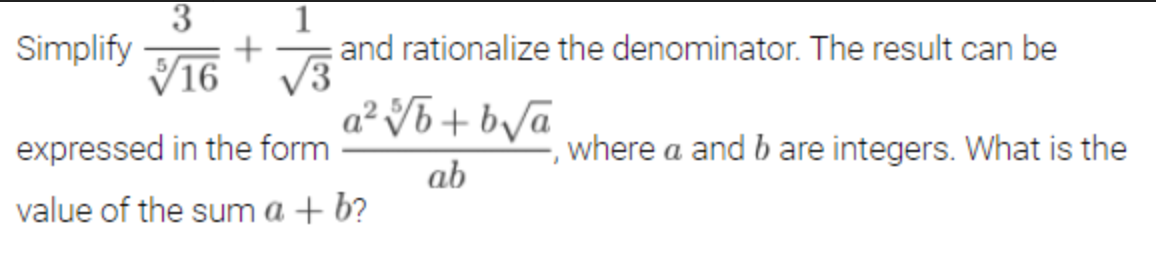
One of the ideas we want to use in this problem is how square roots are related to fractional exponents. For example, \(\large\sqrt{x} = x^{\frac{1}{2}}\) This also helps us understand a bit about how rationalizing denominators work. \(\large x^{\frac{1}{2}}\times x^{\frac{1}{2}}=x^{\frac{1}{2}+\frac{1}{2}}=x^{1} = x\)
 Spectrum:
@snowflake0531 @az
Angle:
This is why we are allowed to do something like: \(\huge \frac{4}{\sqrt{5}}= \frac{4}{\sqrt{5}}\times\frac{\sqrt{5}}{\sqrt{5}} = \frac{4 \sqrt{5}}{5}\)
Angle:
The situation becomes a little different with your ` 5th root ` in this problem \(\large\sqrt[5]{x} = x^{\frac{1}{5}}\) This means that the \(\sqrt[5]{16}\) in your problem is equal to \(16^{1/5}\) In this case, the 16 is interesting, because it's prime factorization is a key point in this problem.
 Shawnte:
better use pemdas.......ask @Tranquility its the best way to do it
Angle:
@Shawnte there's not a brain cell in your head that understands anything that I'm saying here, stay out of this
Angle:
16 can be written as follows: \(16 = 2\times2\times2\times2 = 2^4\) This means that: \(\large\sqrt[5]{16} = (16)^{\frac{1}{5}} = (2^4)^{\frac{1}{5}} = 2^{(4 \times \frac{1}{5})} = 2^{\frac{4}{5}}\)
Angle:
Therefore, in order to "rationalize the denominator" of something with the 5th root of 16 in the bottom, we want to multiply the top and bottom of that fraction by \(2^{\frac{1}{5}}\)
Angle:
I'll say that 4/5 = 0.8 and 1/5 = 0.2 for the sake of avoiding the weird fraction font in the exponents \(\huge \frac{3}{\sqrt[5]{16}} = \frac{3}{2^{0.8}} = \frac{3}{2^{0.8}}\times\frac{2^{0.2}}{2^{0.2}} = \frac{3 \times 2^{0.2}}{2^{0.8}\times2^{0.2}}\) \(= \huge \frac{3 \times 2^{(\frac{1}{5})}}{2^{(0.8+0.2)}} = \frac{3 ~\sqrt[5]{2}}{2^1} = \frac{3 ~\sqrt[5]{2}}{2}\)
Angle:
You'll be able to notice what the ` a ` and ` b ` values for this problem should be at this point, but just let me know if you got confused at any part along the way.
Join our real-time social learning platform and learn together with your friends!
 VERNEISH:
Two objects are moving along separate linear paths where each path is described by position, d, and time, t.
VERNEISH:
Two objects are moving along separate linear paths where each path is described by position, d, and time, t.

 Maci:
what are the best stock apps for people who want to start investing?
Maci:
what are the best stock apps for people who want to start investing?
 Twaylor:
genuienly how do i get better self control i keep watcing youtube and theres this
Twaylor:
genuienly how do i get better self control i keep watcing youtube and theres this
 IzzyCookie:
|dw:1792074056138:dw| Uhm, I don't know where to ask this, but I'm in college welding at my community college, and I need help learning vertical welding for
IzzyCookie:
|dw:1792074056138:dw| Uhm, I don't know where to ask this, but I'm in college welding at my community college, and I need help learning vertical welding for

 thehearken:
not sure if this is considered spam, im sorry if it is, but does anyone have tips
thehearken:
not sure if this is considered spam, im sorry if it is, but does anyone have tips