
 jnlkmnjkm:
math problem

 jnlkmnjkm:
@AZ
 darkknight:
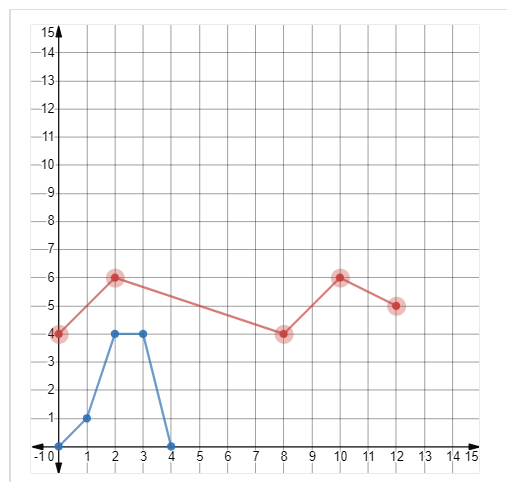
You want to draw the red function as (1/3x) when the blue function is f(x) basically you would have a horizontal stretch of 3 times, remember inside the parenthesis things work backwards, for example (x-1) shifts tothe right, and f(1/3 x) is f(x) but stretched (by 3 times)
darkknight:
The easiest way to do this is take every point on the red function and plug it in, then you can see where to plot the blue function, for example f(0) = 4 where 0 is x at this point, so f(1/3 x) will also be f(0) because 1/3 * x = 0, so x would have to be zero. Basically that means the point (0,4) will be on the blue function as well
darkknight:
lol im in class rn so idk if my brain is working or not, ill get toyou in a few min for the rest of this
Kimberlyramon:
I need help with my Sauceulative exam can anyone help?
darkknight:
So for horizontal stretches or compresssions of some function f(x) goes by f(a * x) when 0 < a < 1, then the graph is stretched by a factor of a, and if a>1 then the graph is compressed by a factor of a, basically just telling you what I told you in the first part of this
darkknight:
You following why f(1/3x) is 3 times horizontally stretched then f(x) right?
jnlkmnjkm:
yep
darkknight:
alright! moving on, \(\color{#0cbb34}{\text{Originally Posted by}}\) darkknight The easiest way to do this is take every point on the red function and plug it in, then you can see where to plot the blue function, for example f(0) = 4 where 0 is x at this point, so f(1/3 x) will also be f(0) because 1/3 * x = 0, so x would have to be zero. Basically that means the point (0,4) will be on the blue function as well \(\color{#0cbb34}{\text{End of Quote}}\) basically continue that process, except you dont need to do as much math, every point will be 3 times further from the origin, for example (2, 6) will be at (6, 6). (8, 4) will be at (24,4) Quick question: you can zoom out of the graph you have right now right?
jnlkmnjkm:
i cant
jnlkmnjkm:
x =1
jnlkmnjkm:
hats next
darkknight:
OHHHHHHHHHHHHHH i misread, the graph of f(x) is in blue
darkknight:
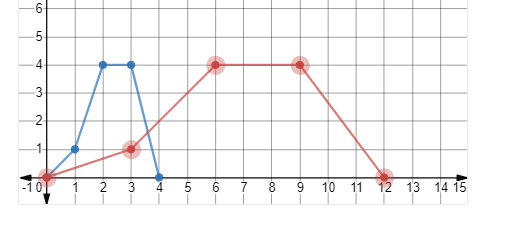
well just take all points on the blue function (x, y) and transform them to (3x, y) for example the point at (3, 4), the corresponding point on the red function will be at (9,4)
jnlkmnjkm:
x = 1 i then change it to y =1 ?
darkknight:
which point you talking about?
jnlkmnjkm:
1, 1
darkknight:
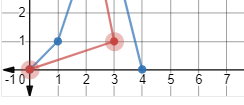
\(\color{#0cbb34}{\text{Originally Posted by}}\) darkknight well just take all points on the blue function (x, y) and transform them to (3x, y) for example the point at (3, 4), the corresponding point on the red function will be at (9,4) \(\color{#0cbb34}{\text{End of Quote}}\) so (1, 1) will be (x, y). this is for the blue function you have, then (3x, y) will be the corresponding point for the red function, remember cuz we are stretching by a factor of 3 horizontally. if you plug in 1,1 into (3x, y) you get (3(1), 1) or (3, 1) which would be the point you plot on the red graph. Now do that for all points
jnlkmnjkm:
multiply or divide?
darkknight:
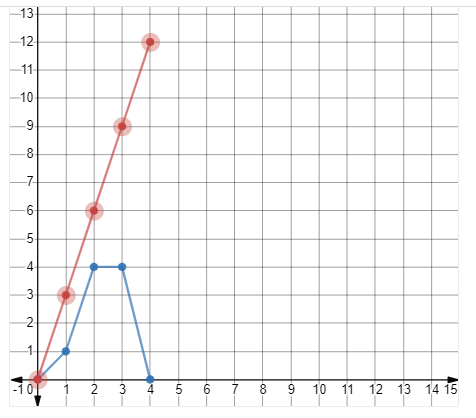
in other words just take the x-coor of every point and multiply by 3, thats all u gotta do
 darkknight:
???
jnlkmnjkm:
is the graph made correct?
darkknight:
\(\color{#0cbb34}{\text{Originally Posted by}}\) @darkknight in other words just take the x-coor of every point and multiply by 3, thats all u gotta do \(\color{#0cbb34}{\text{End of Quote}}\) keep the y coor the same. you are taking points from the blue function, idk what you did in that ss
jnlkmnjkm:
1 multiplied by 3 is 3
 jnlkmnjkm:
darkknight
jnlkmnjkm:
@darkknight
 Imagine:
She will get to it when possible, thanks.
darkknight:
yeah thats the first point right, now keep going with all the other points
 darkknight:
correct
darkknight:
have a good day
jnlkmnjkm:
thanks
Join our real-time social learning platform and learn together with your friends!
VERNEISH:
Two objects are moving along separate linear paths where each path is described by position, d, and time, t.

 Maci:
what are the best stock apps for people who want to start investing?
Maci:
what are the best stock apps for people who want to start investing?
 Twaylor:
genuienly how do i get better self control i keep watcing youtube and theres this
Twaylor:
genuienly how do i get better self control i keep watcing youtube and theres this
 IzzyCookie:
|dw:1792074056138:dw| Uhm, I don't know where to ask this, but I'm in college welding at my community college, and I need help learning vertical welding for
IzzyCookie:
|dw:1792074056138:dw| Uhm, I don't know where to ask this, but I'm in college welding at my community college, and I need help learning vertical welding for

 thehearken:
not sure if this is considered spam, im sorry if it is, but does anyone have tips
thehearken:
not sure if this is considered spam, im sorry if it is, but does anyone have tips