
 jnlkmnjkm:
math problem

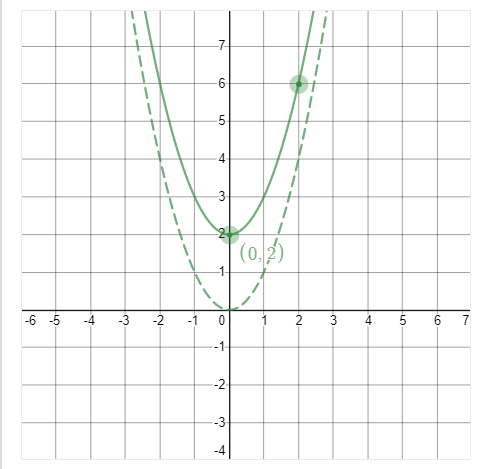 jnlkmnjkm:
@snowflake0531
jnlkmnjkm:
@AZ
 snowflake0531:
I'm still soooooooooo confused, but if you put into desmos x^2 y=f(2x-4)-1 f=anything you can see that whatever you slide f equals, it always intersects (2-1) maybe that's where your vertex should be at then ?_?
jnlkmnjkm:
im not sure
snowflake0531:
Slide the vertex of the parabola to (2,-1) do you know what vertex is
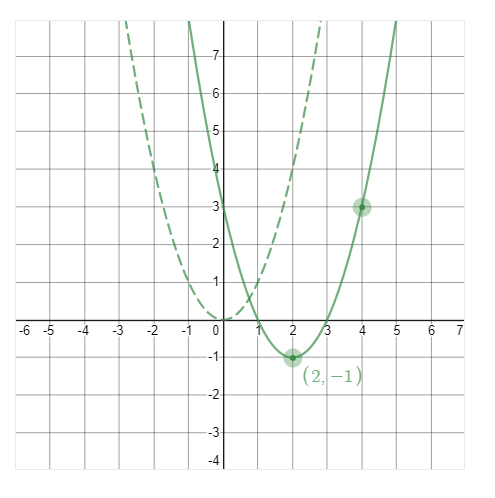 snowflake0531:
Yea... and then.... I absolutely have no clue I don't understand the f(2x-4)-1 thing..... lemme look through all your former questions xd
jnlkmnjkm:
@Honda @Hoodmemes
 Honda:
yes? what do you need help with?
jnlkmnjkm:
this uestion
Honda:
i don't understand what you asking tho sorry
jnlkmnjkm:
@darkknight
 darkknight:
f(2x-4) - 1 lets now do f(2(x-2))-1 This is a little harder then the other questions, but now how would the transformations look like? remember first horizontal dilations, then horizontal shifts, then vertical dilations, then vertical shifts
jnlkmnjkm:
translation?
darkknight:
can you be more specific? how would the transformations look like
jnlkmnjkm:
im not sure
jnlkmnjkm:
help
jnlkmnjkm:
im not sure what the transformations look like
darkknight:
That is perfectly fine, but we have gone over 10+ questions like this, any idea at all?
darkknight:
If you have none then that means you werent paying attention, I aint a puppet that repeats stuff a billion times ._.
jnlkmnjkm:
so sorry not sure lol
jnlkmnjkm:
its my last uestion
jnlkmnjkm:
whats first step
jnlkmnjkm:
darkknight
jnlkmnjkm:
az
darkknight:
\(\color{#0cbb34}{\text{Originally Posted by}}\) jnlkmnjkm so sorry not sure lol \(\color{#0cbb34}{\text{End of Quote}}\) life doesnt work like that, you are showing you havent learned ANYTHING. Thats not the point. I just asked about horizontal/vertical dilations and horizontal/vertical shifts. I even broke it down here f(2x-4) - 1 lets now do f(2(x-2))-1 At this point its on you. I aint abandoning, you have to at least give an IDEA. Not just sit there and write stuff down while I am typing. Why did you say earlier that you were forllowing along if you werent?
jnlkmnjkm:
sorry whats first step
jnlkmnjkm:
@AZ
 AZ:
AZ:
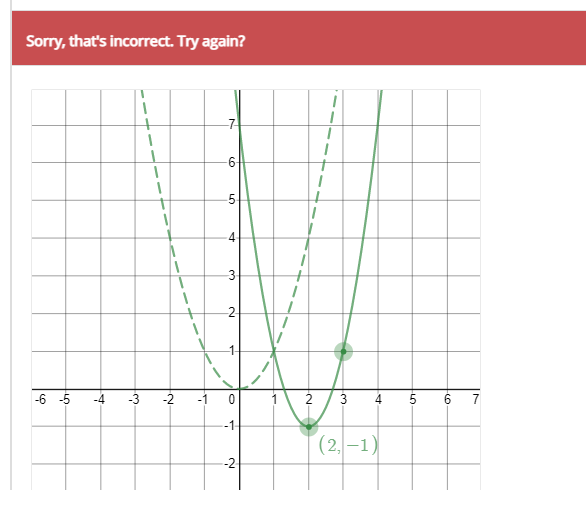
lol okay, let's just plug in numbers? the original graph is your f(x) the new graph is going to be f(2x-4) -1 so let's plug in some numbers to see how your new graph looks like if we say x = 1 f(2*1 - 4) - 1 what is 2 - 4 = and find the y-value on your dashed line at that x-value and then subtract 1 that's going to be the y-value for when x = 1 on your new graph
jnlkmnjkm:
-2
jnlkmnjkm:
y value is 4
jnlkmnjkm:
3?
AZ:
yes, so one of the points on your new graph is (1, 3) now similarly let's find out what the point on your new graph will be when x = 2 so same steps f(2*2 - 4) - 1 what is (2*2) - 4 = and find the y-value on your dashed line at that x-value and then subtract 1
jnlkmnjkm:
4-4=0
jnlkmnjkm:
0-1=-1
AZ:
good so another point on your new graph. So when x = 2, y = -1 let's do it one more time for when x = 3 f(3*2 - 4) - 1 what is (3*2) - 4 = and find the y-value on your dashed line at that x-value and then subtract 1
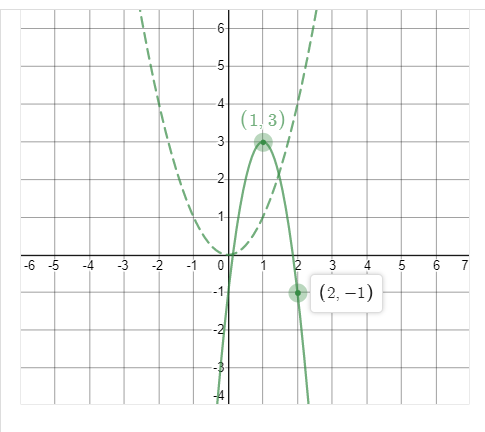 AZ:
AZ:
nope, the graph shouldn't be flipped it's because the vertex is wrong so let's find one more point so you can see how the graph will look correct so for when x = 3 f(3*2 - 4) - 1 what is (3*2) - 4 = and find the y-value on your dashed line at that x-value and then subtract 1
jnlkmnjkm:
3
jnlkmnjkm:
3?
AZ:
good so (3, 3) so put the first vertex dot at (2, -1) and the second one as (3, 3)
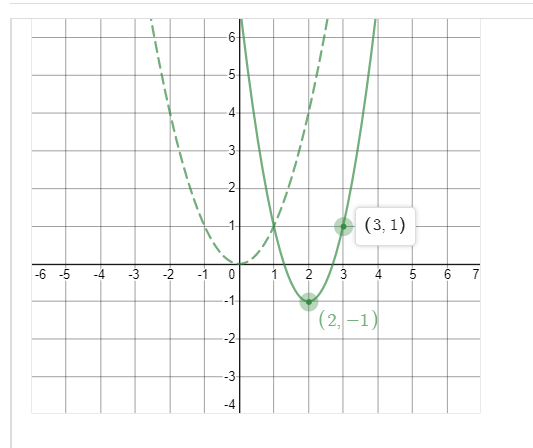 jnlkmnjkm:
az
AZ:
yes
 jnlkmnjkm:
az
AZ:
oh, you didn't plot it correctly it's (3, 3)
jnlkmnjkm:
thanks
Join our real-time social learning platform and learn together with your friends!
VERNEISH:
Two objects are moving along separate linear paths where each path is described by position, d, and time, t.

 Maci:
what are the best stock apps for people who want to start investing?
Maci:
what are the best stock apps for people who want to start investing?
 Twaylor:
genuienly how do i get better self control i keep watcing youtube and theres this
Twaylor:
genuienly how do i get better self control i keep watcing youtube and theres this
 IzzyCookie:
|dw:1792074056138:dw| Uhm, I don't know where to ask this, but I'm in college welding at my community college, and I need help learning vertical welding for
IzzyCookie:
|dw:1792074056138:dw| Uhm, I don't know where to ask this, but I'm in college welding at my community college, and I need help learning vertical welding for

 thehearken:
not sure if this is considered spam, im sorry if it is, but does anyone have tips
thehearken:
not sure if this is considered spam, im sorry if it is, but does anyone have tips