
 darkknight:
(Algebra 2/precalc skill) transformations of functions, Please do not comment, ty
darkknight:
These are some common parental functions: Linear: f(x) = \[x\] Quadratic: h(x) = \[x^2\] Cubic, g(x) = \[x^3\] Absolute value, \[k(x) = \left| x \right|\] Reciprocal function: \[y =1/x\] Square root function: \[y=\sqrt{x}\] where: \[D:[0, \infty ) \]\[R:[0, \infty)\]
darkknight:
Above, are some examples of common parental functions, Next up, basic transformations. Translation of some function f(x). This shifts a graph h units right and k units up. \[f(x-h)+k\] Reflections: \( -f(x) \) reflects \( f(x) \) about the x-axis, so that \( (x,y)\rightarrow(x, -y) \) \( f(-x) \) reflects \( f(x) \) about the y-axis, so that \( (x, y)\rightarrow(-x,y)\) Dilations: These are a stretch OR compression of a function, either performed horizontally or vertically. * Vertical dilation: is a stretch of compression about the x-axis * Horizontal dilation: A stretch or compression about the y=axis Vertical Stretch of \( f(x): a* f(x) \) \( 0<a<1 \) results in a compression by a factor of a \( a>1 \) results in a stretch by a factor of a Horizontal stretch of \( f(x) : f(a*x) \) Where \( 0<a<1\) results in a stretch by a factor of a And \( a>1 \) results in a compression by a factor of a
darkknight:
Transformations should be performed in this order: 1) First Horizontal dilations/reflections about the y-axis 2) Horizontal shifts 3) Vertical dilations/reflections about the x-axis 4) vertical shifts
darkknight:
Lets now look at a few examples, for the function \( f(x) = x^2-5x+1\) What translation is needed to obtain the function of \( g(x) = (x+2)^2-5(x+2)+4 \) ??? There are a few ways to approach this, the easiest and perhaps the most time consuming is to get the function g(x) into the standard form of quadratics. \( (x+2)^2-5(x+2)+4 = x^2+4x+4-5x-10+4 \) Combine like terms: \( x^2+4x+4-5x-10+4 = g(x) = x^2-x-2\) Now we use the quadratic formula to find the vertex of both parabolas. \( +5/2 = 2.5 \) this is the x coordinate of the vertex for f(x) to find the y-coordinate, plug in the x coor into function: \( (2.5)^2-5(2.5)+1 = -5.25\) Vertex for function f(x) is at (2.5, -5.25) Vertex for function g(x) (steps not shown, but do same thing as did with f(x) ) is at (0.5, -2.25) Now to get from f(x) to g(x), we need to subtract 2 from the x-coor (go 2 to the left) and then add 3 to the y-coor (go 3 units up) In all for this example, we needed to shift to the left 2 and up 3.

 darkknight:
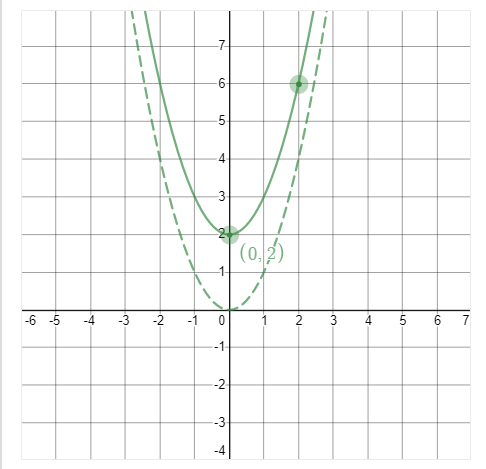
We are going to be graphing the tranformed function \(f(2x-4) -1\) In general, when we apply all the transformations we learned above to some function \( f(x)\), we have \( a*f(b(x-c))+d \) Where a is the vertical stretch factor, b is the horizontal compression factor (remember when 0<b<1 then its a stretch, if b is greater than 1, for example 2, then you are compressing by 2 but if b is 1/2, then you are horizontally stretching by 2). C is the horizontal shift (for example (x-5) shifts the function x 5 units to the right. and d is the vertical shift d units up
darkknight:
So what we want to do in every question that is like this, we want to rewrite the transformed function in the format \( a*f(b(x-c))+d \) in this case, \( f(2x-4)-1 \), we need to factor out the 2 and rewrite like this: \( f(2(x-2))-1 \) We can determine that b = 2. c = 2, and d = -1 From here, we can graph the transformed function, We will horizontally compress the function by a factor of 2, shift the function 2 units to the right, (no vertical dilations because a= 1 in this case), and shift the function 1 unit down. Then graph this and you are done
 darkknight:
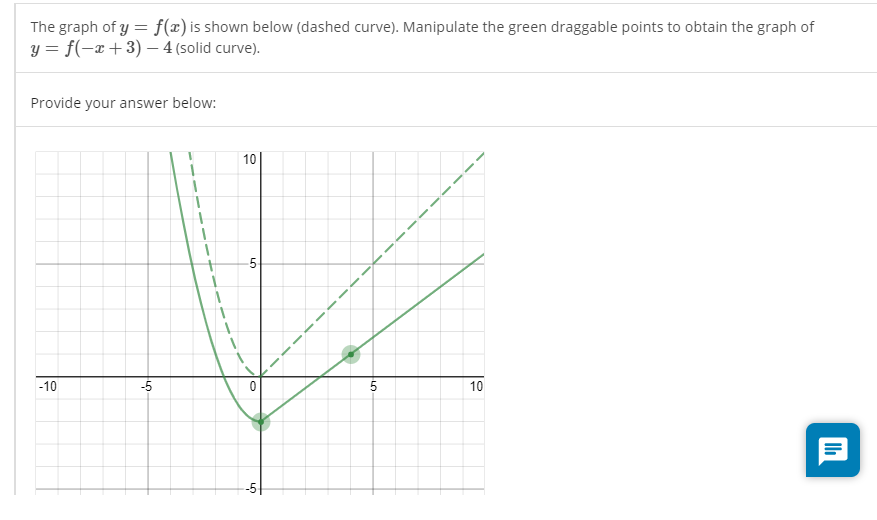
We need to rewrite \( y=f(-x+3)-4 \) in the format \( a*f(b(x-c))+d \) \( f(-x+3)-4 = f(-1(x-3))-4\) We can see that a=1 b = -1 c = 3 d = -4 When graphing this, b being negative means that we reflect f(x) about the y axis, so that (x, y) turns into (-x, y). After that we shift the function 3 units to the right, then 4 units down
darkknight:
@jnlkmnjkm here you go
darkknight:
Now for example we have a function \( f(x) = x^2 \) and we have to graph \( 2(f(-x+3))+4 \) If we write it in the form (mentioned above) we would write it like this, \( 2(f(-1(x-3)))+4 \) This means that we reflect about the y-axis because of the -1. Shift 3 units to the right, apply a vertical stretch, a factor of 2, then shift 4 units up
darkknight:
Now you can graph x^2 and 2(f(-1(x-3)))+4 and see that the latter function is indeed x^2, but with the transformations we described above. In order to graph the transformed function, lets see what happens to the vertex. Since x^2 has a vertex at (0,0). Vertical and horizontal dilations will not affect the location of the vertex. We will shift the vertex 3 units tothe right and 4 units up though. And you can take a point on the parent function, such as (1,1), the reflecting about the y-axis does nothing in this case (implied) and when we dilate the function by 2 vertically, the point (1, 1) will first be moved 3 units to the right (4, 1) and then dilated by 2, making it (4, 2). Then up 4 units to (4, 6). You can do the same process with other points and graph any transformed function using the above steps
 Sarg:
Sarg:
uhm why?
Join our real-time social learning platform and learn together with your friends!
 VERNEISH:
Two objects are moving along separate linear paths where each path is described by position, d, and time, t.
VERNEISH:
Two objects are moving along separate linear paths where each path is described by position, d, and time, t.

 Maci:
what are the best stock apps for people who want to start investing?
Maci:
what are the best stock apps for people who want to start investing?
 Twaylor:
genuienly how do i get better self control i keep watcing youtube and theres this
Twaylor:
genuienly how do i get better self control i keep watcing youtube and theres this
 IzzyCookie:
|dw:1792074056138:dw| Uhm, I don't know where to ask this, but I'm in college welding at my community college, and I need help learning vertical welding for
IzzyCookie:
|dw:1792074056138:dw| Uhm, I don't know where to ask this, but I'm in college welding at my community college, and I need help learning vertical welding for

 thehearken:
not sure if this is considered spam, im sorry if it is, but does anyone have tips
thehearken:
not sure if this is considered spam, im sorry if it is, but does anyone have tips