
 Yoda:
Yoda:
Helps me
Yoda:
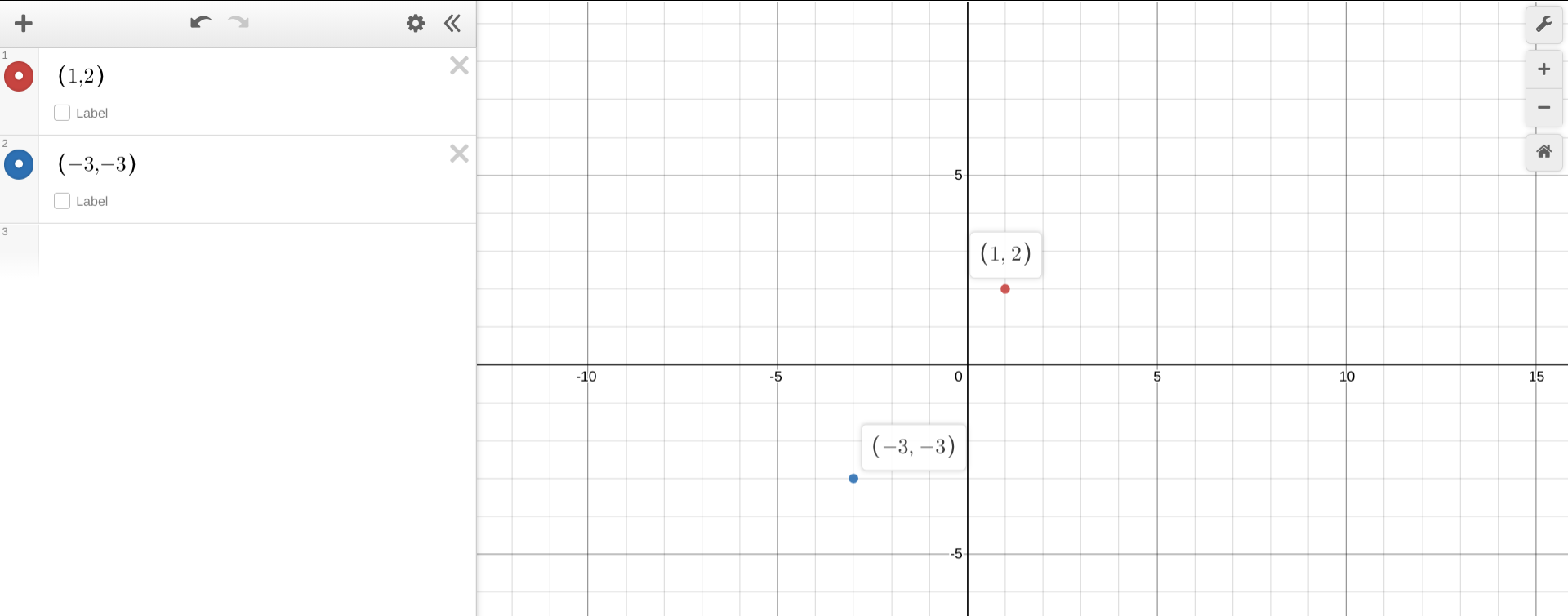
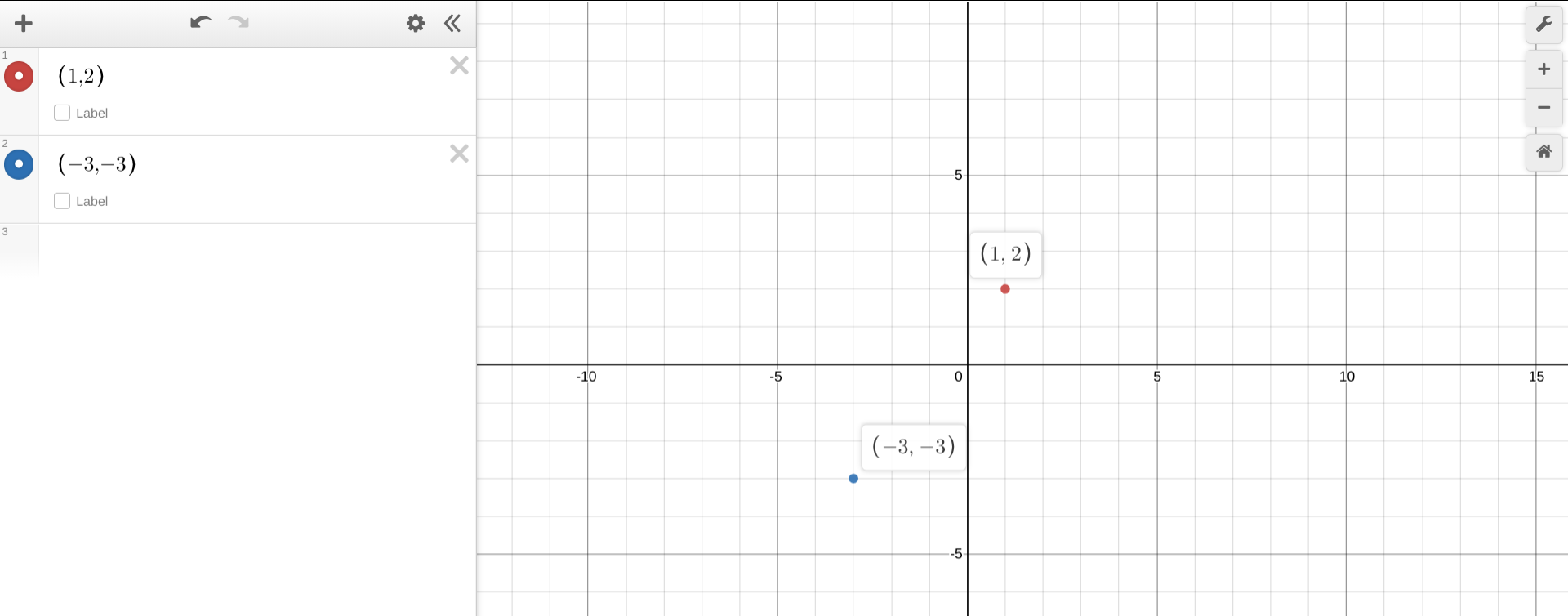
On a coordinate grid, both point (1, 2) and point (−3, −3) are reflected across the y-axis. What are the coordinates of the reflected points?
 CripQUEZZ:
Ok with all the info here what do you know?
Yoda:
The points are 1,2 and -3 -3
 Kylo:
Kylo:
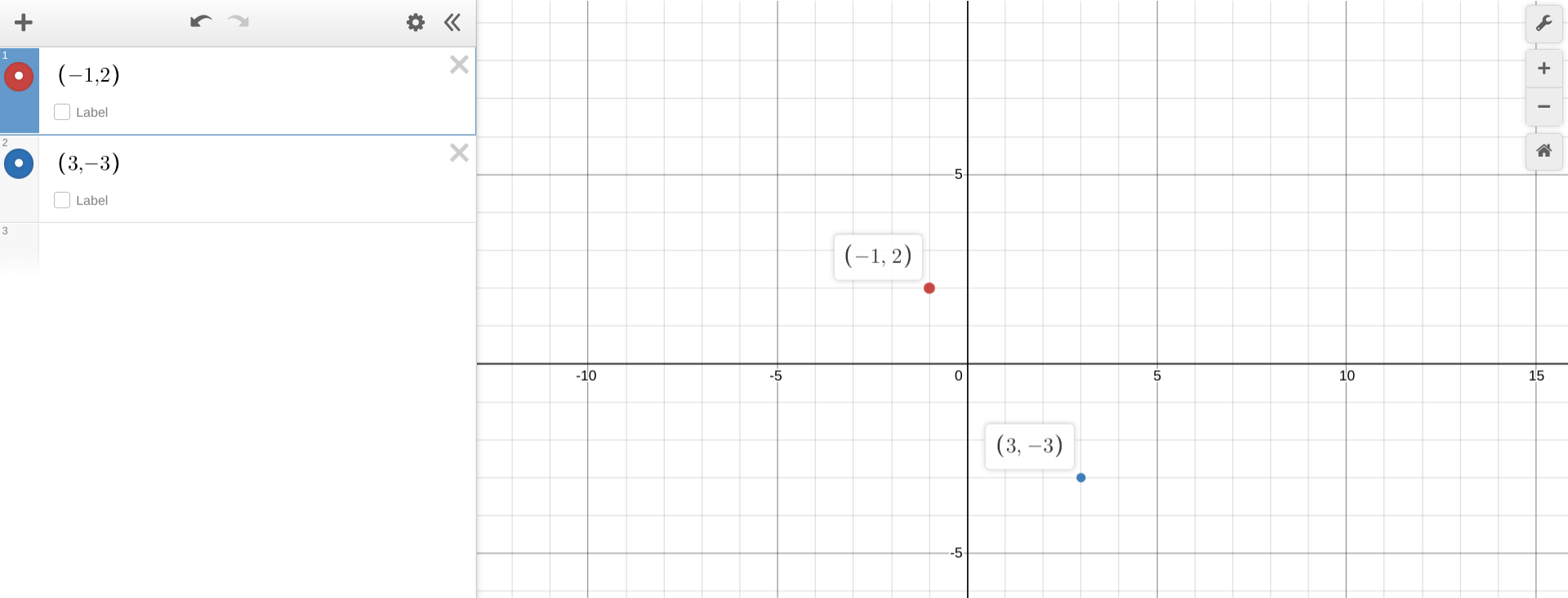
A (-1,2) and (3,-3) : )
CripQUEZZ:
\(\color{#0cbb34}{\text{Originally Posted by}}\) @Yoda The points are 1,2 and -3 -3 \(\color{#0cbb34}{\text{End of Quote}}\) That’s all? Do you have a graph that shows it?
Yoda:
no
CripQUEZZ:
Ok
CripQUEZZ:
Do you have any notes that explain how to do it or is then new to you?
Yoda:
no
Yoda:
it is new to me
CripQUEZZ:
Ok
 KjSaif:
Reflecting by the y-axis makes the "x" in x,y the opposite. If it was -3 it would now be 3.
CripQUEZZ:
Ok so reflect the the (1,2) across the y axis
CripQUEZZ:
Which way is the y axis? Do you know?
Kylo:
A (-1,2) and (3,-3
Kylo:
)
Yoda:
No there is no Graph
CripQUEZZ:
\(\color{#0cbb34}{\text{Originally Posted by}}\) @Kylo A (-1,2) and (3,-3 \(\color{#0cbb34}{\text{End of Quote}}\) Stop giving direct answers
Kylo:
stop not being helpful
CripQUEZZ:
\(\color{#0cbb34}{\text{Originally Posted by}}\) @Kylo stop not being helpful \(\color{#0cbb34}{\text{End of Quote}}\) I’m being helpful I’m walking them through it
Kylo:
not really
Kylo:
but okay not going to argue
CripQUEZZ:
Ok so the y axis is the straight line going up and down and there’s four quadrants
Kylo:
here is me walking through it When we reflect the figure across the y-axis then the rule of the transformation is given by: (x,y) → (-x,y) i.e. each point on the figure is transformed as the x-coordinate of the point takes the opposite sign and the y-coordinate remains the same. Hence, (1,2) → (-1,2) and (-3,-3) → (-(-3),-3) i.e. (-3,-3) → (3,-3)
CripQUEZZ:
The first quadrant is what (1,2) is in, so reflecting over that axis what would you think the coordinates would be?
 KjSaif:
graph at first ^
CripQUEZZ:
\(\color{#0cbb34}{\text{Originally Posted by}}\) @Kylo here is me walking through it When we reflect the figure across the y-axis then the rule of the transformation is given by: (x,y) → (-x,y) i.e. each point on the figure is transformed as the x-coordinate of the point takes the opposite sign and the y-coordinate remains the same. Hence, (1,2) → (-1,2) and (-3,-3) → (-(-3),-3) i.e. (-3,-3) → (3,-3) \(\color{#0cbb34}{\text{End of Quote}}\) That’s from sum1 else’s answer
Kylo:
just go back to "walking through it " the question is answered if im correct so close the question
CripQUEZZ:
Kyle if you’re gonna help don’t steal other ppls answers but if you do give credit to the website
CripQUEZZ:
Kylo*
CripQUEZZ:
Ok so yoda reflecting over the y axis from the 1st quadrant will change which number?
Yoda:
Oh sry
CripQUEZZ:
\(\color{#0cbb34}{\text{Originally Posted by}}\) @CripQUEZZ Ok so yoda reflecting over the y axis from the 1st quadrant will change which number? \(\color{#0cbb34}{\text{End of Quote}}\) The numbers will stay the same but will become a negative
Yoda:
Oh
CripQUEZZ:
So if you reflect (1,2) over the y axis what do you think you will get?
Yoda:
(−1, 2)
Yoda:
?
CripQUEZZ:
\(\color{#0cbb34}{\text{Originally Posted by}}\) @Yoda (−1, 2) \(\color{#0cbb34}{\text{End of Quote}}\) Correct now with (-3,-3) try that one
Yoda:
(3, −3)
CripQUEZZ:
\(\color{#0cbb34}{\text{Originally Posted by}}\) @Yoda (3, −3) \(\color{#0cbb34}{\text{End of Quote}}\) Correct so that will be your answer
CripQUEZZ:
(-1,2) and (3,-3) good job
Yoda:
gtg BYE THX
CripQUEZZ:
\(\color{#0cbb34}{\text{Originally Posted by}}\) @Yoda gtg BYE THX \(\color{#0cbb34}{\text{End of Quote}}\) Np have a good one
 Yoda:
Yoda:
Thank you, Young Ones. MMMHMHM
KjSaif:
lol np
Yoda:
hehe
Join our real-time social learning platform and learn together with your friends!
 VERNEISH:
Two objects are moving along separate linear paths where each path is described by position, d, and time, t.
VERNEISH:
Two objects are moving along separate linear paths where each path is described by position, d, and time, t.

 Maci:
what are the best stock apps for people who want to start investing?
Maci:
what are the best stock apps for people who want to start investing?
 Twaylor:
genuienly how do i get better self control i keep watcing youtube and theres this
Twaylor:
genuienly how do i get better self control i keep watcing youtube and theres this
 IzzyCookie:
|dw:1792074056138:dw| Uhm, I don't know where to ask this, but I'm in college welding at my community college, and I need help learning vertical welding for
IzzyCookie:
|dw:1792074056138:dw| Uhm, I don't know where to ask this, but I'm in college welding at my community college, and I need help learning vertical welding for

 thehearken:
not sure if this is considered spam, im sorry if it is, but does anyone have tips
thehearken:
not sure if this is considered spam, im sorry if it is, but does anyone have tips