
 Shasha14:
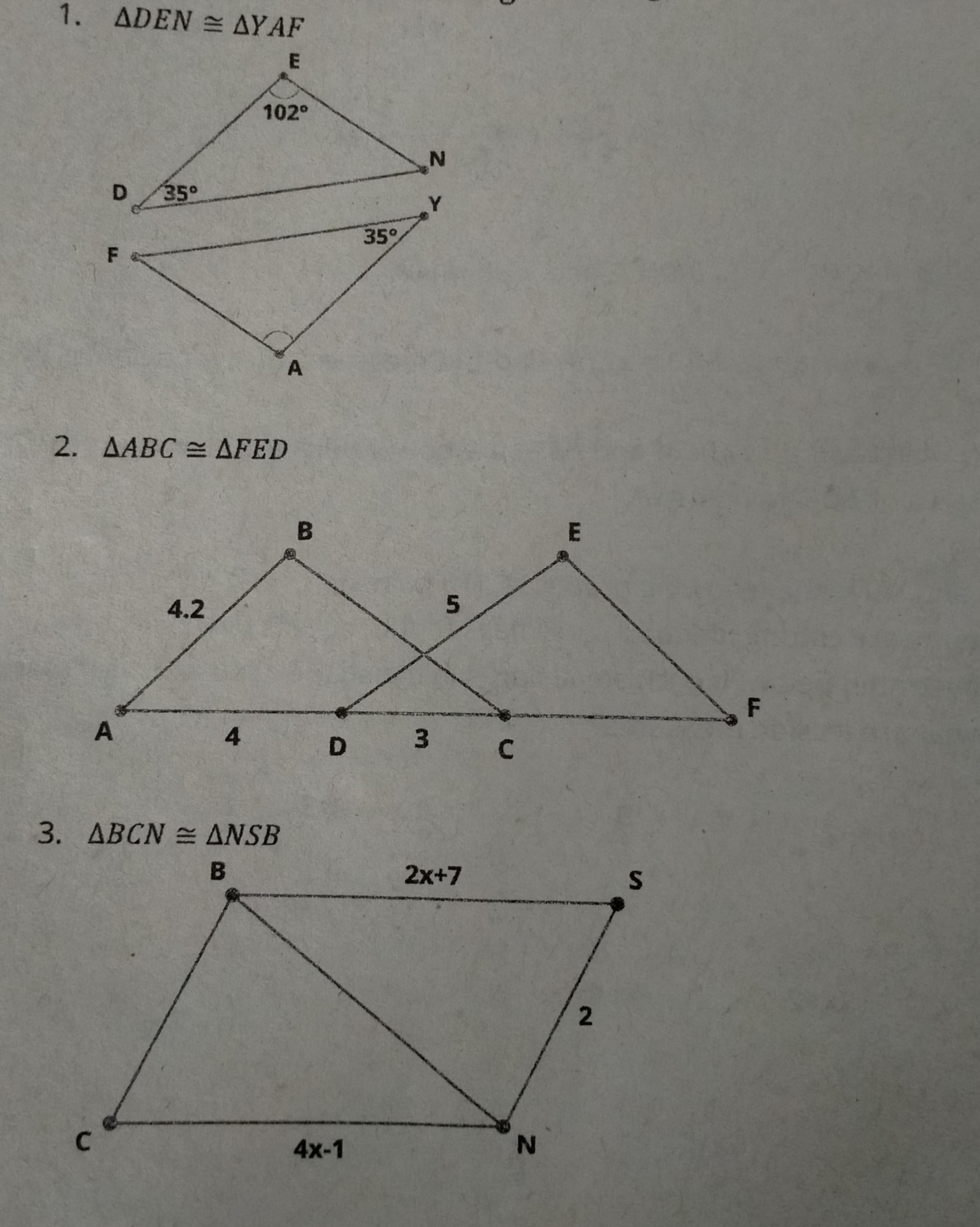
Determine the unknown sides or angles of the given congruent triangles.
 Extrinix:
QUESTION 1: \(DEN \cong YAF\) we can find our similar angles easily by seperating the congruency statement out, \(D=Y\) , \(E=A\) , \(N=F\) We already have D and Y so we can skip those now we have \(E\) and \(A\) \(m \angle E = 102 ^ \circ\) E being equal to A makes this statement true: \(m \angle A = 102 ^ \circ\) now to find \(N=F\), we know that the inside angles of a triangle must always equal 180 so we make an equation to find out what \(N\) is: \(n+32 ^\circ +102 ^\circ =180 ^\circ\) combine like terms \(n+134 ^\circ = 180 ^\circ\) remove 134 from both sides \(n = 46 ^\circ\) N equals 46, making F equal 46
Extrinix:
QUESTION 2: \(ABC \cong FED\) now this one is a little bit different, this one you are finding the sides not the angles so we must figure out which sides match which: \(\overline{AB}=\overline{FE}\) , \(\overline{BC}=\overline{ED}\) , \(\overline{CA}=\overline{DF}\) lets start with \(\overline{AB}=\overline{FE}\) it says that \(\overline{AB}=4.2\) meaning \(\overline{FE}=4.2\) by congurence. now to find \(\overline{BC}=\overline{ED}\) it says that \(\overline{ED}=5\) so that makes \(\overline{BC}=5\) by congruence now \(\overline{CA}=\overline{DF}\) for this one it gives\(\overline{AD}\) and \(\overline{DC}\) add these together \(4+3\) and that gives you \(\overline{CA}=7\) meaning \(\overline{DF}=7\) by congruence there's your info for #2
Extrinix:
QUESTION 3: \(BCN \cong NSB\) so to start off note that this question is similar to #2, finding sides \(\overline{BC}=\overline{NS}\) , \(\overline{CN}=\overline{SB}\) , \(\overline{NB}=\overline{BN}\) now lets figure out \(\overline{BC}=\overline{NS}\) it says \(\overline{NS}=2\) meaning \(\overline{BC}=2\) now for \(\overline{CN}=\overline{SB}\) now, there is an equation to solve here, figure out what x equals \(4x-1 = 2x+7\) add one to both sides \(4x = 2x+8\) remove 2x from both sides \(2x = 8\) divide by 2 on both sides \(x = 4\) Answer for x now that we know x, we can plug it in to find \(\overline{CN}\) and \(\overline{SB}\) \(\overline{CN} = 4(4)-1\) \(4 \times 4\) first \(16-1\) remove 1 \(\overline{CN} = 15\) so your answer for \(\overline{CN}\) is 15 now plug in 4 for x in the \(\overline{SB}\) equation \(\overline{SB} = 2(4)+7\) \(2 \times 4\) first \(8+7\) add together \(\overline{SB} = 15\) so your answer for \(\overline{SB}\) is 15 (like it should be there is your help for question #3
Extrinix:
If you need any more assistance then this, feel free to dm me.
Shasha14:
Thanks
Extrinix:
You're welcome.
 Madiron:
damn Ext,you are smart
Join our real-time social learning platform and learn together with your friends!
VERNEISH:
Two objects are moving along separate linear paths where each path is described by position, d, and time, t.

 Maci:
what are the best stock apps for people who want to start investing?
Maci:
what are the best stock apps for people who want to start investing?
 Twaylor:
genuienly how do i get better self control i keep watcing youtube and theres this
Twaylor:
genuienly how do i get better self control i keep watcing youtube and theres this
 IzzyCookie:
|dw:1792074056138:dw| Uhm, I don't know where to ask this, but I'm in college welding at my community college, and I need help learning vertical welding for
IzzyCookie:
|dw:1792074056138:dw| Uhm, I don't know where to ask this, but I'm in college welding at my community college, and I need help learning vertical welding for

 thehearken:
not sure if this is considered spam, im sorry if it is, but does anyone have tips
thehearken:
not sure if this is considered spam, im sorry if it is, but does anyone have tips