
 klmjnmkj:
math problem
 klmjnmkj:
@florisalreadytaken
klmjnmkj:
@snowflake0531
 Imagine:
@darkknight , do you know what to do?
 darkknight:
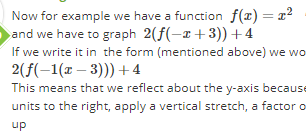
your lucky day https://questioncove.com/users/darkknight#/updates/606b831e88a1242fd23b3800 describes transformations
darkknight:
whatever part of the tutorial fits the question take a look at those parts, then come back here
 klmjnmkj:
im not sure
 Alexis1415:
hmmm c:
darkknight:
are you the same guy I made the other tutorial for on another acc...? so specifically look at what happens when you translate down or up c units, and what vertical compression does
darkknight:
still there klmjnmkj?
Florisalreadytaken:
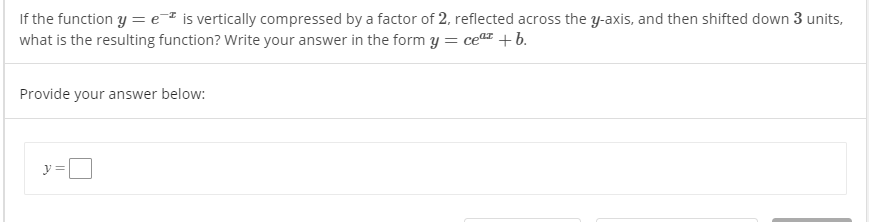
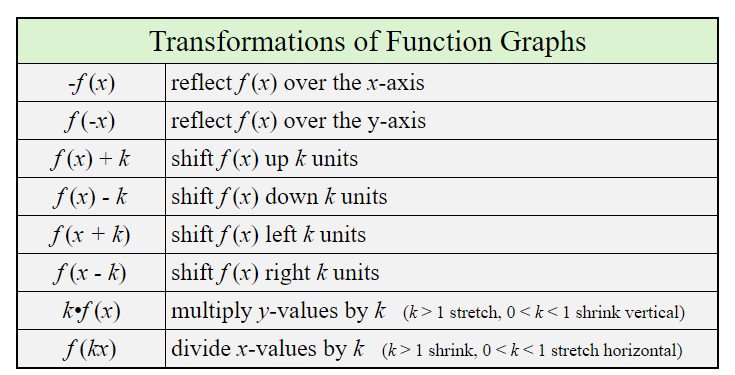
ok so we are asked to turn that \( y=e^{-x} \) function into \( f(x)=a b^{x+c}+d \) form -- the steps we are asked are: 1) compress the function by a factor of 2 2) reflect it across the y axis 3) shifted down 3 units lets do it step by step firstly, compress it by 2 -- by looking at the table i attached, we would do it this way: \( y=e^{-x} \Rightarrow y=2e^{-x} \) then reflect it to the y axis -- turn \(-x\) to \((+)x\) \(y=2e^{-x} \Rightarrow y=2e^{x} \) to finish it off, we have to do the horizontal asymptote, which is \(−3\) -- so that would be: \( y=2e^{x} -3 \) and that's it! :D
 darkknight:
hmm you want to compress horizontally by 2, so instead of multiplying \[e^x\] by 2 you have to multiply by 1/2
darkknight:
vertically*
Florisalreadytaken:
oh yes i missed that -- cuz it has to be \( k<1 \) good one.
darkknight:
yw
Florisalreadytaken:
so it would be \[ y= \frac{1}{2}e^{x} -3 \]
katelyn865:
3
katelyn865:
33
Join our real-time social learning platform and learn together with your friends!
VERNEISH:
Two objects are moving along separate linear paths where each path is described by position, d, and time, t.

 Maci:
what are the best stock apps for people who want to start investing?
Maci:
what are the best stock apps for people who want to start investing?
 Twaylor:
genuienly how do i get better self control i keep watcing youtube and theres this
Twaylor:
genuienly how do i get better self control i keep watcing youtube and theres this
 IzzyCookie:
|dw:1792074056138:dw| Uhm, I don't know where to ask this, but I'm in college welding at my community college, and I need help learning vertical welding for
IzzyCookie:
|dw:1792074056138:dw| Uhm, I don't know where to ask this, but I'm in college welding at my community college, and I need help learning vertical welding for

 thehearken:
not sure if this is considered spam, im sorry if it is, but does anyone have tips
thehearken:
not sure if this is considered spam, im sorry if it is, but does anyone have tips