
 kittybasil:
[ REPOST FOR REFERENCE ] A car picking up speed at a uniform rate from rest passes three VECO posts in succession. The posts are 91 meters apart along the road. The car takes 10 seconds from the first to the second post, and 6 seconds from the second to the third post. Calculate: the acceleration of the car the distance from the starting point of the car to the first post the car’s velocity at each post.
kittybasil:
This is a remake of another post due to it being posted twice and everything being crazy in the responses. ALL OF THIS IS MY OWN WORK in response. Original posts are HERE and here Reposting in progress...
kittybasil:
First let's calculate for part two, "distance from the starting point of the car to the first post" let \(d\) be the distance from the starting point to the first post, \(t\) be the time it takes to reach the first post from rest, and \(a\) be the magnitude of the uniform acceleration. \[d=\frac{1}{2}a_1t^2\]\[d+91=\frac{1}{2}a_2(t+10)^2\]\[d+182=\frac{1}{2}a_3(t+16)^2\] We should solve the system for \(d\) in each one.
Note: the second equation's time is \(t\) plus 16 because 10+6=16 seconds passed since bypassing the first post, and the distance is \(d\) plus 182 because two posts have been bypassed with 91 meters in between each. And 91+91=182
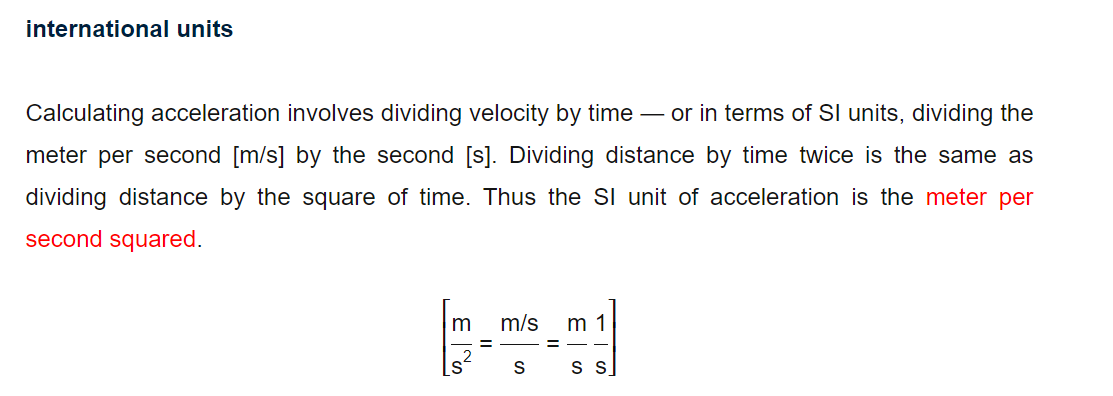
But what about acceleration \(a\)? Well, let us view acceleration as the following formula:\[a=\frac{distance}{time\cdot time}=\frac{d}{t^2}\]Yes, you square the time value, because acceleration is velocity over time and velocity is distance over time. See the below image for an example explanation of how we calculate acceleration.
 kittybasil:
(The acceleration variables have subscripts because they aren't referring to the same situation, HOWEVER acceleration should be a constant rate so they should all be equivalent.) Technically, acceleration and velocity involve direction, but the car is literally on a flat plane (the road) and going in a singular forward direction, so we don't need to worry about that.
Anyway, we are solving for variable \(d\) as the distance from rest (t=0, again) to the first post. This is actually a system of equations involving 3 equations and 3 variables, so there are multiple ways to solve this: 1. Gaussian elimination (aka matrices) 2. substitution 3. Cramer's rule
Since explaining the two fancy-sounding ones will take a LOT of time and effort and end up making this post long-winded and confusing, I have instead searched up the steps on Symbolab for substitution. HERE is the link (click the blue text) to those steps.
Based on this, \(d=\frac{4459}{250}=17.836\text{ meters}\), \(t=7\text{ seconds}\) and \(a=\frac{91}{120}= 0.758\overline{3}\approx0.7583\text{ m/s}^2\). You now have the answer for part three (distance from start point to the first post) AND part one (acceleration of the car)! Remember, \(a=a_2=a_3\), all acceleration values are the same constant rate of increasing velocity.
kittybasil:
Note: Please don't reply even if I'm not on the question, I might be taking a break from solving but be assured I am actively working on it in my free time (Since this is an extensive project I will be periodically taking time off in between solving parts of the question.)
I will be back to work on part two later!
kittybasil:
That's gonna be a long "later" tbh. Classes just threw a gajillion amount of work at me 😔
kittybasil:
If anyone wants to contribute feel free, but if you are not solving the question do not answer. Also please don't correct me unless you plan on redoing the entire question (in which case please do not do it on my own post)... I put a lot of work into making this.
 AnimeWeeebLMAO:
I know this is late, but do you still need help by any chance?
kittybasil:
Actually no, it's just for reference, but if you want to do the whole thing (preferably from scratch in case I have it wrong) feel free!
Also I'm an idiot why did I bump this.
kittybasil:
again, if anyone wants to contribute please do your own work cause A) I might have done the entire thing wrong. My Physics is insanely rusty. B) Really would prefer people don't leech/piggyback off my work! ლ(́◉◞౪◟◉‵ლ)
 Timmyspu:
Distance formula \[d= (x2-x1)^2+ (y2-y1)^2\] (x1,y1) (x2,y2) (9,3) (8,2) \[(8-9)^2+(2-30)^2\] \[-1^2+-28^2\] 1+784 square root 785 28.01
kittybasil:
Bless you ლ(́◉◞౪◟◉‵ლ) (Also yes I gave the medal, in case the context of this comment is confusing)
Join our real-time social learning platform and learn together with your friends!
 VERNEISH:
Two objects are moving along separate linear paths where each path is described by position, d, and time, t.
VERNEISH:
Two objects are moving along separate linear paths where each path is described by position, d, and time, t.

 Maci:
what are the best stock apps for people who want to start investing?
Maci:
what are the best stock apps for people who want to start investing?
 Twaylor:
genuienly how do i get better self control i keep watcing youtube and theres this
Twaylor:
genuienly how do i get better self control i keep watcing youtube and theres this
 IzzyCookie:
|dw:1792074056138:dw| Uhm, I don't know where to ask this, but I'm in college welding at my community college, and I need help learning vertical welding for
IzzyCookie:
|dw:1792074056138:dw| Uhm, I don't know where to ask this, but I'm in college welding at my community college, and I need help learning vertical welding for

 thehearken:
not sure if this is considered spam, im sorry if it is, but does anyone have tips
thehearken:
not sure if this is considered spam, im sorry if it is, but does anyone have tips