
 SpiffingBrit:
A physics question I need help with
 SmokeyBrown:
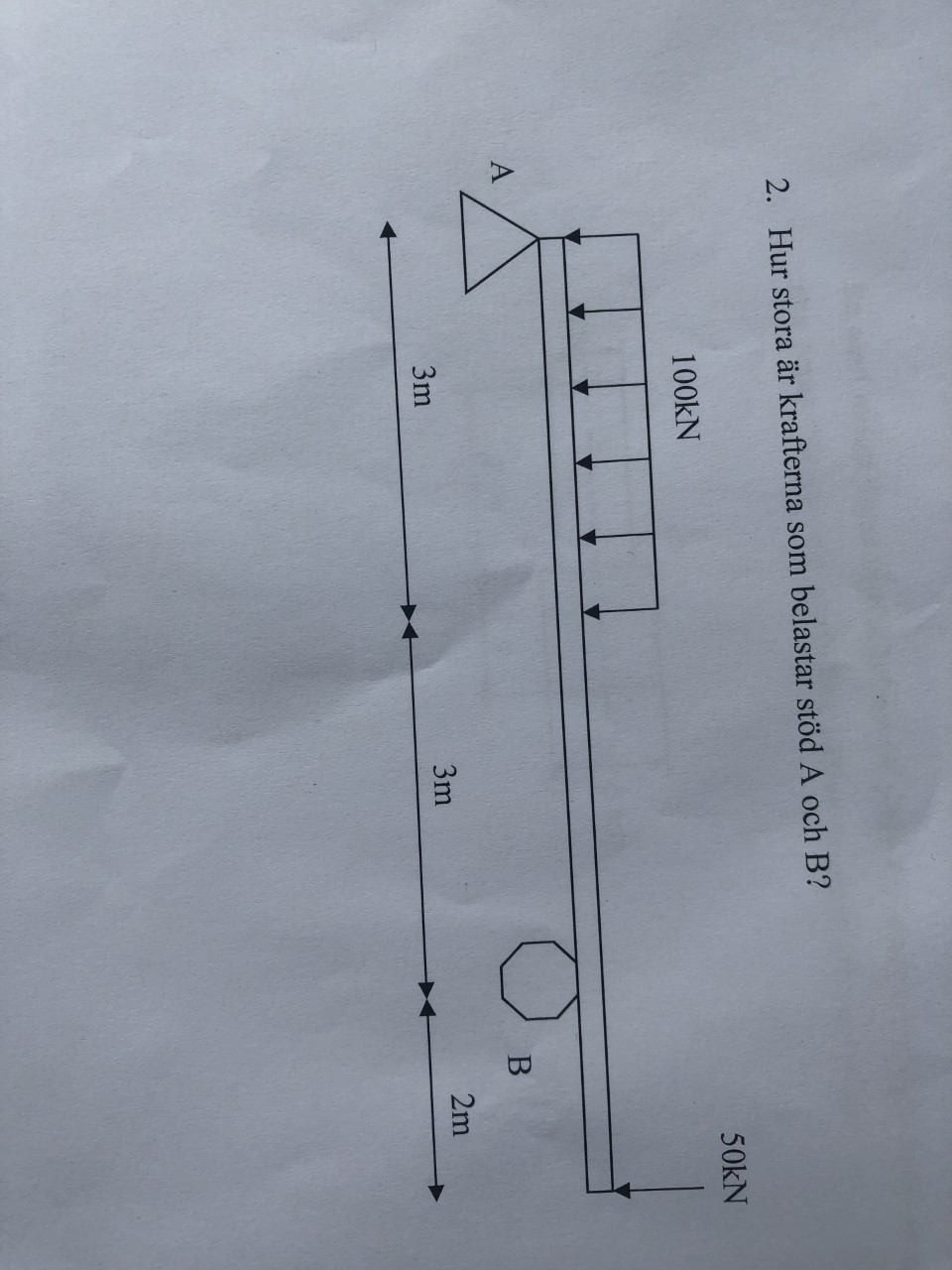
So the shapes A and B support a load of force from the long bar, right? There's 100 kN of force pushing down on the left side and 50 kN of force pushing down on the right side, if I'm reading the diagram correctly. That should be a total of 150 kN pushing down on the bar. Of course, the force isn't distributed evenly between shape A and shape B. I don't remember exactly how to calculate that, but I think it's related to a proportion of the length of the bar... The bar has a total length of 10 m, and shape B is 2 m from the right side... I'm not sure exactly how this factors into the calculations, sorry
SmokeyBrown:
Oh! Maybe this resource is what you're looking for? It's a pretty thorough walkthrough on how to calculate "distributed loading" which I think is the key concept here: https://web.iit.edu/sites/web/files/departments/academic-affairs/academic-resource-center/pdfs/Distributed_Loading.pdf
SmokeyBrown:
So, from that, it seems like the left side has a "rectangular load", which would actually be 100 kN multiplied by the length of the load (100 kN/m * 3 m = 300 kN). Except it says 100 kN, not 100 kN/m, which is a little confusing. So maybe it is just 100 kN, but if that's the case they might as well have drawn it as a single arrow. So, that would be 350 kN of total force. Now just to find out how that force is shared between shape A and shape B
SmokeyBrown:
Ok, so here's the method I got from watching this YouTube video (https://www.youtube.com/watch?v=WLGQkLHiK-I) We want to calculate the "moment" of each force on each object by multiplying the center of force by the distance from the object. Now, the center of the force on the right is given to us, it is 2 meters away from shape B. The center of the force on the left would be in the center of that 3 m range, which is 1.5 m away from shape A. So, we have 300 kN pushing down 1.5 m away from A, and 50 kN pushing down 10 m away from A. The bar is still supported, so we know that the forces pushing down and the force of A pushing back must equal 0. Let's also take into account that A appears on the very end of the bar, along the total of 10 meters. We can represent this in the following: A*10m - 300kN * 1.5m - 50kN * 10m = 0; A*10m - 450kNm - 500kNm = 0; A*10m - 950kNm = 0; A*10m = 950kNm; A = 95kN We can do the same thing for B, and I'll be happy to walk through that process with you as well, if you need me to
SmokeyBrown:
Actually, now that we've done the calculations for shape A, we can find the force of shape B through simple subtraction. We already know that the total force on the bar is 350 kN. So, if A is supporting 95kN, then B must be supporting the remaining (350 - 95 kN). The result of that subtraction is 255kN, so that should be the force supported by shape B (assuming my calculations aren't messed up)
SpiffingBrit:
Thank you! I was confused on what to do with that distributed force, and you concentrated it at the centre of mass and then proceeded to calculate all the moments
SpiffingBrit:
But, I am wondering: The force furthest away from B, would it not generate a lever force on the body closest to A?
SmokeyBrown:
That's a fair point. The problem is quite possibly more complicated than I assumed! Lever force, huh? I could look into it
SmokeyBrown:
Actually, it seems like the calculations for lever force are the same types we're using, multiplying distance by the force. So, I think we've accounted for that already. I think.
SpiffingBrit:
I'm just thinking that if the force was inside the length defined by A and B, then it would be a matter of finding the total moment, and applying the calculations you've made, but on the other side, most of the load will fall on B; whilst the force is well mitigated on A
SpiffingBrit:
Oh, okay, so it is already accounted for? let me double check the theory, maybe I skipped something
SmokeyBrown:
SmokeyBrown:
Yeah, you're right. The 50 kN force would mitigate the force that A needs to support. Hm. I don't suppose you recall how to calculate that? If not, it's cool, we can do more research about levers
SpiffingBrit:
So, what I am thinking is that we can forget about A, calculate the total force that's gonna be applied downwards and then distribute it to the different supports
SpiffingBrit:
So, that 100kN will be concentrated at the centre of mass of that body; thusly: \[100 \times 3 = 300kN=F_1 \] That's gonna be 1.5m away from A. Therefore, and I am assuming ideal conditions here, with no friction, the Ideal Mechanical Advantage is: \[IMA=4.5/2 = 2.25\] Meaning that the 50kN applied will translate to an opposite force to the distributed one, by a factor of 2.25. \[M(F_2)=IMA \times F_1 =2.25 \times 50 =112.5 kN\] And because the Moment of F2 is opposite to the force generated by F1 (which has no moment because A is supporting it): \[F_t = 300kN - 112.5kN=187.5 kN\]
SpiffingBrit:
And I believe that might be the force we have to distribute, unless my thought-process is incorrect
SmokeyBrown:
Wow, looks brilliant! I'll be honest, I'm not that knowledgeable about physics (everything I said earlier is stuff I looked up), so I didn't follow all of it, but the reasoning seems sound
SpiffingBrit:
Thank you! I think discussing the problem is the better way to go, as opposite to you giving me the answer. I have one more, which is particular, and I could use some aid.
SmokeyBrown:
No problem, it's a pretty fun exercise for me too, and I'm glad you were able to figure out the solution!
Join our real-time social learning platform and learn together with your friends!
VERNEISH:
Two objects are moving along separate linear paths where each path is described by position, d, and time, t.

 Maci:
what are the best stock apps for people who want to start investing?
Maci:
what are the best stock apps for people who want to start investing?
 Twaylor:
genuienly how do i get better self control i keep watcing youtube and theres this
Twaylor:
genuienly how do i get better self control i keep watcing youtube and theres this
 IzzyCookie:
|dw:1792074056138:dw| Uhm, I don't know where to ask this, but I'm in college welding at my community college, and I need help learning vertical welding for
IzzyCookie:
|dw:1792074056138:dw| Uhm, I don't know where to ask this, but I'm in college welding at my community college, and I need help learning vertical welding for

 thehearken:
not sure if this is considered spam, im sorry if it is, but does anyone have tips
thehearken:
not sure if this is considered spam, im sorry if it is, but does anyone have tips