
 MrsHero:
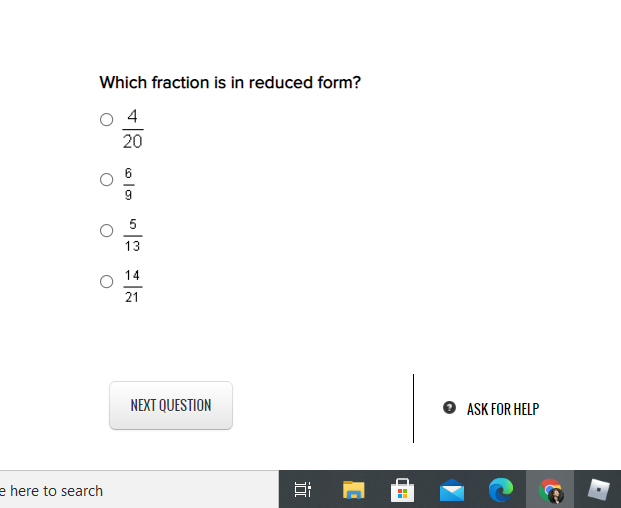
help ss down below
 itsmehjay:
you have to find the common factor for each number. see if there is a number that both the numerator and the denominator can be easily divided by
 Astrid1:
Let's put it this way. \[\frac{ 4 }{ 20} Can~Become~ \frac{ 2 }{ 5}\] This means it can be reduced and hasn't yet. \[\frac{ 6 }{ 9 } Can~become~\frac{ 3 }{ 3 } \] Which can be whole but it hasn't been reduced. \[\frac{ 5 }{ 13} 13~ Can't~be~reduced~\] Because it's as low as it can go ^^. \[ \frac{ 14 }{ 21} \to \frac{ 7 }{ 11 } \] Can be reduced but hasn't yet. So from what we're left with, what do you think the answer is?
Astrid1:
I didn't mean to add the 13 2 times on the 3rd one xd
MrsHero:
A??
Astrid1:
Nope.
itsmehjay:
4/20 can be easily divided again to make a new fraction 4 and 20 can both be divided by 2, therefore it's not in it's simplest form
MrsHero:
i really think its B
itsmehjay:
nope... 6 and 9 can be divided by 3 \[6\div3=2\] \[9\div3=3\]
 snowflake0531:
Just look at it this way, in which fraction, do the numerators and denominators not have a single common factor besides for 1?
Join our real-time social learning platform and learn together with your friends!
 VERNEISH:
Two objects are moving along separate linear paths where each path is described by position, d, and time, t.
VERNEISH:
Two objects are moving along separate linear paths where each path is described by position, d, and time, t.

 Maci:
what are the best stock apps for people who want to start investing?
Maci:
what are the best stock apps for people who want to start investing?
 Twaylor:
genuienly how do i get better self control i keep watcing youtube and theres this
Twaylor:
genuienly how do i get better self control i keep watcing youtube and theres this
 IzzyCookie:
|dw:1792074056138:dw| Uhm, I don't know where to ask this, but I'm in college welding at my community college, and I need help learning vertical welding for
IzzyCookie:
|dw:1792074056138:dw| Uhm, I don't know where to ask this, but I'm in college welding at my community college, and I need help learning vertical welding for

 thehearken:
not sure if this is considered spam, im sorry if it is, but does anyone have tips
thehearken:
not sure if this is considered spam, im sorry if it is, but does anyone have tips