
 Fisa:
Fisa:
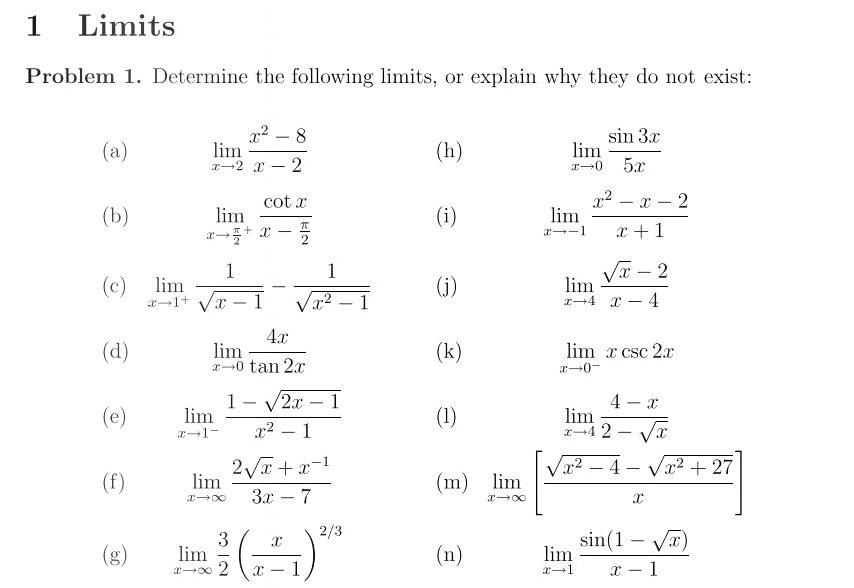
Problem 1. Determine the following limits, or explain why they do not exist:
 MidnightMoonLight:
what limits?
 Fisa:
Fisa:
I only need help with m
 jhonyy9:
so for a fraction to be defined the denominator not can be equal never zero in these cases how i see the denominator come to be equal zero - in this way these fractions will be undefined
Florisalreadytaken:
Fisa:
Help please
 darkknight:
For each problem, as the limit approaches a number, find what y-value is being approached from both sides, for example if the limit approaches h=2 then find the values at like 1.9 and 1.99 and see what they approach and similarly for the other side
Fisa:
I don't get it I am confused
Florisalreadytaken:
hmm ok i have got a bit time so were given this: \[ \lim _{x \rightarrow \infty}\left[\frac{\sqrt{x^2-4}-\sqrt{x^2+27}}{x}\right] \] pay attention to EVERY step. \[ \lim _{x \rightarrow \infty}\left[\frac{\sqrt{x^2-4}-\sqrt{\color{lightskyblue}{x}^2+27}}{\color{lightskyblue}{x}}\right] \] \[ \lim _{x \rightarrow \infty} \frac{\sqrt{\frac{x^2-4}{x^2}}-\sqrt{\frac{x^2}{x^2}+\frac{27}{x^2}}} {1} \Rightarrow \lim _{x \rightarrow \infty} \frac{\sqrt{\frac{x^2-4}{x^2}}-\sqrt{\frac{\cancel{x^2}}{\cancel{x^2}}+\frac{27}{x^2}}} {1}\] \[ \lim _{x \rightarrow \infty} \frac{\sqrt{(1\times){\frac{x^2-4}{x^2}}}-(1\times)\sqrt{1+\frac{27}{x^2}}} {1} \] \[ \frac{\sqrt{ \lim _{x \rightarrow \infty}{\frac{\cancel{x^2}-4}{\cancel{x^2}}}}- \lim _{x \rightarrow \infty}\sqrt{1+\frac{27}{x^2}}} { \lim _{x \rightarrow \infty}1} \] \[ \frac{\sqrt{ \lim _{x \rightarrow \infty}{\frac{1-\frac{4}{x^2}}{1}}}- \lim _{x \rightarrow \infty}\sqrt{1+\frac{27}{x^2}}} { \lim _{x \rightarrow \infty}1} \] \[ \frac{\sqrt{ {\frac{\lim _{x \rightarrow \infty}1-\lim _{x \rightarrow \infty}\frac{4}{x^2}}{\lim _{x \rightarrow \infty}1}}}- \lim _{x \rightarrow \infty}\sqrt{1+\frac{27}{x^2}}} { \lim _{x \rightarrow \infty}1} \] \[ \frac{\sqrt{{\frac{1-4 \ \lim _{x \rightarrow \infty}\frac{1}{x^2}}{1}}}- \lim _{x \rightarrow \infty}\sqrt{1+\frac{27}{x^2}}} { \lim _{x \rightarrow \infty}1} \] since the numerator is a real number whilst its denominator is just unbounded, that means it approaches 0 \[ \frac{\sqrt{{\frac{ 1-4 \times 0}{ \lim _{x \rightarrow \infty}1}}}- \lim _{x \rightarrow \infty}\sqrt{1+\frac{27}{x^2}}} { \lim _{x \rightarrow \infty}1} \] \[ \frac{\sqrt{{\frac{ 1-4 \times 0}{ \lim _{x \rightarrow \infty}1}}}- \sqrt{\lim _{x \rightarrow \infty}1+\frac{27}{x^2}}} { \lim _{x \rightarrow \infty}1} \] do the same thing for the other side as well -- kinda lazy to do the latex, but you will end up with: \[ \frac{\sqrt{{\frac{ 1-4 \times 0}{ \lim _{x \rightarrow \infty}1}}}- \sqrt{1+27\times 0 }} { \lim _{x \rightarrow \infty}1} \] evaluate the limits and then get rid of the fraction form: \[ \sqrt{{ 1-4 \times 0}}- \sqrt{1+27\times 0 } \] \[ \frac{\sqrt{{\frac{ 1-4 \times 0}{\cancel1}}}- \sqrt{1+27\times 0 }} {\cancel 1} \] \[ \sqrt{{ 1-4 \times 0}}- \sqrt{1+27\times 0 } \ \ \ \ \ \ \ \ \ \ \text{its all times 0} \] \[ 1-1 \] \[ 0 \] thus, it doesnt exist. yay.
 AZ:
AZ:
Flor did an excellent job explaining how to calculate the limit But a point of contention, if I may. Limit approaching 0 \(\neq\) Limit DNE The limit will not exist at a point if you get two different values when you approach from the left and right side A simple example \[\lim_{x \rightarrow 0} \dfrac{1}{x} = \text{DNE}\] You can see that as you approach from the left, as x becomes -0.1 then -0.01, -0.00001 and closer and closer to 0 The limit approaches -\(\infty\) As you approach 1/x from the right, so as x becomes 0.1 then 0.01 and 0.00001 and so on closer to 0 The limit approaches \(\infty\) Now take a look at \[\lim_{x \rightarrow \infty} \dfrac{1}{x} = 0\] When you increase the x value to something very large 1/100 = 0.01 1/1000000 = 0.000001 1/10000000000 = a number even smaller and so as x gets closer to \(\infty\) the limit is approaching 0 And you can take a look at a graph to see this too
Florisalreadytaken:
yes, i see where youre going, but what we have is the rational function of \( \lim_{x \rightarrow \infty} \dfrac{1}{x^{\color{lightskyblue}2}} \) as you may know its bottom heavy so automatically its 0 yes? thats why we say that \( \lim_{x \rightarrow \infty} \dfrac{1}{x^{2}} \) is \(=0\)
AZ:
yes, I agree it was just that at the end of your previous reply, you said "0 thus, it doesnt exist" so I wanted to clarify that just in case it wasn't clear :)
Join our real-time social learning platform and learn together with your friends!
VERNEISH:
Two objects are moving along separate linear paths where each path is described by position, d, and time, t.

 Maci:
what are the best stock apps for people who want to start investing?
Maci:
what are the best stock apps for people who want to start investing?
 Twaylor:
genuienly how do i get better self control i keep watcing youtube and theres this
Twaylor:
genuienly how do i get better self control i keep watcing youtube and theres this
 IzzyCookie:
|dw:1792074056138:dw| Uhm, I don't know where to ask this, but I'm in college welding at my community college, and I need help learning vertical welding for
IzzyCookie:
|dw:1792074056138:dw| Uhm, I don't know where to ask this, but I'm in college welding at my community college, and I need help learning vertical welding for

 thehearken:
not sure if this is considered spam, im sorry if it is, but does anyone have tips
thehearken:
not sure if this is considered spam, im sorry if it is, but does anyone have tips